
Part 8-3
“Subhuti, that which is called Buddha Dharma is not Buddha Dharma.”
Commentary:
The phrase “That which is called Buddha Dharma is not Buddha Dharma” signifies that all things are inherently Empty (the true-Self). In their true essence, they have no names, no boundaries, and no forms; they are One. The terms ‘Buddha Dharma’ ‘the true-Self’ ‘Emptiness’ ‘the Buddha’ ‘the Middle-Path’ are merely expedient means—names borrowed from worldly language to explain this truth. We must not be deceived by the words and mistake Buddha-Dharma for something with a specific, tangible form. In short, one can only attain enlightenment by not being deceived by words and appearances.
For instance, the statement ‘All things are Empty’ is the core teaching of Buddhism. If we truly understand this, the very words “All things are Empty” must also appear and sound empty to us. In other words, we must perceive these words not as mere language, but as the functioning of Emptiness (the true-Self) itself. Once you truly comprehend the Diamond Sutra, it should no longer appear as Sutra but as Emptiness.
Similarly, Emptiness is simply another name for Buddha. To say ‘All things are Empty’ is to say ‘All things are Buddha’. These names are given for convenience to describe that which is nameless, formless, boundless, infinite, and eternal. Do not be fooled by the word ‘Buddha’ into thinking of Him as an omnipotent being with a specific physical form.
Therefore, when you see the word ‘Buddha’ or hear the name ‘Buddha’, you must be able to see and hear the formless Emptiness beyond the name and image. If you worship the Buddha as a specific entity (like a statue), that is idolatry, not Buddhism. This is why ancient masters would say, “If you meet the Buddha, kill the Buddha.” The Buddha’s teaching to Subhuti regarding the Buddha Dharma carries the same meaning as saying ‘What is called the Buddha is not the Buddha’.
The Buddha was teaching us how to see and hear the true-Self (Buddha-nature) in everything we encounter in daily life. For example, when looking at a flower, applying the teaching would be: “Subhuti, what is called a flower is not, in fact, a flower.” This is seeing and hearing things as they truly are. To see everything in this way is to reach the state described in the Avatamsaka Sutra: “I see Buddhas as numerous as motes of dust in every direction, yet they do not come here, nor do I go there.”
Consider the encounter between Master Dazhu Huihai and Master Mazu:
Mazu asked, “Where do you come from?”
Huihai replied, “From Dayun Temple in Yuezhou.”
Mazu asked, “What do you intend to do by coming here?”
Huihai said, “I have come to seek the Buddha Dharma.”
Mazu remarked, “You ignore the treasure in your own house and leave it behind to run elsewhere. I have nothing here; what Buddha Dharma are you seeking?”
Huihai bowed and asked, “What is my own treasure?”
Mazu replied, “That which is asking me right now is your treasure. It is complete with everything, lacking nothing, and you can use it freely. Why do you seek it outside?”
At those words, Huihai realised that his original mind did not depend on sensory knowledge. Everything in this world is the Buddha Dharma, and we ourselves are Buddha Dharma itself. We simply fail to recognise it because we are deceived by appearances.
As the Avatamsaka Sutra says: “Just as the nature of space is one, so are the Buddha’s form and voice; they pervade all of space, yet each sentient being sees and hears them differently according to their own heart and wisdom.” The Buddha is everywhere, but we miss Him even when He is right before our eyes. The effort to see and hear everything as it is, is practice, and reaching this state is called entering the Pure Land, seeing the Buddha, and attaining Enlightenment.
Disciple: “What is the Buddha Dharma?”
Master: “No one can hide it.”
Disciple: “If no one can hide it, why can’t I see it?”
Master: “Because you turn away from the Buddha-Dharma right before your eyes to search for it elsewhere.”
Since the Buddha Dharma is not the Buddha Dharma,
What is the Buddha-Dharma?
The Buddha-Dharma veils the eyes,
Making it impossible to see the true Buddha Dharma.
Koan:
When a monk asked National Teacher Huizhong, “What is the great meaning of the Buddha-Dharma?”
The National Teacher replied, “The many Bodhisattvas inside the Manjushri Hall.”
The monk said, “I do not understand.”
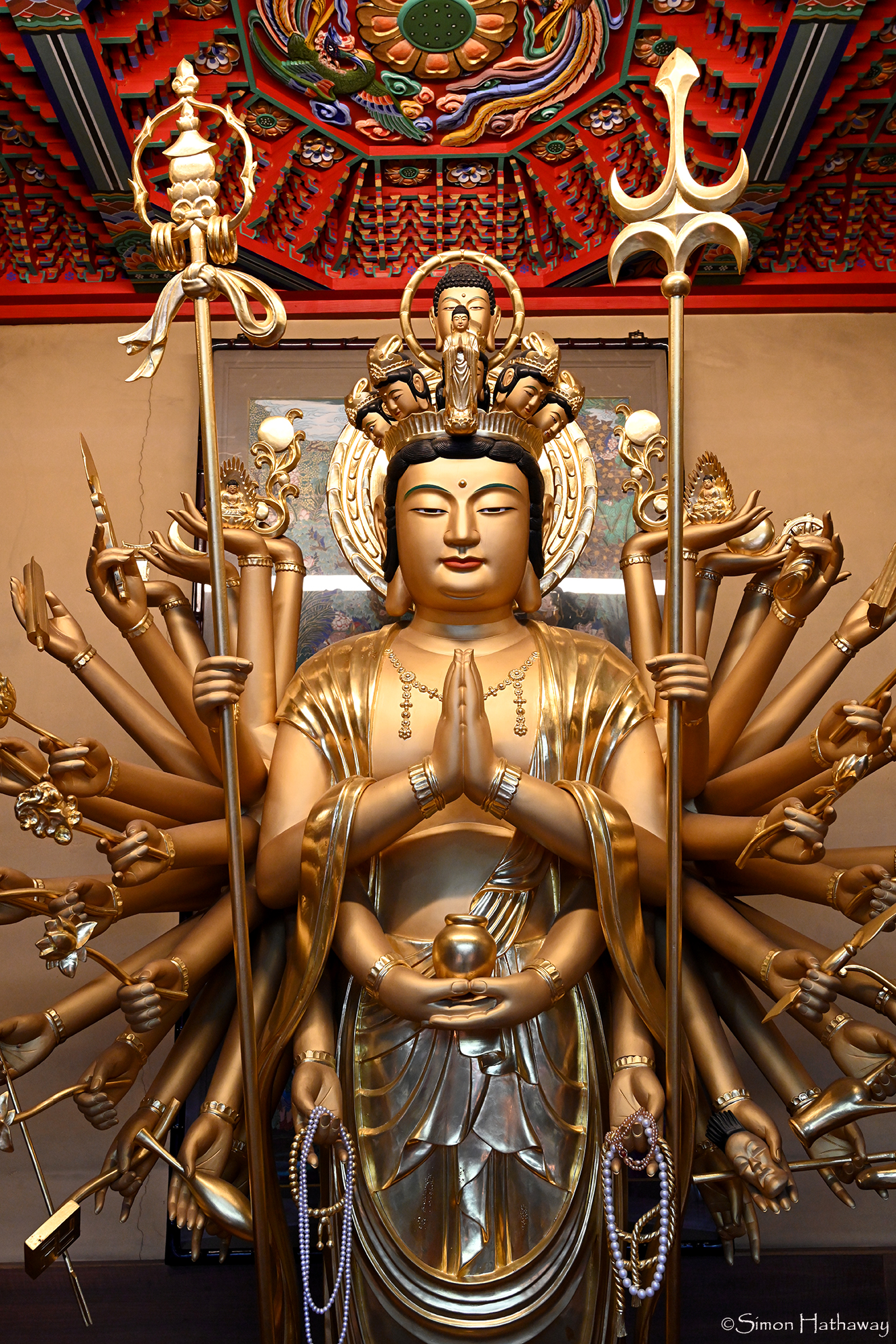
The National Teacher replied, “The Thousand Hands and Eyes of Great Avalokiteshvara.”
Question 1: What is the meaning of “The many Bodhisattvas inside the Manjushri Hall”?
Question 2: What is the meaning of “The Thousand Hands and Eyes of Great Avalokiteshvara”?
©Boo Ahm
All writing ©Boo Ahm. All images ©Simon Hathaway

 Zen Fools