Zen

The Buddha said, “Better than a thousand hollow words, is one word that brings peace.” What is the one word that brings peace?

There is no distinction between one word that brings peace and hollow words. In fact, what matters is that although every single word brings peace, we cannot enjoy the peace because we cannot recognise it. The point is not what one word that brings peace is but how we can discern and enjoy the peace that every word brings.
According to the Buddha’s teaching, we should hear every word as it is without being deluded by the illusion of it. In other words, you should hear all words not as words but just as the function of the universe that is one with you. Then, you come to realise that all words, from others, or from ourselves, are your own words, which are referred to as words that bring peace.

Student: “What is a word that brings peace?”

Master: “You have already said it.” 

©Boo AhmAll writing ©Boo Ahm. All images ©Simon Hathaway
Zen

All the Universe is in This (2)

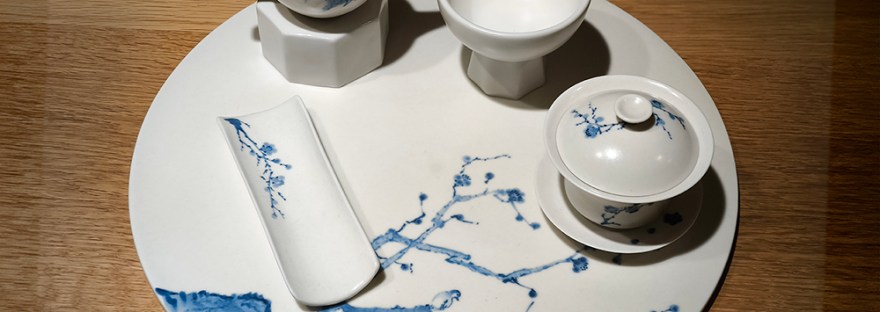
When Master Haesan visited Master Tooja, Master Tooja, handing a cup of tea to Haesan, said, “All the universe is in this.” On receiving it, Haesan, pouring the tea out of the cup, asked, “Where is all the universe now?” Master Tooja said, “A cup of tea is wasted.”

Student: “Where is all the universe when Haesan poured the tea out of the cup?”

Master: “Haesan showed it.”

Student: “If Haesan showed it, why did Tooja say that a cup of tea was wasted?”

Master: “Because you don’t see it.”

Commentary:

Trying to see the universe beyond what is seen and heard is like trying to find a rabbit horn.

©Boo Ahm

All writing ©Boo Ahm. All images ©Simon Hathaway
Zen

The Diamond Sutra (55)

Part 14-13

“Subhuti, the Realised One is one who speaks genuinely, one who speaks truly, one who speaks as it is, one who speaks without deception, one who speaks without contradiction.”

Commentary:

What matters here is how we can hear and comprehend what the Buddha, the Realised One speaks genuinely. As I have said that the Buddha is not enlightened until we get enlightened, the Buddha speaks genuinely only when we can hear genuinely. No matter how genuinely the Buddha preaches, his words cannot be genuine words but rather Mara’s words unless we can accept them genuinely.

In order to apprehend his Dharma talk, we, keeping his words ‘Not a word did I say’ in mind, should not be deluded by words. Instead, we should see and hear each of his words as the function of the true-Self. When we can see and hear each of his words as the function of the true-Self, we can realise that all, including ourselves, what we see and hear is the same as each of his words, as the function of the true-Self. Only when we can hear and see everything as such can we hear the Buddha’s genuine words genuinely.

Student: “What are the words the Buddha spoke genuinely?”

Master: “Not words.”

©Boo Ahm

All writing ©Boo Ahm. All images ©Simon Hathaway
Zen

The words ‘The Best Repentance is to Realise that One’s Sin is Empty’ Sound Selfish.

There is a saying that if a mote is empty, all the universe is also empty along with it. If one realises that one’s sin is empty, one will be sure to realise that the price for one’s sin is also empty. He is willing to accept the price for the sin he commits and tries his best to compensate victims for their loss.

If one doesn’t see the price he will pay for his sin as empty whilst regarding his sin as empty, he is far from comprehending this scripture. To interpret scriptures to one’s advantage like this is the last thing that we should do. Making bad use of the Buddha’s teaching like this is to disgrace the Buddha.

©Boo Ahm

All writing ©Boo Ahm. All images ©Simon Hathaway

Zen

A Master Stripped Himself Naked (2)

Once a master delivered a dharma talk at a special Buddhist service where his mother was present. On the high seat the master stripped himself of his clothes, becoming completely naked. All the attendees, including his mother, were embarrassed and left the place in a hurry. Then, the master said to his mother who was leaving, “When I was young, you hugged and kissed me all the time. Why are you avoiding me now even though I am still the same son that you loved?”

Student: “Why did the master take off all his clothes?”

Master: “He showed them what they wanted to see.”

Student: “Why did they run away when they saw him stripping himself?”

Master: “Because they couldn’t see what he showed to them.”

Student: “What was it that he showed to them?”

Master: “We are also showing each other now.”

Student: “What is it?”

Master: “I’ll tell it tomorrow.”

Commentary:

What the master showed can’t be hidden and is not different from what you see now.

©Boo Ahm

All writing ©Boo Ahm. All images ©Simon Hathaway
Zen

The Diamond Sutra (54)

Part 14-12

“All images that the Realised One mentioned are not images, and all sentient beings the Realised One mentioned are not sentient beings.”

Commentary:

Here the Buddha reminds his students one more time not to dwell on things by saying that the images and the sentient beings, which he mentioned frequently are not images and not sentient beings, but just called as such as an expedient means. Strictly speaking, if we grasp the Buddha’s words perfectly and see and hear everything in the way we were told to, we should not dwell on the words ‘All images that the Realised One mentioned are not images, and all sentient beings the Realised One mentioned are not sentient beings’ as well. This is why the Buddha said on his deathbed, “Not a word did I say.”

Student: “If sentient beings are not sentient beings, what are they?”

Master: “If sentient beings are not sentient beings, the Buddha is not the Buddha, either.”

Student: “If the Buddha is not the Buddha, who preached this Sutra?”

Master: “The Buddha tried all his life just to show him to us.”

©Boo Ahm

All writing ©Boo Ahm. All images ©Simon Hathaway

Zen

Master Boo’s ‘No Gap’

Master Boo said, “There is no gap as slight as a hair between it and you, because it is never separate from you. It is like a shadow following you. Do you know what the Buddha is? The one who is speaking aloud now is he.”

Student: “How can I recognise the Buddha when I speak?”

Master: “You can’t speak without depending on him, but he never speaks.”

Commentary:

A king has his words announced by his servants.

©Boo Ahm

All writing ©Boo Ahm. All images ©Simon Hathaway

Zen

The Diamond Sutra (53)

Part 14-11

“They should not have the mind dwelling on form, they should not have the mind dwelling on sound, scent, flavour, feeling, or phenomena. They should have the mind that does not dwell on anything.” “If the mind dwells anywhere, this is not a righteous life.” “This is why Buddha says the minds of Bodhisattvas should not dwell on matter as they give charity. Subhuti, Bodhisattvas should give in this way so as to benefit all beings.”

Commentary:

As mentioned previously, dwelling on things means being deluded by the illusions of things, which is the source of our unhappiness and suffering. That is why the Buddha said that dwelling on things is not a righteous life and told us not to dwell on anything.

Not dwelling on matter as Bodhisattvas give charity implies seeing one who gives charity, goods, or services used for charity and the beneficiary as one as the true-Self. Acting in this way is referred to as doing without doing, or the behaviour of the true-Self.

When we cannot see the three; giver, charity, and beneficiary as one, trying to see them as one is practice.

Student: “Why should we try to see the three as one?”

Master: “Because that is the way to see the Buddha.”

©Boo Ahm

All writing ©Boo Ahm. All images ©Simon Hathaway
Zen

Q. If we should not read books including the Sutras, why are there so many books on Buddhism and enlightenment?

A. We should remember that all the Sutras, no matter how many they are, say that we should not be deluded by images and words. The fact that there are numerous Sutras signifies that it is difficult not to be deluded by images and words.

“We should not read books” doesn’t mean that we shouldn’t read books but means that we should not be deluded by forms and words when reading literature on Buddhism and enlightenment. In fact, if we read the Sutras without being deluded by images and words, just as they tell us to, we could see the Buddha in each word and be aware of the reason why it is said that the Sutra is another name of the Sutra.

©Boo Ahm

All writing ©Boo Ahm. All images ©Simon Hathaway