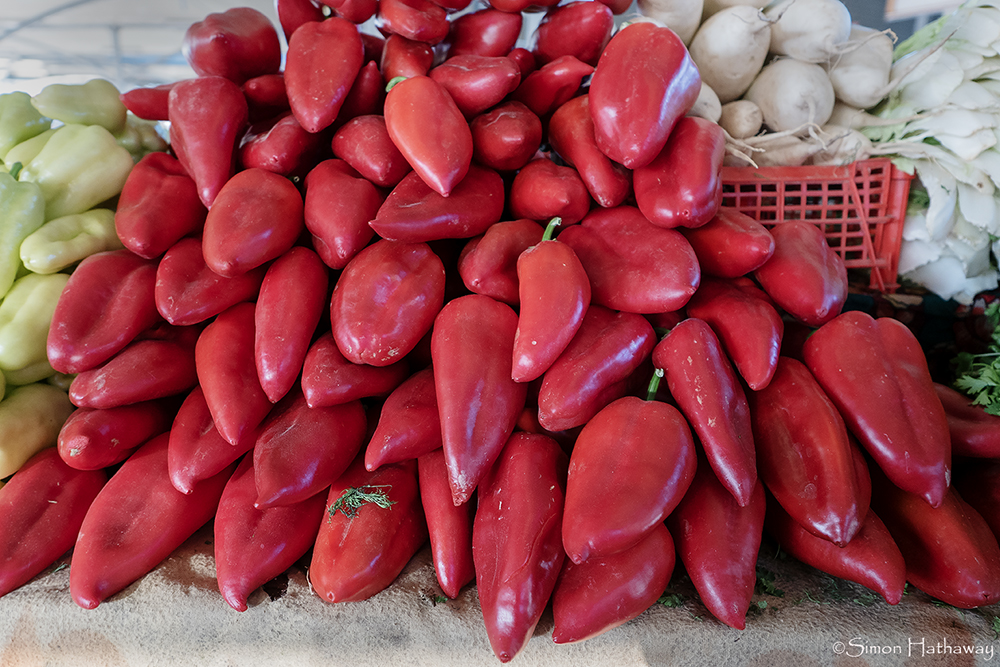
One day Master Jojoo asked a kitchen-steward monk who was in charge of cooking vegetables, “Do we eat raw vegetables or cooked ones today?” The kitchen-steward monk picked up some of them and showed them to the master.
Student: “What did the kitchen-steward monk mean by showing the master some of the vegetables?”
Master: “He showed the best food which we can avoid hunger with for the rest of our lives at a bite.”
Commentary:
We never pass a day without having the best food, but it doesn’t work for us because we don’t digest it.
“For this reason, Subhuti, all Bodhisattvas should have a mind that is pure and clear like this, and should not have a mind that dwells on forms; they should not have a mind that dwells on sound, scent, flavour and touch, or Dharma.”
Commentary:
Bodhisattvas are not separate from the true-Self but are the functions of the true-Self. All of us are essentially Bodhisattvas but we are confused into thinking that we are sentient beings because we have a mind that dwells on forms, that is, because we, being deluded by forms, cannot see things as they are. Therefore, the Buddha said that all Bodhisattvas should have a mind that is pure and clear.
A pure and clear mind that doesn’t dwell on forms; sound, scent, flavour and touch, or Dharma implies a mind that is not deluded by illusions; forms and sounds. When we have a pure and clear mind, that is, when we are free from being deluded by illusions, we are said to have reached the Pure land that is free from birth, ageing, illness and death. We should know that the Pure land, or the true-Self is not so far away that it takes untold effort and time to reach. In the same way that the Avatamsaka Sutra says sentient beings cannot see the Buddha because they, not aware that things are essentially formless, are swayed by forms when they see things, we sentient beings are striving to reach the Pure land which we are already in, or to see the true-Self that is always before and with us, because we have a mind that dwells on forms and sounds.
Once a young monastic asked his master what the Pure land was like. The master said that it doesn’t have a single blade of grass. When the young monastic asked how he could go there, the master answered that he would be wrong even if he moved a single step.
Here ‘a single blade of grass’ implies a single illusion, and the thought that he should go somewhere else to reach the Pure land is also an illusion.
A. Wisdom in Buddhism signifies the ability to see things as they are without being deluded by illusions, that is, the realisation that everything is empty.
He who has the wisdom to see and hear things as they are, is referred to as a man who has transcended birth and death because he sees them just as illusions, or as an idle person with no work to do since he sees whatever he does as empty. So, a life of wisdom means a peaceful and stable life free from the fear and worries that we sentient beings encounter in our lives.
A monastic asked Master Dongan, “What is the teacher of heaven and human beings like?” The master answered, “He has no horns on his head and no hair on his body.”
Student: “Why is he the teacher of the heaven and human beings?”
Master: “Because there is nothing he doesn’t know.”
Commentary:
There is nothing that the Buddha doesn’t know although he has no eyes and no ears, and no place that he can’t reach although he has no limbs.
“Subhuti, what do you think? Do Bodhisattvas adorn the Buddha-land?” “No, World Honoured One, because adorning the Buddha-land is not adornment, but it is just called adornment.”
Commentary:
The Buddha-land, another name of the Pure land which means the true-Self, is so perfect that it leaves nothing to be desired. That is, adding something else to it, removing something from it, or changing it to make it look better is not adorning but dirtying it. The truth is that it is impossible to change the Buddha-land. No matter how hard we may struggle to change it, we cannot change it in the least. To be sure that we can change, or have changed it for good, or for bad, is to be deluded by the illusions created by us.
True adornment means to realise that this world in which we are living now is no other than the Buddha-land. In fact, we sentient beings are deluded into thinking that we are drowning in the ocean of suffering because we cannot see things as they are whilst we are actually in the Buddha-land. That is, we cannot feel how beautiful and perfect this world is since we are deluded by words and forms and can’t see things as they are. Failing to see things as they are like this is referred to as dirtying the Buddha-land. To realise that this world is the Buddha-land by seeing things as they are is to adorn the Buddha-land. This is why adorning the Buddha-land is not adornment, but it is just called adornment.
Student: “How can I adorn Buddha-land?”
Master: “Don’t move even your fingertips.”
Student: “Why, sir?”
Master: “Adoring it is dirtying it.”
Student: “How holy and perfect is it?”
Master: “‘Holy’ and ‘perfect’ are rather dirt that defiles it.”
A. A great book is one thing and reading it well is another. No matter how great a book may be, it cannot be a good book for you if you don’t appreciate its meaning. When ancient masters said that we shouldn’t read books, they didn’t mean that we should not read books but meant that we should not be deluded by words.
Misreading a great book, being deluded by words is like worsening your illness by misusing the best medicine from the best doctor. For example, putting oral medication for eye disease in your eyes will be more harmful than helpful for your eyes. Just as the best medicine, if misused, can be rather harmful for you, so the best book, when misread, can be obstructive to your practice. More often than not, the phrases, or paragraphs known to be helpful for attaining enlightenment lead you to go in the opposite direction from your goal. It is not the phrases or paragraphs but you that are to blame for it.
Master Joshu said to an assembly, “The true-Self is just like a bead in one’s hand. It reflects a bird when a bird comes to it and reflects a lion when a lion comes to it. I use a blade of grass as the Buddha and use the Buddha as a blade of grass. The Buddha is an illusion, and an illusion is the Buddha.”
Then, a monk asked, “I don’t know whose illusion the Buddha is.” Joshu said, “Everyone’s illusion.”
The monk said, “How can I avoid it?” Joshu said, “Why are you going to avoid it?”
Student: “How is it when the Buddha is an illusion?”
Master: “You don’t follow it.”
Student: “How is it when an illusion is the Buddha?”
Master: “You don’t avoid it.”
Commentary:
Neither following the Buddha nor avoiding illusions is the way of seeing the Buddha.
The Buddha said to Subhuti, “What do you think—did I, the Realised One gain any kind of Dharma when I, the Realised One was with the Dipankara Buddha in the past?”
“No, World Honoured One. You, the Realised One really did not gain any Dharma from the Dipankara Buddha.”
Commentary:
The purpose of the Buddha’s teaching, as mentioned previously, is to attain enlightenment, which is to realise the true-Self, Emptiness that is the essence of everything. The true-Self contains everything, including us, and there is nothing that is not the true-Self. Even the historical Buddha and the Dipankara Buddha also belong to the true-Self and are part of it. There is nothing but the true-Self. The true-Self is also referred to as Oneness because everything is one as the true-Self. This cannot be divided, or broken, nor can it be given, or taken since it is formless, boundless and changeless. The Dipankara Buddha just helped the historical Buddha to realise the true-Self in the past but didn’t and couldn’t grant anything to him. This is why Subhuti said that the Buddha really did not gain any Dharma from Dipankara Buddha.
There is a very well-known story that is popular with people. Once the Buddha lifted a flower during his Dharma talk, then, only Mahakasyapa smiled at it. At that time the Buddha said, “I have the Eye of Dharma, and now I pass it on to Mahakasyapa.” This is very likely to allure people to be confused into thinking that there was something that the Buddha gave to Mahakasyapa. The fact was not that the Buddha gave something to Mahakasyapa but that he just revealed the true-Self through his words and action for the purpose of showing it to the assembly.
Let me introduce a story that substantiates that the Buddha didn’t pass on anything to Mahakasyapa. After the Buddha’s death, Ananda once asked Mahakasyapa, “What else did you get from the Buddha except his robe and bowl?” Mahakasyapa said, “Ananda.” Ananda responded, “Yes.” Mahakasyapa said, “Break the flagpole by the door outside.” In the end, Ananda was able to attain enlightenment, or realise the true-Self through this short dialogue. This conversation shows well what the Buddha meant by the words ‘I have the Eye of Dharma, and now I pass it on to Mahakasyapa’.
We should remember that the aim of all words and acts by the Buddha is just to reveal the true-Self to sentient beings and we ought to seek to know what the Buddha took the trouble to show to us.
Student: “What is it that the Buddha wanted to show to people?”
A. The core of the Buddha’s teaching is to help people to escape from illusions. Typical illusions are words and doctrines made up of words. The key problem is that we cannot help but use words to transmit the Buddha’s teaching that we should not be deluded by words. This is why the Buddha said that we should see what his words pointed to instead of being attached to his words themselves. Some ancient masters would say that the Buddha’s words are no more than vessels to carry his teaching. So, we should try to recognise the Buddha’s teaching beyond words in his words.
Student: “What is the Buddha’s teaching beyond words?”
Master: “I’ve not found it although I have sought it for over thirty years.”
Master Joshu said to an assembly, “The true-Self is just like a bead in one’s hand. It reflects a bird when a bird comes to it and reflects a lion when a lion comes to it. I use a blade of grass as the Buddha and use the Buddha as a blade of grass. The Buddha is an illusion, and an illusion is the Buddha.”
Then, a monk asked, “I don’t know whose illusion the Buddha is.” Joshu said, “Everyone’s illusion.”
The monk said, “How can I avoid it?” Joshu said, “Why are you going to avoid it?”
Student: “How is it when Joshu uses a blade of grass as the Buddha?”
Master: “What is humble is not humble.”
Student: “How is it when Joshu uses the Buddha as a blade of grass?”
Master: “What is precious is not precious.”
Commentary:
The Buddha reveals itself when what is humble is equal to what is precious.








 Zen Fools