zen

Rinzai 205

One day at the street market Fuke was begging all and sundry to give him a Buddhist monk’s robe. Whenever people offered him one, he said that he didn’t need it. Rinzai made the monk in charge of the temple’s affairs buy a coffin, and when Fuke returned, said to him, “There, I had this robe made for you.” Fuke shouldered the coffin, and went back to the street market, calling loudly, “Rinzai got this robe made for me! I am going to the East Gate and will leave this world there.” The people from the street crowded after him, eager to watch. Fuke said, “No, not today. Tomorrow, I will go to the South Gate to leave this world.” And so it went on for three days, until nobody believed it any longer. On the fourth day, and now without any spectators, Fuke went alone outside the city walls, and laid himself into the coffin. He asked a traveller who happened to pass by there to nail down the lid. The news spread at once, and the people from the street rushed there. Upon opening the coffin, they found that the body had vanished, but from high up in the sky they heard his hand bell ringing softly.

Commentary:

This part can sound misleading to modern people because it is so exaggerated that it seems to be fictional. What matters is how to grasp the meaning this story conveys without being deluded by words. ‘Fuke was begging all and sundry to give him a Buddhist monk’s robe’ implies that he was revealing the true-Self in a peculiar way to catch people’s attention as an expedient to spread Zen Buddhism. This is why he refused people whenever they, deluded by his words, offered him robes. Rinzai, aware of Fuke’s intention, got a coffin prepared for him.  Fuke, with the coffin on his shoulder, went back to the street market, calling loudly, “Rinzai got this robe made for me!” He meant that Rinzai had the eye of wisdom to see his intention. From ‘I am going to the East Gate and will leave this world there’ to ‘until nobody believed it any longer’ Fuke revealed the true-Self.  From ‘On the fourth day, and now without any spectators’ to ‘the people from the street rushed there’ Fuke, aware that his mission was over, revealed the true-Self finally and dramatically. The last part from ‘On opening the coffin’ to the end of this story shows that although his physical body became invisible, his existence as the true-Self is everlasting. The sounds of raindrops and birds we can hear now are not different from the ringing of his hand bell.

The core of this is that regardless of whether this story is real or fictional, this all the function of the true-Self.

©Boo Ahm

All writing ©Boo Ahm. All images ©Simon Hathaway

#zen #meditation #zenmeditation #enlightened #enlightenment #zenfools #photography

zen

Q. Can anything exist in complete isolation or is everything defined by its relation and connection to other things?

A. Nothing can exist in complete isolation. Everything must depend on something for its existence. For example, in order for a chair to exist, firstly, there should be a person who sees and calls it a chair. Secondly, there should be things that are different and separate from the chair, that can be distinguished from the chair. In fact, each of the things that a chair depends on for its existence exists in the same way as a chair does. So, ancient masters would say that if a mote comes into existence, all the universe comes into existence along with it.

The point here is that nothing can come into existence without our acknowledgment. A chair, for instance, can be a chair only when we differentiate it from other things, think of it as a chair and refer to it as such. This is why the Buddha said that everything is from our mind.

©Boo Ahm

All writing ©Boo Ahm. All images ©Simon Hathaway

#zen #meditation #zenmeditation #enlightened #enlightenment #zenfools #photography

zen

Layman Pang’s Diamond Sutra

Layman Pang said, “The core of the Diamond Sutra is to cut all illusions. From the very first word to the last, all of them are just the way false names are arranged.”

Student: “If from the very first word to the last in the Diamond Sutra, all of them are just the way false names are arranged, why did the Buddha say such false names?”

Master: “They are not the words the Buddha said.”

Commentary:

The words that can be dictated are not the Buddha’s words.

©Boo Ahm

All writing ©Boo Ahm. All images ©Simon Hathaway

#zen #meditation #zenmeditation #enlightened #enlightenment #zenfools #photography

zen

Rinzai 204

With regards to that, a monk then asked Kinzan, “What question and answer were exchanged between you and the monk who just came and left? He just gave a Katsu and went out.” Kinzan said, “That monk came from among Obaku’s assembly. If you want to know, ask him yourself.” More than half of the monks left Kinzan’s community.

Commentary:

Although the phrase ‘If you want to know, ask him yourself’ made by Kinzan was a perfect answer to the question asked by the monk, many of his students failed to grasp Kinzan’s intention because they were deluded by words. That is why more than half of his students left him. However, Rinzai also made a similar answer to Kinzan’s when he was asked who the host was and who the guest was. Majo, when he was asked by a monk what the true-Self is, told him to ask one of his students as well. In order to grasp the answers that masters had the kindness to show, we should not be fooled by the words they used as an expedient to reveal the true-Self.

©Boo Ahm

All writing ©Boo Ahm. All images ©Simon Hathaway
#zen #meditation #zenmeditation #enlightened #enlightenment #zenfools #photography

zen

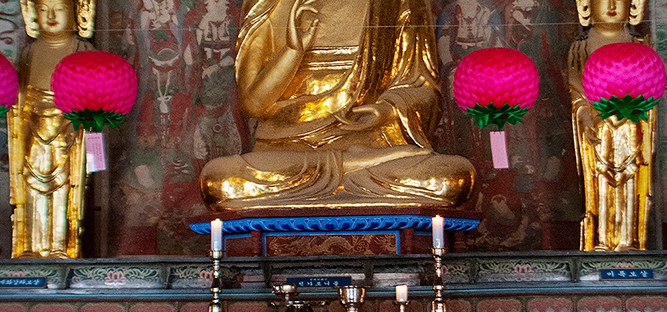
Q. If Buddhism is not a religion that worships idols, why do Buddhist shrines keep Buddha statues?

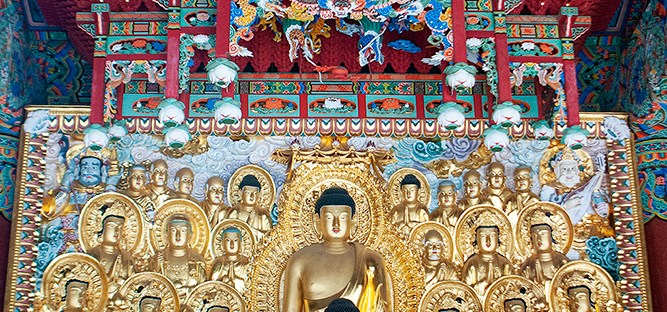
A. The act of offering bows and praying in temples and shrines may appear to be misleading. However, the Buddha statues kept in shrines are not objects of worship but artefacts in honour of the historical Buddha, just like the Lincoln statue in the Lincoln Memorial.

Buddhism is not a religion that leads people to worship and pray to the Buddha for happiness but a religion to help them to realise that everything, including themselves, is the Buddha. It is not a religion that makes its followers the slaves of the Buddha but a religion that makes them aware that there is nothing to worship and pray to. To create an image of the Buddha in the air and hold an invisible string tightly to prevent it from flying away is not Buddhism but a type of superstition, or idolatry that is primitive religion. As long as people are infatuated with the image of the Buddha in this way, they are not Buddhist in the true sense.

©Boo Ahm

All writing ©Boo Ahm. All images ©Simon Hathaway
#zen #meditation #zenmeditation #enlightened #enlightenment #zenfools #photography

zen

King Gari cut the Buddha’s body

The Buddha said, “When King Gari cut my body into pieces, I didn’t have any illusions, including the illusion of ‘I’. Otherwise, I would have had anger and spite against him.”

Student: “How could it be possible for the Buddha not to have any anger and spite against King Gari when his body was cut into pieces by him?”

Master: “His body not only wasn’t cut but also wasn’t scratched.”

Commentary:

What can be cut, or damaged is not the Buddha’s body.

©Boo Ahm

All writing ©Boo Ahm. All images ©Simon Hathaway
#zen #meditation #zenmeditation #enlightened #enlightenment #zenfools #photography

zen

Rinzai 203

Kinzan had a community of five hundred monks, but there were few who consulted him for interviews. Obaku charged a monastic to go to Kinzan for an interview, and asked him, “When you arrive, what will you do?”

The monastic said, “When I get there, expedients will present themselves.” Having arrived, he went up the Dharma Hall in his travelling outfit and saw Kinzan.  When Kinzan was at the point of raising his head, the monastic gave a Katsu. When Kinzan was about to open his mouth to say something, the monastic shook his sleeves and left.

Commentary:

The monastic revealed the true-Self by saying, “When I get there, expedients will present themselves” when he was asked by Rinzai what he would do when he arrived. His answer implied, “There is nothing but this that I can do.” In fact, when he met Kinzan, he responded to Kinzan by giving a Katsu and by shaking his sleeves and leaving, which was what he had told Rinzai he would do when he arrived at Kinzan’s place. Kinzan might seem to have failed to handle the monastic properly, but we should know that he left nothing to be desired.

Student: “Why didn’t Kinzan say anything when the monastic came to him?”

Student: “Because you missed what he said.”

©Boo Ahm

All writing ©Boo Ahm. All images ©Simon Hathaway
#zen #meditation #zenmeditation #enlightened #enlightenment #zenfools #photography

zen

Bodhidharma’s ‘seeing what is not seen’

Bodhidharma said that truly seeing is not seeing what is seen, but seeing what is not seen. How can we see what is not seen? ‘Seeing what is not seen’ may sound illogical and seem to make no sense at all, but this is the very way to see the true-Self. When we see a thing, we can stop seeing it as we please, either by removing it from our sight, or by turning our heads away. However, supposing we see the true-Self, it is impossible to cease to see it even for a moment because everything, including ourselves, is the true-Self and because there is nothing else but the true-Self.

Not only blinding brightness, but also pitch-darkness is the appearance of the true-Self. Even the scene you can feel when you keep your eyes closed is the appearance of the true-Self as well. Like this, if we cannot stop seeing and if there is only ‘seeing’ and not ‘non-seeing’, then ‘seeing’ is not seeing any more, just as red is not red any more when everything is red. So, seeing what is not seen means to see what you cannot stop seeing even for a moment, that is, to see what cannot stop being seen.

©Boo Ahm

All writing ©Boo Ahm. All images ©Simon Hathaway

#zen #meditation #zenmeditation #enlightened #enlightenment #zenfools #photography

zen

Bodhidharma’s ‘Truly seeing’

Truly seeing is not seeing what is seen, but seeing what is not seen. Truly knowing is not knowing what is known, but knowing what is not known.

Student: “What is it to see what is not seen?”

Master: “It is to see what cannot stop being seen.”

Commentary:

When you cannot stop seeing, your seeing is not seeing any more.

©Boo Ahm

All writing ©Boo Ahm. All images ©Simon Hathaway

#zen #meditation #zenmeditation #enlightened #enlightenment #zenfools #photography

zen

Rinzai 202

Later on, when Ryuge was the head of a temple, a monk came into his room and asked for instruction, saying, “While you went on pilgrimage, you went to consult those two masters. Do you agree with them?”

Ryuge said, “Although I agree with them deeply, there is still no meaning of the patriarch’s coming from the West.”

Commentary:

When the monk asked Ryuge if he agreed with the masters who had hit Ryuge with a cushion, he answered that he did. However, the monastic didn’t ask, and Ryuge didn’t say what he agreed upon with them. Can you guess what he agreed upon with them?  All enlightened people agree with each other on the true-Self. Ryuge was compassionate enough to show the monastic what he agreed upon with them. This is why he added, “There is still no meaning of the patriarch’s coming from the West” after answering that he agreed with them. In other words, he revealed the true-Self by saying, “There is still no meaning of the patriarch’s coming from the West.”

©Boo Ahm

All writing ©Boo Ahm. All images ©Simon Hathaway

#zen #meditation #zenmeditation #enlightened #enlightenment #zenfools #photography