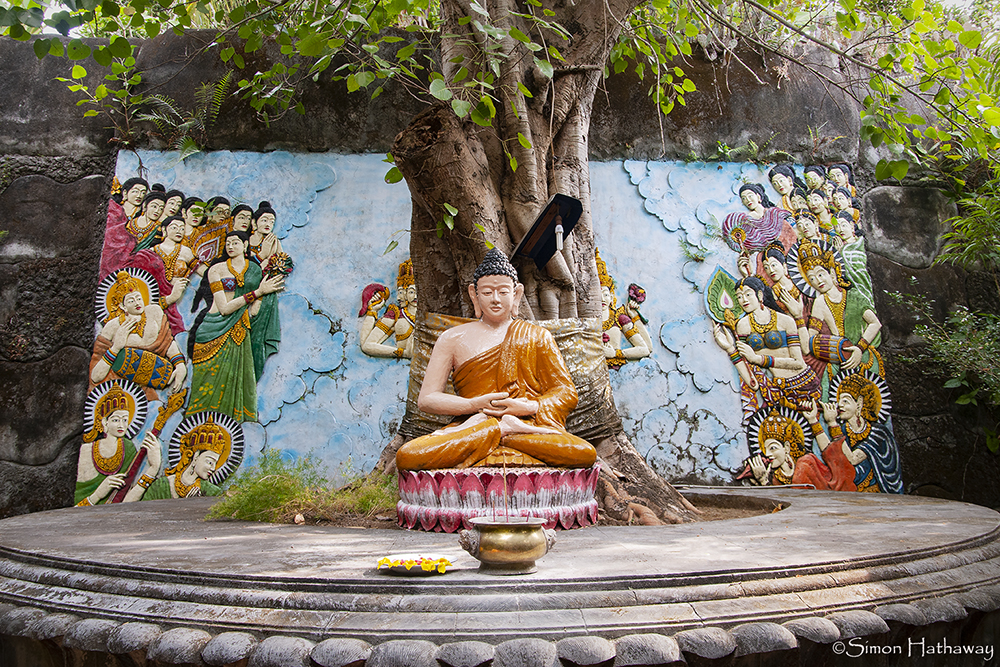
A. ‘The Buddha is illusionary’ implies that there is no other Buddha than that which reaches your eyes and ears. If you, imagining that there is a Buddha who is almighty, holy, glorious and splendid somewhere else out of your reach, seek to see or meet him, you are being deluded by the illusion of the Buddha, that is, you are chasing after the illusion of the Buddha.
In fact, there is nothing but the Buddha. We cannot stop seeing and hearing him even for a moment. Only when we are deluded by the names and forms of that which we see and hear are they referred to as illusions. In essence they are all part of the Buddha. When we see them as they really are, we can recognise them as the Buddha. So, calling the Buddha an illusion is belittling him. This is why illusions are to speak ill of him.
Yunmen was once asked by a monastic, “If, at the beginning of autumn, after the summer retreat period is over, someone asks me about the future, what shall I say?”
Yunmen said, “The assembly adjourns.”
The monastic said, “What will happen after that?”
Yunmen said, “Pay me for the ninety days of meals.”
Student: “What did Yunmen mean by ‘The assembly adjourns’?”
Master: “He meant the assembly that never adjourns.”
Student: “What does ‘Pay me for the ninety days of meals’ mean?”
Master: “He who attends the assembly that never adjourns is excused from paying.”
Commentary:
Those who attend an assembly are bound to break up and those who were served meals for ninety days can’t help paying for the meals.
Followers of the Way, there is no Buddha to be attained. The Three Vehicles and the Five Natures, as well as the Complete and Sudden Teachings are not really existent. All are but expedient means, temporary remedies for curing diseases. Even if they appear to be existent, they are all but surface manifestations, like printed letters on a sign board to indicate the Way. This is my teaching.
Commentary:
There is no Buddha to attain both because we are the Buddha itself and because there is nothing else but the Buddha. There is no more Buddha to attain or to lose than there is the universe to attain or to lose, because we are the universe itself. ‘The Three Vehicles and the Five Natures as well as the Complete and Sudden Teachings’ are nothing but the explanations of how to recognise the Buddha and descriptions of what the Buddha is like. All words, no matter how plausible they are, are no more than illusionary labels created and used for the sake of convenience, not real. In the same way, all Buddhist teachings are but expedient means that lead us to enlightenment and are just temporary remedies for curing us of the disease of being deluded by illusions. Even if they appear to be existent and real, we should not be deluded by them but see what they point to beyond their appearance.
Student: “How can I see beyond what things appear to be?”
A. Don’t believe it. If death were the gateway to Heaven, why wouldn’t those who argue for this idea go there right now instead of struggling to escape from the ocean of suffering? The sooner a good thing happens, the better it is. The later a bad thing happens, the better it is. If they could be sure that they go to Heaven after death, why would they go to see a doctor and struggle to avoid death by all available means when they are not well instead of praying to God to take them to Heaven as soon as possible?
If you want your soul to go to Heaven, you should realise what your soul is and what and where Heaven is above all. If not knowing not only who wants to go to Heaven but also what the destination to go to is, how could you wish to go there? Trying to go to Heaven without knowing either of them is not different from striving to attain the horn of a rabbit, or the hairs of a turtle.
You should remember that to realise either your soul or Heaven is to open the gate to Heaven. The moment you realise it, you will realise that you are already there and have never left it as well. Heaven is no other than where we are at this moment and realising the fact is to go to Heaven. So, Heaven is where you should go while alive, not after death.
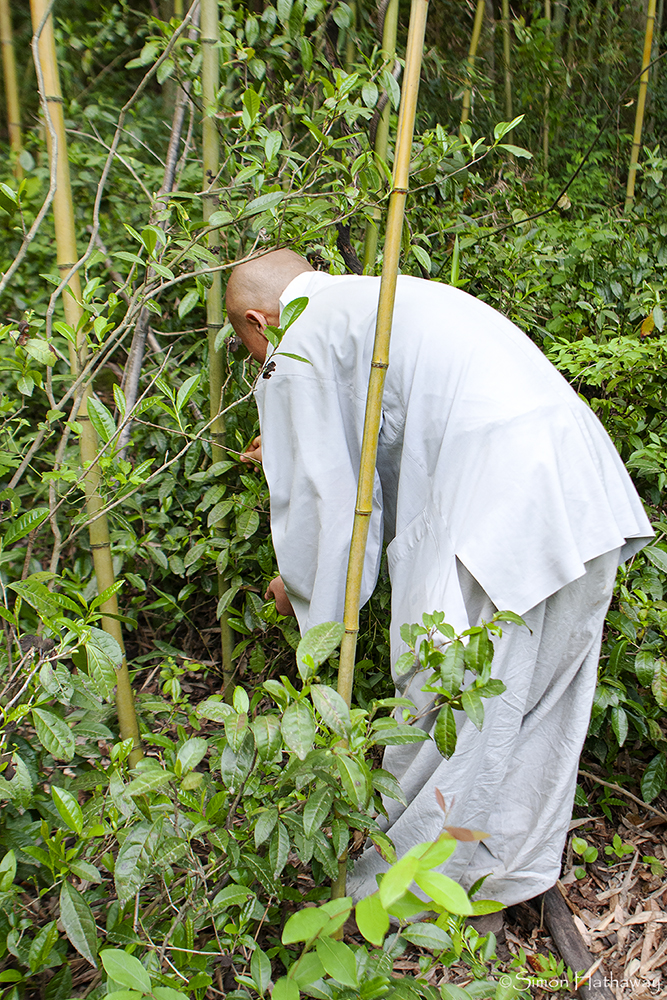
Qingping asked his teacher, Cuiwei, “What is the exact meaning of the Bodhidharma’s coming from India?” Cuiwei said, “I will tell you when no one is around.” After a while Qingping said, “There is no one now. Please tell me, Master.” Cuiwei got down from the meditation platform and took Qingping into a bamboo garden. Qingping said again, “There is no one here. Please tell me.” Pointing to the bamboos, Cuiwei said, “This bamboo is tall just as it is. That bamboo is short just as it is.”
Student: “What did Cuiwei mean by ‘This bamboo is tall just as it is. That bamboo is short just as it is’?”
Master: “He showed the exact meaning of the Bodhidharma’s coming from India.”
Commentary:
See and hear what is neither tall nor short in the tall and short bamboos?
Followers of the Way, do not grasp hold of what I am saying. Why not? My words have no fixed foundation; they are, as it were, pictures provisionally painted as makeshifts in space. This is the same as the metaphor that words colour the appearance of the true-Self and are only designs of an instant in space, like images painted in colour, or other teaching devices. Followers of the Way, do not take the Buddha for the supreme aim. I myself see him as a privy hole, and the Bodhisattvas and Arhats are things that bind men like a pillory and chains. This is why Manjushri grasped the sword to kill Gautama, and Angulimala took the knife to assassinate the Buddha.
Commentary:
When we read or listen to masters’ talks, the last thing that we should do is to accept them literally, as merely intellectual understanding whilst clinging to words. In fact, they are doing two things at once; explaining or describing the true-Self and revealing the true-Self in person. Whatever they say is just an expedient to reveal the true-Self in person. This is why Rinzai advised his students not to grasp hold of what he was saying.
People, however, pay all their attention only to the explanation or description in the way they are accustomed to, overlooking the true-Self they reveal. In order to rid us of this bad habit Rinzai said, “I myself see him as a privy hole, and the Bodhisattvas and Arhats are things that bind men like a pillory and chains”. ‘Manjushri grasped the sword to kill Gautama, and Angulimala took the knife to assassinate the Buddha’ was mentioned to show how hard they tried to put into practice the teaching that we should kill the Buddha when we meet him and not be deluded by the illusion of him.
Student: “Why should we kill the Buddha that we respect and are so anxious to see?”
A. You do. However, you should know that every action is empty and neutral, not good, not bad, and so all karma created by actions is also empty and neutral. A certain action is said to create good karma or bad karma, not because the action creates good karma, or bad karma in essence but because you think it does. That’s why an action can appear to be different; a cause of good karma and a cause of bad karma, depending on the beholder’s perspective.
Determining what actions create good and bad karma is no other than discriminating, that is, being deluded by illusions, which runs counter to enlightenment. So, ancient masters would say that creating good karma is not as good as creating no karma. In the Bible, Luke 6:37 says, “Do not judge others, and God will not judge you; do not condemn others, and God will not condemn you; forgive others, and God will forgive you.” The best we can do is not to be deluded by illusions by realising that karma is also empty.
One day when Dagui went to the mountains, he saw Yangshan doing sitting meditation under a tree. Dagui tapped Yangshan on the back once with his staff. Yangshan turned his head. Dagui asked, “Can you say a phrase about going beyond Buddhadharma?” Yangshan replied, “Although I cannot say it, I will not depend upon someone else’s mouth.”
Student: “Who was it that Yangshan depended upon when he said, ‘I cannot say’?”
Master: “There is no one who doesn’t depend on him. Even the Buddhas and Bodhisattvas do.”
Student: “Who is it?”
Master: “I don’t know his name.”
Commentary:
It is revealing itself naked on bare feet before you all the time.
Venerable ones, if one comes to see things thus, one gets rid of being obstructed by names like worldly and sacred. Thoughts in your mind do nothing but create understanding from the fingers of an empty fist, and you vainly do something unusual and abnormal with six kinds of illusions from six roots; eye, ear, nose, tongue, body and will. You belittle yourselves by modestly saying, “I am but a common man – he is a sage.” You bald idiots! What is the frantic hurry to wear a lion’s skin and yap like a wild fox instead of spreading the spirit of a man? You do not believe in the treasure in your own house, so you go outside searching, and fall into the trap of words and phrases of the old masters; relying on Yin, leaning on Yang, you cannot arrive at any real mastery of your own. So, encountering phenomena, you discriminate them. Encountering illusions, you cling to them. Because everything you touch causes you illusions, you cannot stabilise yourself.
Commentary:
‘Thoughts in your mind do nothing but create understanding from the fingers of an empty fist, and you vainly do something unusual and abnormal with six kinds of illusions from six roots; eye, ear, nose, tongue, body and will’ means that when your master reveals the true-Self by folding and unfolding his hand, you, deceived by the illusions of the motions of the master’s hand, guess in vain by using your knowledge. ‘What is the frantic hurry to wear a lion’s skin and yap like a wild fox instead of spreading the spirit of a man?’ means ‘Why do you say such nonsense while your appearance is not different from the Buddha’s?’. ‘You do not believe in the treasure in your own house’ implies that you have not realised that you are the very Buddha itself you are looking for. ‘You go outside searching, and fall into the trap of words and phrases of the old masters; relying on Yin, leaning on Yang’ means that you vainly grapple here and there with the words and phrases of old masters without grasping them clearly and talk nonsense with wild guesses just as a fortune teller does depending on Yin and Yang. This is why you are deluded by whatever reaches your eyes and ears and are attached to them. Chasing after them makes your lives unstable.
Student: “What is the treasure in my own house?”
Master: “Why don’t you rummage your house for it.”
A. What do you mean by a good thing? In essence everything is neutral, neither good nor bad. Nothing says, “I am bad”, or “I am good.” What is good to you can be bad to someone else, and what is good today can be bad tomorrow and vice versa. There is a proverb that poison, well used, can be medicine.
On the contrary, food, no matter how high quality it may be, can be harmful and poisonous either when we feed it to babies who are not capable of digesting it, or when we overindulge ourselves with it. Whether a thing is good or bad depends upon your perspective based on your situation. The best way to replace a bad thing with a good thing is to realise that the former is not different from the latter.










 Zen Fools