Zen

The Diamond Sutra (10) – Second Commentary

Part 3
The Buddha said to Subhuti, “The bodhisattvas should surrender their minds thus: All kinds of sentient beings—be they born from eggs, born from wombs, born from moisture, or born from transmutation, be they material, immaterial, thinking or non-thinking, or neither thinking nor non-thinking, — I shall have them all enter perfect nirvana without remainder and thus liberate them all. Although I liberate innumerable, countless, infinite sentient beings, not a single sentient being is liberated in fact.”

“Why not? Subhuti, if the bodhisattvas have images of self, images of person, images of a being, images of a liver of life, they are not bodhisattvas.”

Commentary:
In this context, “all sentient beings” refers not only to living creatures but also to inanimate things like stones and pieces of wood. Other than the Buddha, nothing lies outside the realm of sentient beings. People often say it’s difficult enough to help even humans—beings we can communicate with—attain enlightenment. So how is it possible to lead all the sentient beings mentioned above to enlightenment, many of whom cannot even communicate with us? There is a saying: “When I attain enlightenment, the whole universe is enlightened along with me”. To attain enlightenment means not being deluded by forms or words—it means seeing and hearing all things just as they are. This way of seeing is referred to as seeing things as empty.

Now, “emptiness” doesn’t mean voidness. It means a state free from all conceptual discrimination. It’s such a complete and indescribable state that even opening one’s mouth to speak about it causes distortion. Calling it “sacred” would be to defile it. It is this unspeakable, perfect clarity that is also known as the true-Self, Buddha-nature, Tathāgata, nonduality, nirvāṇa, or the Pure Land. To see all things as empty is to see the Buddha; to reach this state is to enter nirvāṇa.

When enlightenment is attained, all conceptual distinctions fall away: there is no more one who attains nirvāṇa, no object of nirvāṇa, no sentient beings, no Buddhas, no self, no other. All sentient beings—including oneself and the entire universe—are seen as not separate, but one. This is what the expression “Throughout heaven and earth, I alone am the honoured one” refers to the realisation of nonduality and the state of Buddhahood.

Thus, when the sutra says, “I shall liberate all incalculable, innumerable, and boundless sentient beings,” it doesn’t mean changing the sentient beings themselves, but changing the way we see them—seeing them not as sentient beings but as Buddhas. This is why the Buddha said, “If a bodhisattva has images of self, images of person, images of sentient beings, or images of a liver of life, then he is not a true bodhisattva.” In short, to lead all sentient beings to nirvāṇa by liberating them from illusions doesn’t mean to transform them, but to perceive them rightly, as they truly are— the functions of the true-Self.

The various types of beings—those born from eggs, from wombs, from moisture, or spontaneously; beings with form or without form; beings with thought, without thought, or neither with nor without thought—are distinctions we make when we fail to see them as they really are. In true vision, these are all nothing but the functions of the true-Self.

That’s why ancient masters would say, “When I was deluded, even the Buddha or Maitreya seemed foolish. But now that I’ve attained enlightenment, even a cat or a white ox appears wise.” It is our own enlightenment that liberates all beings. And this is why the Buddha said, even though countless sentient beings are liberated, not a single sentient being has truly been liberated—because in the ultimate view of the enlightened, there are no beings to be liberated.

Disciple: “How should I liberate sentient beings?”
Master: “Don’t waste time liberating sentient beings that don’t exist—just serve the Buddha in front of you well.”
Disciple: “What is the Buddha in front of me?”
Master: “What? Say that again.”
Disciple: “What is the Buddha in front of me?”
Master: “I’m not deaf.”

©Boo Ahm

All writing ©Boo Ahm. All images ©Simon Hathaway

Zen

What does ‘The true-Self is difficult to discern because it is neither sound nor form’ mean?

It is true that the true-Self is neither sound nor form; it is so subtle that it is difficult to discern.

However, it doesn’t mean that the true-Self is separate from sound and form. All sounds and forms are just the functions of the true-Self, just as all waves are the functions of the sea. A wave cannot be said to be the sea, but all waves are part of the sea. We should be able to see forms and the true-Self at the same time like seeing waves and the sea.

©Boo Ahm

All writing ©Boo Ahm. All images ©Simon Hathaway

Zen

Nanquan’s Body (2)

Nanquan said to the assembly, “I am going to sell my body. Is there anyone who will buy it?”
A monk stepped forward from the crowd and said, “I will buy it.”
Nanquan said, “It is neither expensive nor cheap. How will you buy it?”

The monk was silent.

Student: “What would you have said if you had been the monk’s shoes?”
Master: “I would have said, ‘Why are you going to sell what is already mine to me?”

Commentary:
The reason why masters are called thieves is that they sell what sentient beings lost back to sentient beings.

©Boo Ahm

All writing ©Boo Ahm. All images ©Simon Hathaway

Zen

The Diamond Sutra (9) – Second Commentary

Part 2-3
The Buddha said, “Good, Subhuti! As you say, I always have the bodhisattvas in mind well, protect them well and entrust them well with the propagation of Buddhist Dharma. Listen carefully now; I will expound to you. When good men and good women have made up their minds to attain supreme enlightenment, they should live and surrender their minds thus.”
“Yes indeed, World-Honoured One, we look forward to listening.’’

Commentary:
The Buddha said, “Now listen carefully—I shall teach you for your benefit.” But what does it truly mean to “listen carefully”? In Part 13 of this sutra, the Buddha asks Subhūti, “What do you think, Subhūti? Is there any Dharma (teaching) that the Tathāgata has preached?” Subhūti replies, “No, World-Honoured One, the Tathāgata has not spoken any Dharma.”

Despite the fact that the Buddha gave countless Dharma talks, that Subhūti said the Buddha had not spoken any Dharma implies that understanding the Dharma means grasping what lies beyond the words. The heart of the Buddha’s teaching cannot be found in words alone. This is why it is often said that true Dharma is “a special transmission outside the scriptures”. This does not mean we should disregard all spoken or written teachings. Rather, we should listen to or read them while simultaneously recognising the functions of the true-Self (Emptiness). If someone reads a sutra and clings only to the literal words, failing to perceive the true-Self, we say, “the person is being controlled by the scripture.” But if someone reads the sutra and, while understanding the words, also sees the functions of the true-Self, we say “he is using the scripture.”

If one only chases words without realising what they point to, one ends up increasing illusions and actually going against the Buddha’s teaching. This is why ancient great Zen masters would say that without the right understanding, scriptures and Dharma talks can become like the teachings of Maras (demons). So, when reading a sutra, one must always strive to read not just the text (form) but also see through it to the function of the true-Self (Emptiness). This dual approach is known in doctrinal terms as “seeing in both ways”. And this is not limited to sutras—if we try to see and hear everything in our daily lives in this way, our entire life becomes practice. And there is no greater practice than this.

Disciple: “If we’re not supposed to be deceived by words, why are there so many sutras?”
Master: “Because you don’t yet know how to read scriptures without being deceived by words.”

If you listen carefully, you will see the Buddha in your daily lives.

©Boo Ahm

All writing ©Boo Ahm. All images ©Simon Hathaway
Zen

Is there mind, or not?

It is said that we should realise mind, but sometimes it is said that there is no mind.

Mind that the Buddha pointed to is the true-Self that is boundless, formless, changeless and nameless. This cannot be said to be existent, or non-existent because it is beyond words. There is nothing but mind, and there is nothing that is not mind. In fact, there cannot be a word ‘mind’ when there is nothing but mind, because there is nothing else to distinguish mind from. This is why it is nameless. Accordingly, everything is mind, and there is nothing that is not mind. Then, that there is no mind means that there is only mind.

©Boo Ahm

All writing ©Boo Ahm. All images ©Simon Hathaway

Zen

Nanquan’s Body (1)

Nanquan said to the assembly, “I am going to sell my body. Is there anyone who will buy it?”
A monk stepped forward from the crowd and said, “I will buy it.”
Nanquan said, “It is neither expensive nor cheap. How will you buy it?”
The monk was silent.

Student: “What would you have said if you had been the monk’s shoes?”
Master: “I would have said that I wouldn’t accept it even for nothing.”

Commentary:
What can be sold and bought is not a holy thing.

©Boo Ahm

All writing ©Boo Ahm. All images ©Simon Hathaway

Zen

The Diamond Sutra (8) – Second Commentary

Part 2-2
“World-Honoured One, when good men and good women have made up their minds to attain supreme enlightenment, how should they live, and how should they surrender their minds?”

Commentary:
The question Subhūti asks—“How should one subdue and control the mind in order to attain enlightenment?”—is a very common one among Buddhist practitioners.

This question is a prime example of how sentient beings become confused by forms (or illusions). It not only reveals how illogical we can be but also how unaware we are of what we are actually saying. For example, if someone asks, “How should I maintain my car?” we have no doubt that this person knows what his car looks like—its colour, age, size, and condition—because that question assumes he knows what car he’s referring to. Likewise, when someone asks, “How should I subdue and control my mind to attain enlightenment?” it implies that he at least knows what mind he is trying to subdue.

However, this question actually reveals that the person doesn’t even realise the fact that he doesn’t know what his mind is. Because to know one’s mind is to be enlightened, anyone who truly knows what his mind is would no longer need to seek enlightenment or ask such a question.

The purpose of Buddhism is enlightenment; to realise what the mind is. There’s a well-known exchange between Bodhidharma and his disciple Haeka that illustrates this point perfectly.

One day, Haeka said to Bodhidharma, “My mind is not at ease. Please put it to rest.” Bodhidharma replied, “Bring me your mind, and I will set it at rest.” Haeka said, “I have searched for my mind, but I cannot find it.” To this, Bodhidharma replied, “There—I have set it at rest for you.”

This meant that if you don’t know where your mind is, or even what it is, how can you say it is not at ease? In that moment, Bodhidharma revealed the mind (or the true-Self) to Haeka. Upon hearing this, Haeka attained enlightenment—because, for the first time, he realised what his mind truly was.

Disciple: “How should I subdue my mind to attain enlightenment?”
Master: “Before trying to subdue it, first find out what your mind is.”
Disciple: “What is my mind?”
Master: “Why do you ask me about something that’s in your own mouth?”
Disciple: “But there’s nothing in my mouth.”
Master: “Exactly—that’s it.”

Mind, mind….
They said I had to see it,
So I finally looked it in the face,
And it isn’t it.

©Boo Ahm

All writing ©Boo Ahm. All images ©Simon Hathaway

Zen

Why is it said in Buddhism that all forms are untrue?

Because all forms are not inherent and innate but artificial, fabricated and imaginary.

A mountain, for example, is a mountain not because it said, “I am a mountain. Call me mountain from now on” but because we attached an imaginary label ‘mountain’ to it and believe that it is a mountain. It is not permanent but changes all the time just as we can see some mountains were the bottom of the sea many years ago. This is why all forms are untrue.

©Boo Ahm

All writing ©Boo Ahm. All images ©Simon Hathaway

Zen

Master Yeomgwan’s Buffalo Horn Fan (2)

One day, Master Yeomgwan called his attendant and said, “Bring me the buffalo horn fan.”

The attendant replied, “The fan is completely broken.”
The master then said, “If the fan is broken, bring the buffalo to me.”
The attendant had no response.

Student: “Why did the master want the Buffalo?”
Master: “In order to let his attendant know what he was riding.”

Commentary:
Everyone has it in his hands and is riding it at the same time all the time.

©Boo Ahm

All writing ©Boo Ahm. All images ©Simon Hathaway
Zen

The Diamond Sutra (7) – Second Commentary

Part 2-1
At that time the venerable Subhuti was in the assembly. He rose from his seat, uncovered his right shoulder, knelt on his right knee, joined his palms together in respect, and said to the Buddha, “It is rare and marvellous, Buddha. You always have the Bodhisattvas in mind, protect them well and entrust them well with the Dharma.”

Commentary:
Here, we must deeply contemplate what Subhūti saw and why he expressed such awe and reverence toward the Buddha—even though the Buddha had not spoken a single word. Subhūti had seen the true-Self, the Tathāgata, the true essence of the Buddha that the Buddha had always sought to reveal to his disciples. He called it “rare and marvellous” because the true-Self is utterly free from defilements, beyond worldly conception, and perfect in a way that is extremely difficult to recognise with an ordinary, worldly perspective. This is why the ancient masters warned that no matter how beautifully or nobly someone may describe the Tathāgata (or the true-Self), such words inevitably fall short—or worse, may even defile it. Anyone who understands Subhūti’s words must also recognise that Subhūti’s own act of reverence was itself rare and marvellous as well.

Disciple: “What is it that is rare and marvellous?”
Master: “The Buddha showed it, and now you are showing it too.”
Disciple: “What is it?”
Master: “It is the most common and abundant.”
Disciple: “Why is it called rare if it is so common and abundant?”
Master: “Because many seek it, but few ever see it.”
Disciple: “Then what exactly is it?”
Master: “Come alone tomorrow, and I’ll tell you.”

“He protects all Bodhisattvas well” means the Buddha is not showing favouritism by guarding only Bodhisattvas. In truth, everything is always within the Buddha—the Tathāgata—and nothing can ever be outside of it. Just as no form can escape emptiness, no being can escape the embrace of the Buddha. Bodhisattvas who realise this know they are always protected within the field of the Tathāgata and thus are free from harm. Sentient beings who do not realise this live lives filled with anxiety and illusions. This is why, in the Lotus Sutra, the Buddha compared sentient beings to a rich man’s son who, not knowing his father is the wealthiest man in the world, lives the life of a beggar.

Disciple: “How does the Buddha protect the Bodhisattvas?”
Master: “They cannot leave his embrace.”
Disciple: “How can I enter the Buddha’s embrace?”
Master: “Don’t take a single step.”

“He entrusts the Dharma well to the bodhisattvas” means the Buddha guides Bodhisattvas to enlightenment and thereby transforms them into Tathāgatas like himself. He entrusts them not just with preaching the Dharma, but with embodying the Dharma—so that their every action and word is indistinguishable from the Buddha’s own. The aim of Buddhism is not to worship the Buddha, but to realise that we ourselves are the Buddha. This is how we truly repay the Buddha’s grace.

Disciple: “How does he entrust the Dharma to the Bodhisattvas?”
Master: “He helps them realise there is nothing to entrust.”

Just as the historical Buddha did, we must come to see that our friends, families, neighbours, and coworkers are constantly revealing something rare and marvellous. Not only they, but we ourselves are the Dharma—we are the Tathāgata, the Buddha. This is what Śākyamuni Buddha strove to help people awaken to.

What is rare and marvellous?
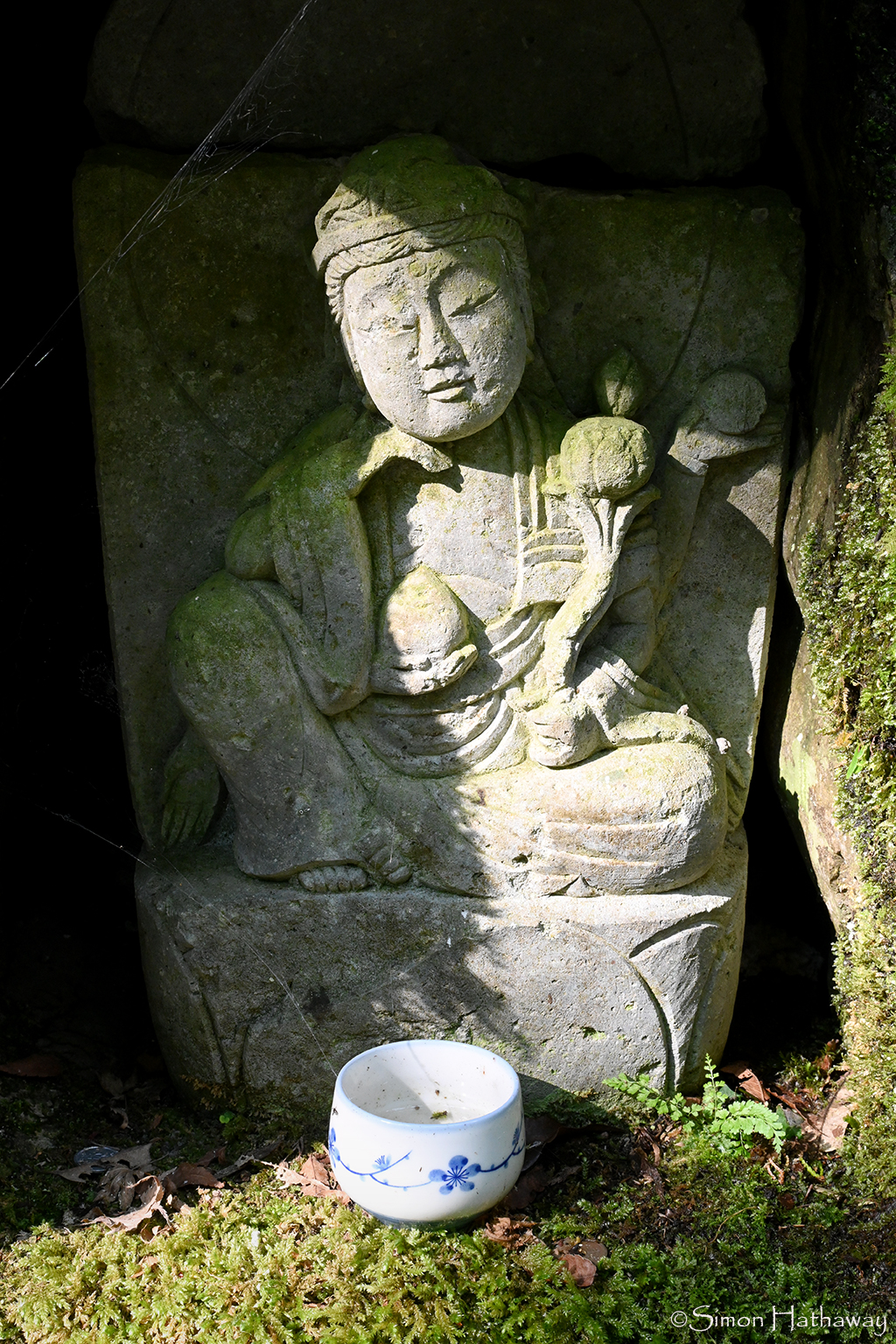
If the teacup before your eyes is rare and marvellous, you will see the Buddha.

©Boo Ahm

All writing ©Boo Ahm. All images ©Simon Hathaway