Zen

Rinzai 115

If there is change, there is also existence. Without change, there is nothing. “The Three Worlds are the mind only; The ten thousand things are but its differentiation.” This is why it is said: “Dreams and phantoms, flowers in the empty sky; why trouble yourself to seize them?”
Commentary:

‘If there is change, there is also existence. Without change, there is nothing’ means that if we discriminate, things come into being, but there is nothing if we don’t discriminate. ‘Three Worlds are the mind only; The ten thousand things are but its differentiation’ implies that the whole universe is just the product of our discrimination that is the function of our mind. So, it can be said that the ten thousand things are to the mind as countless waves are to the sea. All things are just illusions like dreams, phantoms and flowers in the empty sky created through our discrimination. This is why we don’t have to exhaust ourselves by trying to seize them.

©Boo Ahm

All writing ©Boo Ahm. All images ©Simon Hathaway

#zen #meditation #zenmeditation #enlightened #enlightenment #zenfools #photography

Zen

Q. During my meditation, I felt myself going inside, but I don’t know where I was moving to. Is this feeling just an illusion, or is it real?

A. Yes, it is just an illusion. The purpose of your meditation is to see the true-Self that is edgeless. That the true-Self is edgeless means that it has neither inside nor outside. Then, what are you going inside of? Anything with inside and outside is just an illusion.

Such phenomenon indicates that you are making illusions and are deluded by them. It happens when you miss your question, koan, or you cannot focus all your attention on your koan. Some people say they see something very holy-looking such as the Buddha or Bodhisattvas. Others say that they see something horrible such as monsters or ghosts. Whatever you may see and hear during meditation, they are all illusions created by your imagination, which are called Maras in Buddhism. You should be neither attracted by the former nor frightened by the latter. Refocus on your question if you happen to come across this situation again.

©Boo Ahm

All writing ©Boo Ahm. All images ©Simon Hathaway

#zen #meditation #zenmeditation #enlightened #enlightenment #zenfools #photography

Zen

Sansheng’s Blindness

Master Baoshou took the high seat. Zen master Sansheng pushed a monastic forward. Baoshou hit the monastic with his staff. Sansheng said, “This guidance of yours does not only blind this monastic, but it also blinds everyone in the entire city.” Baoshou threw down the staff and went back to the abbot’s room.

Student: “Why did Sansheng push a monastic forward?”

Master: “Because you are blind.”

Student: “Why did Baoshou hit the monastic?”

Master: “Because you are blind.”

Student: “Why did Sansheng say to Baoshou, ‘This guidance of yours does not only blind this monastic, but it also blinds everyone in the entire city’?”

Master: “Because you are deaf.”

Student: “Why did Baoshou throw down the staff and go back to the abbot’s room?”

Master: “Because you are blind.”

Commentary:

Masters show one but the blind see many.

Masters show something big, but the blind see many small things.

©Boo Ahm

All writing ©Boo Ahm. All images ©Simon Hathaway

#zen #meditation #zenmeditation #enlightened #enlightenment #zenfools #photography

Zen

Rinzai 114

The true student of the Way clings neither to Buddha, nor to Bodhisattvas, nor to Arhats; he clings not to anything that passes as supreme in the Three Worlds. He keeps his distance, stands alone and free, and is not bothered by things. Though heaven and earth be turned upside down, he will not be bewildered. Though all the Buddhas of the ten directions appear before him, he will not care. And if the three deepest hells suddenly gape before him, he will not be afraid. Why not? Because he sees everything as empty.

Commentary:

Realising that everything is illusionary and empty, we should not be tempted to be attached to anything even if it appears to be holy like the Buddha, Bodhisattvas, and Arhats nor should we lose our heads even though things seem to be horrible and terrible as if heaven and earth were turned upside down. All things, independent of whatever shapes they may have, are just illusions created by our imagination. In order to prevent people from being deluded by illusions, Jesus said in Corinthians 4:18, “For we fix our attention not on things that are seen, but on things that are unseen. What can be seen lasts only for a time, but what cannot be seen lasts forever.”

We should know that being attracted or scared by what can be seen is to be deluded by illusions and seeing what cannot be seen through what can be seen, by realising that what can be seen is the function of what cannot be seen, is seeing the true-Self, the true Buddha.

Student: “What is it that cannot be seen?”

Master: “It is the essence of what can be seen.”

Student: “Where is it?”

Master: “It is hidden in what can be seen.”

Student: “How can I see it?”

Master: “What have you seen so far?”

©Boo Ahm

All writing ©Boo Ahm. All images ©Simon Hathaway

#zen #meditation #zenmeditation #enlightened #enlightenment #zenfools #photography
Zen

Q. If I already know intellectually that I am the true-Self, what steps still need to be taken to become enlightened? That is, how can I know with my heart what I already know in my head?

A. Koans are the best expedients not only to check whether you really have correct intellectual knowledge of the true-Self but also to turn your intellectual knowledge into your experience. Intellectual knowledge of the true-Self is to koans as the basic explanation of arithmetic rules are to exercises in arithmetic. No matter how much basic explanation of arithmetic rules you have learnt by heart, it is of no use at all if you cannot solve the numerical calculations you face in your daily life. Strictly speaking, you cannot be said to have intellectual knowledge of arithmetic rules in this situation.

In the same way, the intellectual knowledge that you think you have is not knowledge of the true-Self but no more than a kind of hearsay of it until you have realised it through experience in person. The best way to solve your problem is to struggle with koans. That is practice.

©Boo Ahm

All writing ©Boo Ahm. All images ©Simon Hathaway

#zen #meditation #zenmeditation #enlightened #enlightenment #zenfools #photography

Zen

Changsha’s ‘Returning to Mountains, Rivers, and the Great Earth’ (2)

Zen master Changsha was once asked by a monastic, “How do you turn the mountains, rivers, and great earth into your true-Self?” Changsha said, “How do you turn the true-Self into the mountains, rivers, and great earth?”

Student: “How would you answer if you were in Master Changsha’s shoes?”

Master: (Clenches his fist.)

Student: “How would you respond if you were the monastic?”

Master: (Opens his fist.)

Commentary: 

Be watchful. The true-Self is impossible to fold and unfold.

©Boo Ahm

All writing ©Boo Ahm. All images ©Simon Hathaway

#zen #meditation #zenmeditation #enlightened #enlightenment #zenfools #photography

Zen

Rinzai 113

Followers of the Way, the true Buddha has no shape, the true Dharma has no form. You put on top of your delusion only further fantasies. Such is the way of outsiders. Though you may attain something that way, it is only the spirit of a wild fox, and not the true Buddha.

Commentary:

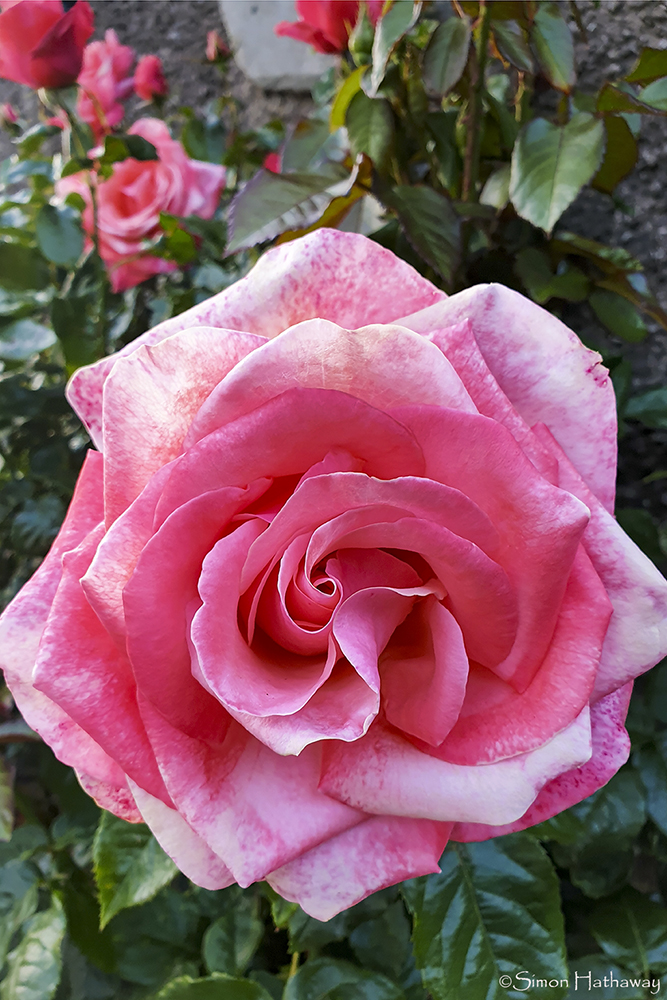
In order to help you to understand better the words ‘the true Buddha has no shape, the true Dharma has no form’ I am going to talk about what ‘having a shape’, or ‘having a from’ means. When we see things, everything has its own unique shape, by which we can recognise what it is. The word ‘rose’, for example, reminds us of a flower that often has a pleasant smell, and is usually red, pink, white, or yellow. Is there any of all the distinctive features, shapes that a rose has which is not granted by people? Whatever beautiful shapes a thing may have, however ugly its forms may be, they are not innate but given by us. A rose is a rose not because it said in the beginning, “I am a rose and I am red”, but because we named it ‘rose’ and added other labels such as red, pink, or yellow. In brief, none of the features and natures that define a thing are real and innate but are all just imaginary labels which are artificially given by people. This is why everything is said to be illusionary.

Therefore, seeing what is formless is seeing the true Buddha and trying to attain enlightenment with words and forms is no better than putting more illusions on top of your illusions and struggling to grasp mirages. The latter is called the spirit of a wild fox.

©Boo Ahm

All writing ©Boo Ahm. All images ©Simon Hathaway

#zen #meditation #zenmeditation #enlightened #enlightenment #zenfools #photography
Zen

Q. When the masters say, abandon all worldly things, what is a ‘worldly thing’?

A. We should remember that our worldly things and the true-Self are not separate from each other but identical, or that our worldly things are no other than the true-Self. The purpose of Buddhism is not to abandon worldly things but to realise that all worldly things are the true-Self and that the world we are living in at this moment is the Pure Land.

When we can see or hear things as they are, they are the true-Self. When we fail to see or hear them as they are by being deluded by the labels attached to them, they are worldly things. Don’t abandon worldly things but try to see and hear them as they are. Whether they are worldly things, or the true-Self depends upon how we see and hear them.

Student: “How can I see worldly things as the true-Self?”

Master: (Lifting a cup) “I call this a cup. Is this a worldly thing or the true-Self?”

Student: “I don’t know.”

Master: (Putting the cup down on the table) “Seeing the cup on the table is seeing a worldly thing and seeing the cup that has not left my hand is seeing the true-Self.”

©Boo Ahm

All writing ©Boo Ahm. All images ©Simon Hathaway

#zen #meditation #zenmeditation #enlightened #enlightenment #zenfools #photography
Zen

Taiyuan Fans Himself

Master Taiyuan asked his student Gushan, “Where are the nostrils you had before your parents were born?”

Gushan said, “Born right now.”

Taiyuan did not approve and said, “You ask me, and I will tell you.”

Gushan said, “Where are the nostrils you had before your parents were born?”

Taiyuan just fanned himself.

Student: “What would you say if you were asked the same question?”

Master: “They are in the face you had before your parents’ births.” 

Student: “I can make no sense of it.”

Master: “They can’t be plugged.”

Commentary:

Don’t mistake what is shown for what is explained.

©Boo Ahm

All writing ©Boo Ahm. All images ©Simon Hathaway

#zen #meditation #zenmeditation #enlightened #enlightenment #zenfools #photography

Zen

Rinzai 112

As I see it, all those supernatural powers are karmic and dependent. They are not the six supernatural powers the Buddha possessed: entering the realm of forms without being deluded by forms; entering the realm of hearing without being deluded by sounds; smelling without being deluded by smells; tasting without being deluded by tastes; touching without being deluded by touch; and of mental configurations without being deluded by mental configurations.

Therefore the six fields of form, sound, smell, taste, touch and mental configurations are all formless; they cannot bind the man of true independence. Although he is an illusionary body made of five skandhas, he is no other than the supernatural power that walks the earth.

Commentary:

‘All those supernatural powers are karmic and dependent’ means that all the supernatural powers of the Devas, Immortals, Asuras, and the Great Demons are just illusions, the products of discrimination and dependent on discrimination.  As mentioned previously, the six supernatural powers of the Buddha is the ability to see everything as empty, which means not to be deluded by what reaches our eyes, ears, nose, our tongue, skin and imagination. When we are not fooled by what we see, hear, taste, smell, feel and imagine, that is, when we have realised that everything is empty, nothing can bind us. Then, we are referred to as a man of true independence whom nothing can bind, or a man who has escaped from the yoke of karma. At that time, we realise that our illusionary bodies made of five skandhas are the true-Self itself and our actions are the six supernatural powers.

©Boo Ahm

All writing ©Boo Ahm. All images ©Simon Hathaway

#zen #meditation #zenmeditation #enlightened #enlightenment #zenfools #photography