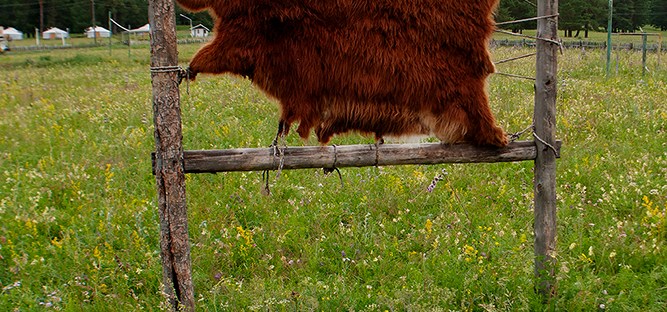
When Master Yaksan was reading a sutra, one of his students said to him, “Why do you read the sutras yourself whilst telling people not to read the sutras?” The master answered, “I am just covering my eyes.” The student asked, “May I use the sutras just as you do?” The master said, “You should see through even a cow’s hide.”
Student: “What did the master mean by ‘see through even a cow’s hide’?”
Master: “If there happens to be even a single thing you can’t see through, you can’t read the sutras.”
Commentary:
Reading the sutras is struggling with black ink and white paper if one can’t see through them from cover to cover without touching them.
“Subhuti, what do you think—can the Realised One be seen by way of the thirty-two marks?” “No, World Honoured One, the Realised One cannot be seen by way of the thirty-two marks. Why? The thirty-two marks explained by the Realised One are not marks, they are just called the thirty-two marks.”
Commentary:
This scripture says that we should not dwell on the thirty-two marks, physical characteristics that the Buddha said as expedient means. The Avatamsaka Sutra also says, “If one is not attached to the Buddha even when seeing Him, he is the one who knows the Buddha and will see the dharma of the true-Self.”
However, it doesn’t mean that we should ignore them completely but means that we should see the Realised One, the true-Self amid and through them, just as we recognise air in and through winds.
Emptiness is forms, and forms are emptiness. Both are one, dependent on each other, and one contains the other, and so one can be recognised through the other.
The historical Buddha is to the true-Self as a wind is to air. We should be able to recognise the Realised One, the true-Self, the essence of the historical Buddha through seeing his physical body, or hearing his words, just as we can recognise air through winds that are its function.
Student: “How can we recognise the Realised One if He cannot be seen by way of the thirty-two marks?”
Master: “The thirty-two marks should not be the thirty-two marks.”
A. The core of the Buddha’s teaching, as mentioned previously, is non-duality, emptiness. In other words, everything is empty. When everything is empty, everything is oneness as emptiness. Saying that we should offer our illusions to the Buddha makes no sense at all and contradicts the Buddha’s teaching, because it is to divide oneness into three: offerer, illusions, and the Buddha. Breaking oneness into many is referred to as making illusions.
Don’t be deluded by the words ‘we should remove illusions’. Not only is it impossible to remove them, no matter how hard we may try as long as we think that illusions are real, but also we can’t do without them. Illusions are not illusions in essence, but they appear to be illusions because we cannot see them as they are. In Buddhism removing illusions doesn’t mean doing away with, or moving them from one place to somewhere else unseen and far away, but means to realise that they are not illusions but the functions of the true-Self by seeing them as they are. This is why an ancient master said, “Why are you anxious to discard such precious things?” when one of his students asked how he could remove illusions.
“Subhuti, what do you think — are there many particles of dust in a billion-world universe?” Subhuti said, “Very many, World Honoured One.” “Subhuti, all those particles of dust the Realised One says are not dust, they are just called dust. The universe that the Realised One says is not the universe, but it is just called the universe.”
Commentary:
This scripture shows another example of how to see things without dwelling on images and words. By these words, the Buddha means that when he says that everything is empty, even the universe and dusts in it cannot be an exception. To quote from the Avatamsaka Sutra, it says, “If we dwell on illusions, we, having the pure eye damaged, cannot see the Buddha forever, with foolish ideas increasing.” If we dwell on illusions, the words such as dust and universe spoken by the Buddha, we cannot see the true-Self, the real Buddha, no matter how long we may struggle to see it. To introduce one more scripture from the Avatamsaka Sutra, it says, “In seeing things, if there is no seeing, it is truly seeing, and then you can see everything. If there is seeing in seeing things, you cannot see anything.”
Student: “How is it if the universe is not the universe?”
Master: “Things you see and hear are not things.”
Student: “How is it when things are not things?”
Master: “Although your eyes and ears are full, there is nothing to be seen.”
A. As noted earlier, attaining enlightenment means escaping from the net of words. Reading a lot is making the net denser by accumulating words. If enlightenment were possible to attain through reading a lot, scholars who study Buddhism would get enlightened earlier than monastics. Enlightenment is beyond intellectual, or academic understanding.
This is why it is said that Buddha Dharma is transmitted out of doctrinal teaching. You can attain knowledge by reading a lot but can’t attain enlightenment by reading a lot, just as you cannot buy time with money although you can buy a clock with money.
A monastic asked Master Boja, “When stillness comes into being, wisdom is blocked, and when thinking changes, the true-Self is changed. How is it before stillness comes into being?” The master answered, “Blocked.” The monastic said, “What blocks when stillness has not come into being yet?” The master said, “You’ve not met the man.”
Student: “Why is wisdom blocked when stillness has not come into being?”
Master: “The words ‘stillness has not come into being’ blocks it.”
“What do you think, Subhuti—is there any doctrine that the Realised One has preached?” Subhuti said to the Buddha, “World Honoured One, there is no doctrine that the Realised One has preached.”
Commentary:
The Buddha preached these words to stop people from being attached to the words of his teachings whilst they try not to dwell on anything according to his teaching.
If there is no doctrine preached by the Realised One, how should we see this sutra we are reading now?
An ancient master called Dongan left very succinct words regarding how to read the sutras. He said that if we understand the true-Self depending on the words in the sutras, we will be the enemy of the Buddha and that if we either miss or misunderstand even a single word in the sutras, the sutras will become Mara’s talk. In other words, we should not dwell on words when reading the sutras just as the Buddha told us not to dwell on anything. When we don’t dwell on words when reading the sutras, words are not words anymore. When words are not words, each single word is the function of the true-Self. In other words, when words are not words, we are above depending on words, and when each single word is the function of the true-Self, one word contains all the other words. When one word contains all the other words, we cannot miss or misunderstand even a single word because reading one word is reading all. When we face the true-Self in each word like this, it is said that we can bring dead characters back to life and that we know how to read the sutras.
When we can see and hear without dwelling on anything, we come to realise that everything around us is the grand sutra that is open all the time.
Student: “If there is no doctrine that the Realised One has preached, what is the Buddha’s teaching?”
Master: “His teaching is not words.”
Student: “What is his teaching if it is not words?”
A. Proneness to divide, to name, to define, to exaggerate, or to modify the true-Self, wittingly or unwittingly, is a natural weakness of human beings because we have been addicted to the habit of following words and forms all our lives.
The truth is that the true-Self is formless. Only try to see and hear things without attaching any words and any images, no matter how holy and wonderful they may appear and sound. This is why ancient masters would tell their students to kill the Buddha if they met him. Once you adhere to the truth that the true-Self is formless, the Buddha reveals himself naturally.
A monastic asked Master Boja, “When stillness comes into being, wisdom is blocked, and when thinking changes, the true-Self is changed. How is it before stillness comes into being?” The master answered, “Blocked.” The monastic said, “What blocks when stillness has not come into being yet?” The master said, “You’ve not met the man.”
Student: “Why is wisdom blocked when stillness comes into being?”
Master: “What comes into being, or doesn’t is not stillness but an illusion.”
Commentary:
Stillness is true stillness when it is not a word.












 Zen Fools