A. Of course he is. He said that everything, including all of us, is the Buddha. When everything is the Buddha, there is no exception. The Diamond Sutra has the answer to your question, where the Buddha said, “One who tries to see me by my voice and forms cannot see me”, and where he said to his disciples on his deathbed, “Take a close look at me. Anyone who thinks that I perish is not my student, and anyone who thinks that I don’t perish is also not my student.”
He meant that because the essence of his being had never been born, there could be no concept such as ‘die’ and ‘not die’.” In other words, his teaching is that we cannot recognise not only him but also ourselves because we are deluded by the illusion of us. If you can recognise the Buddha who didn’t die about 2,500 years ago, you can also realise the essence of your being that transcends birth and death.
Student: “How can I see the Buddha who didn’t pass away 2,500 years ago?”
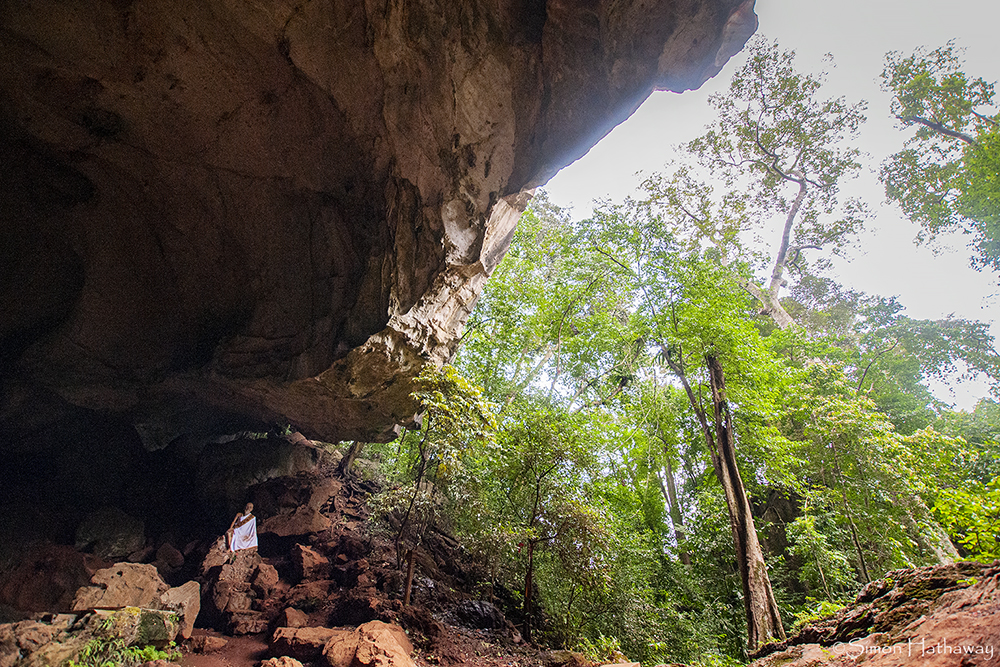
One day the Buddha was coming back from a long teaching journey. Many monks, nuns and laypeople went to meet him. Then, a nun named Lotus-colour was determined to meet him ahead of the others, including old monastics and so found her way through the congregated people by using her divine power. She was the first to see the Buddha before the others just as she had wanted. As soon as the Buddha noticed her behave in such an impolite way, he scolded her, “Why do you jump ahead of the old monastics to see me earlier than they do? Although you saw my physical body, you didn’t see my Dharma body. Rather Subhuti saw my Dharma body while sitting silently in his cave now.”
Student: “What is the Buddha’s Dharma body?”
Master: “It was in the cave where Subhuti stayed.”
Commentary:
Although it never moves at all, there is no place it doesn’t reach.
One day the Rinzai and Fuke went to a vegetarian banquet given to them by a believer. During the meal, the master asked Fuke, “‘A hair swallows the vast ocean, a mustard seed contains Mt. Sumeru’ – does this happen by means of supernatural powers, or is the essence like this?” Fuke kicked over the table. The master said, “Rough fellow.” Fuke retorted, “What place is this here to speak of rough and refined?” The next day, they went again to a vegetarian banquet. During that meal, the master asked, “Today’s fare, how does it compare with yesterday’s?” Fuke kicked over the table again. The master said, “Understand it you do – but still, you are a rough fellow.” Fuke replied, “Blind fellow, does one preach of any roughness or finesse in the Buddha-Dharma?” The master clicked his tongue.
Commentary:
In order to understand Fuke’s answer to Rinzai’s question, we should know the core meaning of Rinzai’s question above all. To rephrase Rinzai’s question, when everything is empty, not only a hair and the vast ocean but a mustard seed and Mt. Sumeru are also empty. When all of them are empty, there is no difference among them whatsoever. Rinzai asked Fuke if he knew this principle. Fuke answered by kicking over the table, which means ‘My kicking over this table is not different from a hair swallowing the vast ocean and a mustard seed containing Mt. Sumeru’. When there is no difference between a hair and the vast ocean, there cannot be any difference between being rough and being refined since all of them are just illusions.
In the realm of Emptiness, the true-Self, everything is empty and there is no concept of time such as yesterday and today. More strictly speaking, there is not only no one who can compare things but also nothing to compare. That is, there is nothing but the true-Self, Emptiness. Fuke meant, “Whatever you say and whatever happens are all the function of the true-Self” by revealing the true-Self through kicking over the table. When Rinzai responded, “You are a rough fellow” in order to test whether Fuke would be deluded by his words, Fuke nicely countered, “Blind fellow, does one preach of any roughness or finesse in the Buddha-Dharma?” Rinzai approved his answer by clicking his tongue.
Student: “Why did Fuke always kick over the table when he was questioned by Rinzai?”
Master: “In order to show what cannot be kicked over.”
A. ‘Mind is the Buddha’ is one of the most common expressions that represent Buddhism. When we say that mind is the Buddha, mind doesn’t mean the one mentioned in psychology but Emptiness that is the state free from discrimination. However, we usually have an abstract image of mind and are attached to it. That is, we are deluded by the illusion of mind.
To prevent us from clinging to the illusion of mind, masters would say that we should discard mind and become no-minded. This is why ‘no-mind’ is said to be the Buddha. In fact, the mind we refer to in Buddhism is a formless state without name, which is referred to as the Buddha, or the true-Self. So, both expressions are right.
One day the Buddha, showing a precious stone that changed colour depending on beholders, asked his students, “What colour is this?” Each of the students responded with a different colour. Then, the Buddha hid the precious stone in his sleeve and raising his hands, said, “What colour is this?” His students answered, “You don’t have the precious stone in your hands. Where can the colours be?” The Buddha said with a sigh of grief, “How can your ignorance be this deep? When I showed you a worldly precious stone, each of you produced words such as blue, orange, red, white, black and so on. However, when I show you the true precious stone, you say that you don’t know.”
Student: “What was the true precious stone that the Buddha showed?”
One day Rinzai said to Fuke, “Since I am going to spread Obaku’s teaching from now on, you should help me with what I lack.” Fuke, showing homage, retreated. When Kukbu came to see him, he repeated what he had said to Fuke. Kukbu also, showing respect, retreated. Three days later Fuke visited Rinzai again and after greeting him, asked, “What did you say to Kukbu a few days ago?” Rinzai hit him with his stick. Three days later, Kukbu came to see him again as well and after saying hello, asked, “I hear that you hit Fuke three days ago. What happened?” Rinzai hit him with his stick as well.
Commentary:
Rinzai said the same words to both Fuke and Kukbu and responded by hitting Fuke with his stick when he was asked by Fuke three days later what he had said to Kukbu. He meant that whatever he said is the function of the true-Self by revealing the true-Self. Rinzai answered Kukbu’s question ‘I hear that you hit Fuke three days ago. What happened?’ by hitting him as well. He meant that his hitting might appear to be different from his speaking, but they are the same in essence as the function of Emptiness.
Student: “Why did Rinzai only hit his disciples whenever he was asked a question?”
Master: “Because the blind have difficulty distinguishing hugging from wrestling.”
A. ‘A branch of a tree’ symbolises plausible words spoken by the Buddha and ancient masters. ‘Cliff’ implies our lives that are doomed to end sooner or later. Most people who are anxious to escape from birth and death through Buddhism tend to cling to plausible words thinking of them as lifelines to save them. Being attached to such words is not grasping the meaning of them but being deluded by them.
This is why ancient masters would say that plausible words are rather a stake to tether people who want to reach enlightenment. Only he who is not deceived by such words can attain enlightenment. The Buddha said that everything is empty. When everything is empty, not only the Buddha but His words ‘everything is empty’ are also empty.
An official, bringing some offering to Master Woongoh, asked him, “They say that the Buddha transmitted a secret remark to his first student Mahakasyapa, who didn’t conceal it. What is it?” The master called him by his official title and he answered, “Yes.” The master asked, “Do you know?” The official answered, “No, it doesn’t make any sense to me.” The master said, “If you don’t know, it is a secret remark, but if you know, it is what Mahakasyapa didn’t hide.”
Student: “What is the secret remark?”
Master: “You are speaking it.”
Student: “What is it that Mahakasyapa didn’t hide?”
Master: “You are revealing it.”
Commentary:
The true-Self is impossible to hide even from the blind and the deaf.
Rinzai asked a monk, “Where do you come from?” The monk gave a Katsu. The master made a polite bow with his hands in front and told him to sit down. The monk hesitated – then the master hit him. The master saw a monk coming. He raised his fly whisk. The monk bowed – the master hit him. Again, he saw a monk coming and again raised his fly whisk. The monk pretended not to see him. The master hit him.
Commentary:
When Rinzai tested if the monk knew the true-Self by asking, “Where do you come from?” the monk passed the first test and responded properly by revealing the true-Self through giving a Katsu. However, he couldn’t pass the more sophisticated test that Rinzai posed by inviting him to sit down whilst politely showing courtesy. When the monk was at a loss for words, Rinzai hit him as an answer and as punishment for failing to answer at the same time.
Seeing a monk coming, Rinzai tested if he knew the true-Self by raising his fly whisk. The monk answered the question by offering a bow, and Rinzai responded by hitting him. Seeing another monk coming, Rinzai tested whether he knew the true-Self by raising his fly whisk as well. The monk responded to Rinzai’s action by pretending not to see him, which was not different from offering a bow. Rinzai also responded by hitting him. It is not certain whether Rinzai approved the second and third monks by hitting them or not. What matters here is that we should grasp the meaning of Rinzai’s hitting the monks.
Student: “Why did Rinzai always respond by hitting monastics?”
Master: “Because you only saw him hitting them.”
Student: “Were the second and third monks enlightened?”
A. This means that we should stop wandering in search of the Buddha by chasing after His illusion. The Avatamsaka Sutra says that if one, seeing the Buddha, is not attracted by or attached to Him, he is the one who knows the Buddha and His Dharma. Seeing the Buddha here implies to see the illusion of the Buddha. One who is not deluded by the illusion of the Buddha is the one who knows the Buddha. The real Buddha has no given form and reveals itself in the forms of everything, everywhere, all the time. It never conceals itself and cannot be hidden even for a moment.
There is nothing that is not the Buddha. All that we see and hear is nothing but the Buddha. Even we ourselves are the Buddha and all the sounds we make are the sound of the Buddha. There is no other Buddha to be attached to than that which reaches our eyes and ears. Believing that there is another Buddha other than this is being deluded by the illusion of the Buddha. This is why it is said that when you speak or take a step, the Buddha reveals itself.







 Zen Fools