
Questions & Koans

zen

The Diamond Sutra (13)

Part 5-1

“Subhuti, what do you think—is it possible to see me, the Realised One in terms of physical characteristics?” “No, World Honoured One; it is not possible to see you, the Realised One in terms of physical characteristics.”

“Why? Because physical characteristics explained by you, the Realised One are not physical characteristics.”

Commentary:

This passage explains how we can see our true Buddha-nature.

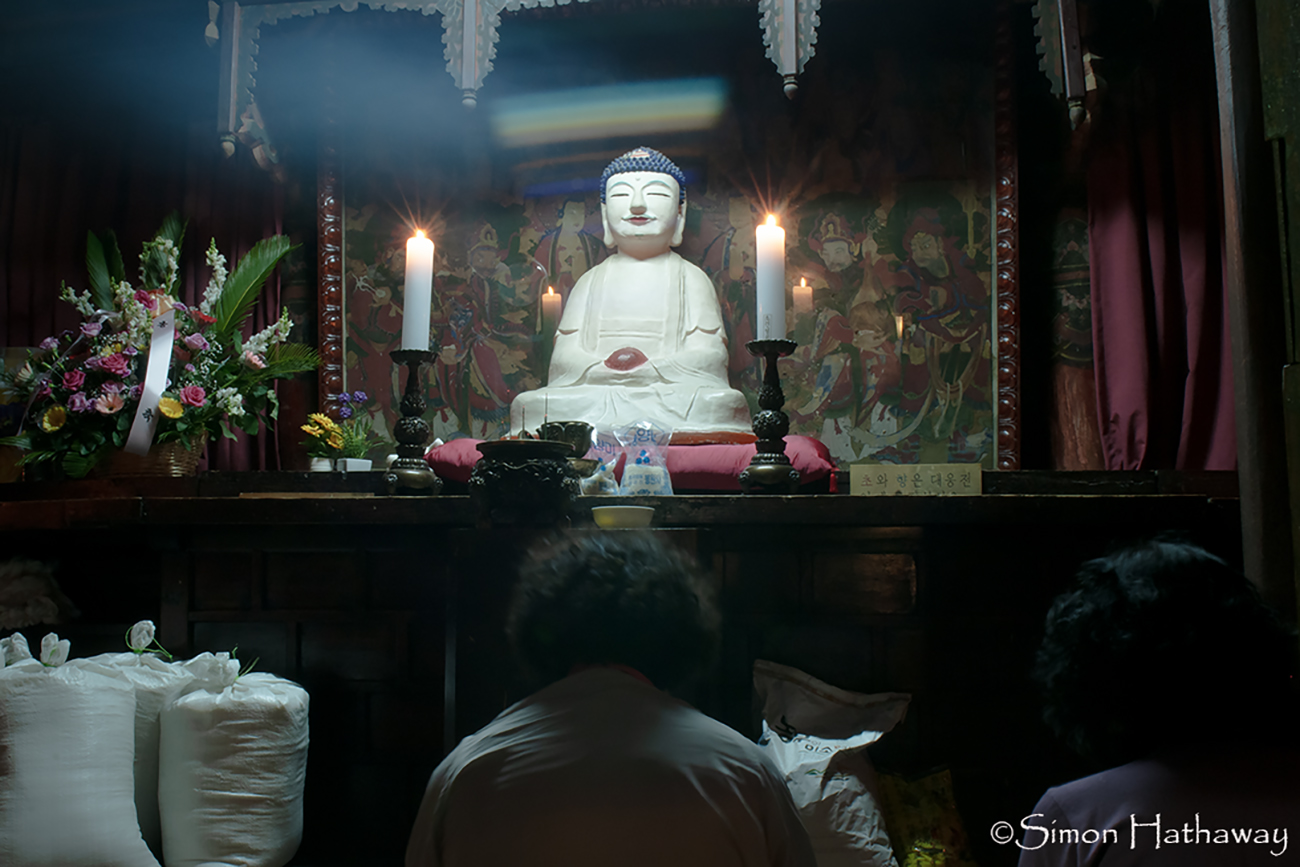
As mentioned earlier, Shakyamuni Buddha taught that those who regard the 32 physical marks and 80 minor characteristics of the Buddha as his true form cannot truly see the Buddha. This is because those physical attributes are not the reality but merely a form of illusion.

Regarding these physical characteristics as the true Buddha is to be deluded by form, images, which goes against the core of the Buddha’s teaching: “If you know that form is not form, you will see the true-Self (Tathagata).” This means that one must not dwell on any form to see the Tathagata(true-Self).

However, not clinging to the form of things does not mean ignoring it.

As taught in the phrase “Form is emptiness, emptiness is form”—meaning that form (material reality) is emptiness (the true-Self, Buddha-nature) and emptiness is form—we should understand that, just as the wind and air are one, where wind is air and air is wind, the physical form of the Buddha is one with the infinite true-Self (Emptiness). Through the Buddha’s physical form, we should be able to see the true-Self.

Just as the wind, regardless of its form, is a function of air and cannot be separated from it, and just as the cessation of wind does not mean the air disappears, our bodies, as forms, arise and cease due to causes and effects as part of Emptiness (the true-Self). Even if the wind stops, its essence, the air, remains; in the same way, though our bodies may disappear, our essence, the true-Self (Emptiness), never vanishes.

When we are deluded by forms and names, we see only the small—the form—and fail to see the great—the true-Self (Emptiness). Seeing only the historical, physical Buddha and not the original Buddha that He spoke of is called an “open secret” or “the true-Self hidden within form,” because we can’t see Him although He is revealing himself before us all the time.  The Avatamsaka Sutra admonishes such sentient beings, saying: “Even if one gazes upon the Buddha for hundreds of thousands of kalpas, if they do not rely on the true principle and see the one who saves the world as the Buddha, one clings only to form, adding to the net of foolish doubts, bound by the prison of birth and death, blind and unable to see the Buddha.”

The true form of the Buddha, as taught by the Buddha, is emptiness. This is not only the original form of the Buddha but of all of us. Realising this original form is the enlightenment that is the goal of Buddhism. When we see our existence as a physical body, birth and death are evident. However, when we see our existence as Emptiness (the true-Self), the essence of all things, there is no birth and death. Realising Emptiness is called “liberation from birth and death.”

Disciple: “Why did the historical Buddha say that the Buddha has 32 marks and 80 minor characteristics?”

Master: “One person spoke falsely, but ten thousand people heard it as truth.”

©Boo Ahm

All writing ©Boo Ahm. All images ©Simon Hathaway
zen

Q. I have studied the Sutras and practised meditation for over ten years. How long do I have to wait to attain enlightenment?

A. No one knows it. Maybe tomorrow, or this evening. What is certain is that it is not because enlightenment is sufficiently far away to be out of your reach that you cannot attain it easily. You have it in your hands all the time and are facing it at every moment.

Trying to attain enlightenment is like seeking to reach Britain while staying in London and like thinking over how to return to your home whilst sitting in your living room. If you recognise it any moment, that is the enlightenment. 

©Boo Ahm

All writing ©Boo Ahm. All images ©Simon Hathaway

zen

Linji’s True Dharma Eye (2)

When Linji was about to pass away, Sansheng was the head of the monastery. Linji addressed him, saying, “After I depart from this world, you must not let my True Dharma Eye be extinguished.” Sansheng replied, “How could I ever let the Master’s True Dharma Eye be extinguished?” Linji asked, “If someone suddenly asks you about it, what will you say?” Sansheng gave a shout. Linji said, “Who would have thought that my true Dharma Eye would vanish with this blind donkey?”

Student: “What did Linji mean by saying that his True Dharma Eye would vanish with this blind donkey?”

Master: “Why do you still have his True Dharma Eye that vanished then?”

Commentary:

What can vanish is not the True Dharma Eye.

©Boo Ahm

All writing ©Boo Ahm. All images ©Simon Hathaway
zen

The Diamond Sutra (12)

Part 4-2

“Subhuti, what do you think — is the space to the east measurable in thought?” “No, World Honoured One.”

“Subhuti, is the space to the south, or the west, or the north, or the four intermediate directions, or the zenith, or the nadir, measurable in thought?” “No, World Honoured One.”

“Subhuti, the merit of the Bodhisattvas’ practice of charity without dwelling on forms is also like this—it cannot be measured in thought.”

“Subhuti, the Bodhisattvas should live just as they are taught.”

Commentary:

What must be kept in mind is that the core of Buddhism is non-duality (Buddha-nature), meaning that everything is one. This oneness is referred to as Emptiness, Buddha, Tathagata, or Buddha-nature. Experiencing this state directly is called enlightenment, also described as “seeing the Buddha” or “reaching the Pure Land,” and it is the ultimate goal of Buddhism.

The belief that everything is separate and distinct from each other, swayed by forms and names—in other words, seeing everything only in terms of forms (images, sounds and words) and not in terms of Emptiness—is what defines the world of sentient beings, or the world of suffering. Ancient masters would say, “Calamity does not come alone.” This means that seeing everything solely as forms and not as Emptiness is the root of all suffering. Therefore, we must avoid the error of regarding giver, alms, the act of giving in charity, or merit as separate from Buddha-nature.

When practising giving in charity, one should not cling to the concepts or names of “giving” or “merit.” Only then can we realise non-duality, the Buddha-nature or Tathagata, which we seek. This is true giving in charity, leading to immeasurable merits. Giving that is bound by the names and forms of “giving” or “merit” merely constitutes good karma and differs from the true giving or merit as taught by the Buddha, which aims for enlightenment without attachment to anything. The ancient masters’ sayings, such as “Let not even the right hand know what the right hand does” or “Even good deeds are not as good as doing nothing,” all urge us to avoid clinging to anything.

Thus, the phrase “Bodhisattvas should abide as taught” means that we, as Buddhists, should not cling to images or words. We should see everything, including ourselves, as non-duality, the Buddha—and regard the place where we are as the Pure Land.

If we strive to apply this teaching to everything we see and hear in daily life, that itself is true practice. Just as true giving becomes possible when giving and Buddha-nature become one, true practice is possible when daily life and practice are not separate but one as the function of the true-Self. If you apply the Buddha’s teaching to yourself at this very moment while reading this text, you should not merely linger on the words. Instead, try to see this text and yourself as one, that is, not as a person and text, but as the functioning of the true-Self. This effort is true practice and the proper attitude for reading scriptures. When reading scriptures and practising become one as the functioning of the true-Self, that is the true practice of abiding nowhere, as taught by the Buddha.

Disciple: “What is merit?”

Master: “As long as you seek it, you cannot attain it.”

Disciple: “How can I abide as taught?”

Master: “There is nothing taught.”

©Boo Ahm

All writing ©Boo Ahm. All images ©Simon Hathaway
zen

Q. I feel as if I have to do something, but I am told that doing so is wrong. What shall I do?

A. You seem to misinterpret ‘Doing something is wrong’. How could we sustain our lives without doing anything? This is why ancient masters would say that if we understood the Sutras, or Dharma talks just through literally following words, we would become the Buddha’s enemy.

‘Doing something is wrong’ doesn’t mean that you should not do anything but that you should be aware that both you and all your deeds are empty, no matter what things you may do. In other words, you are wrong if you are entrenched in the idea that all you do, whether good, or bad, is real and not empty.

©Boo Ahm

All writing ©Boo Ahm. All images ©Simon Hathaway
zen

Linji’s True Dharma Eye (1)

When Linji was about to pass away, Sansheng was the head of the monastery. Linji addressed him, saying, “After I depart from this world, you must not let my True Dharma Eye be extinguished.” Sansheng replied, “How could I ever let the Master’s True Dharma Eye be extinguished?” Linji asked, “If someone suddenly asks you about it, what will you say?” Sansheng gave a shout. Linji said, “Who would have thought that my true Dharma Eye would vanish with this blind donkey?”

Student: “What is Linji’s True Dharma Eye?”

Master: “Linji handed it to Sansheng.”

Commentary:

A thief hands over stolen goods to his son who is also a thief. No one catches them giving and taking whilst many people are watching them.

©Boo Ahm

All writing ©Boo Ahm. All images ©Simon Hathaway
zen

The Diamond Sutra (11) – Second Commentary

Part 4-1
“Furthermore, Subhuti, the bodhisattvas should not dwell on anything when they practise charity. That is, they should not dwell on sounds, scents, flavours, feelings, or phenomena when they practise charity. Subhuti, the bodhisattvas should not dwell on forms by practising charity like this.”

“Why? Because if the bodhisattvas practise charity without dwelling on forms, the merits are inconceivable.”

Commentary:
As already emphasised, the teaching “Do not dwell on anything” is so central that it can be considered the very core of Buddhism. This means that when we encounter things, people, or experiences, we should perceive them without attaching words that discern their identities, forms, or conceptual labels—such as form, sound, smell, taste, touch, or mental constructs. In other words, we must see and hear everything as it truly is without distortion.

This is why, when practising charity, if we do so without dwelling on anything—seeing things clearly, as they are, without conceptual distinctions—then the one giving is not a fixed ‘self’, the one receiving is not a separate ‘other’, and the object given is not a fixed ‘thing’. All three—giver, receiver, and gift—become undivided as one; simply the functioning of the true-Self.

In this state, giving is no longer ‘giving’ in the ordinary sense, but the function of the true-Self. This is the true practice of charity, or perfect alms. If even a trace of thought remains such as “I am giving”, then it means one is still clinging to the idea of giving, which is not true alms, but simply an action that produces karmic merit—not the boundless merit of formless alms.

The essence of true giving is that, while practising generosity, one sees all things—including oneself as the functions of the true-Self—without dwelling on form, sound, smell, taste, touch, dharmas. This allows the act to manifest as a pure expression of the true-Self.

The Avataṃsaka Sūtra (Flower Garland Sutra) says:
“Sentient beings, when they perceive all things, are swayed by forms and names. They do not know that things have no fixed form, and thus they cannot see the Buddha.”

In other words, not dwelling on anything—not just when giving, but in every moment of life—is the greatest merit for a Buddhist. Why? Because it is to see the Buddha, which means to realise the truth that oneself is Buddha. That is why it’s said that the merit of giving without dwelling on forms is immeasurable.

Disciple: “What happens when we no longer dwell on forms?”
Master: “To answer is to abide.”
Disciple: “Then what is merit?”
Master: “To speak it is to break it.”

©Boo Ahm

All writing ©Boo Ahm. All images ©Simon Hathaway

zen

If everything is empty and there is nothing to gain or lose, why is it said that all the Buddhas of the past have attained enlightenment?


Enlightenment is to realise that everything is empty and there is nothing to gain or lose. Prior to enlightenment, there are enlightenment, an aim to achieve through practice and ‘I’ who tries to attain it, but after enlightenment there is no one who will attain enlightenment and no enlightenment to attain because everything is empty.

Only after enlightenment can we know this truth. This is why it is said that all the Buddhas of the past have attained enlightenment.

©Boo Ahm

All writing ©Boo Ahm. All images ©Simon Hathaway
zen

The World-Honoured One’s enlightenment (1)

The World-Honoured One saw the morning star and attained enlightenment.
He stated:
“Through the star, I got enlightened,
But upon attaining enlightenment,
I saw it was not truly a star.
I do not follow after things,
Nor am I without denying them.”

Student: “What did the Buddha realise upon attaining enlightenment?” Master: “It was there even before the star came into existence.”

Commentary:
Enlightenment is to see what we, while facing it all the time, have missed so far.

©Boo Ahm

All writing ©Boo Ahm. All images ©Simon Hathaway
zen

The Diamond Sutra (10) – Second Commentary

Part 3
The Buddha said to Subhuti, “The bodhisattvas should surrender their minds thus: All kinds of sentient beings—be they born from eggs, born from wombs, born from moisture, or born from transmutation, be they material, immaterial, thinking or non-thinking, or neither thinking nor non-thinking, — I shall have them all enter perfect nirvana without remainder and thus liberate them all. Although I liberate innumerable, countless, infinite sentient beings, not a single sentient being is liberated in fact.”

“Why not? Subhuti, if the bodhisattvas have images of self, images of person, images of a being, images of a liver of life, they are not bodhisattvas.”

Commentary:
In this context, “all sentient beings” refers not only to living creatures but also to inanimate things like stones and pieces of wood. Other than the Buddha, nothing lies outside the realm of sentient beings. People often say it’s difficult enough to help even humans—beings we can communicate with—attain enlightenment. So how is it possible to lead all the sentient beings mentioned above to enlightenment, many of whom cannot even communicate with us? There is a saying: “When I attain enlightenment, the whole universe is enlightened along with me”. To attain enlightenment means not being deluded by forms or words—it means seeing and hearing all things just as they are. This way of seeing is referred to as seeing things as empty.

Now, “emptiness” doesn’t mean voidness. It means a state free from all conceptual discrimination. It’s such a complete and indescribable state that even opening one’s mouth to speak about it causes distortion. Calling it “sacred” would be to defile it. It is this unspeakable, perfect clarity that is also known as the true-Self, Buddha-nature, Tathāgata, nonduality, nirvāṇa, or the Pure Land. To see all things as empty is to see the Buddha; to reach this state is to enter nirvāṇa.

When enlightenment is attained, all conceptual distinctions fall away: there is no more one who attains nirvāṇa, no object of nirvāṇa, no sentient beings, no Buddhas, no self, no other. All sentient beings—including oneself and the entire universe—are seen as not separate, but one. This is what the expression “Throughout heaven and earth, I alone am the honoured one” refers to the realisation of nonduality and the state of Buddhahood.

Thus, when the sutra says, “I shall liberate all incalculable, innumerable, and boundless sentient beings,” it doesn’t mean changing the sentient beings themselves, but changing the way we see them—seeing them not as sentient beings but as Buddhas. This is why the Buddha said, “If a bodhisattva has images of self, images of person, images of sentient beings, or images of a liver of life, then he is not a true bodhisattva.” In short, to lead all sentient beings to nirvāṇa by liberating them from illusions doesn’t mean to transform them, but to perceive them rightly, as they truly are— the functions of the true-Self.

The various types of beings—those born from eggs, from wombs, from moisture, or spontaneously; beings with form or without form; beings with thought, without thought, or neither with nor without thought—are distinctions we make when we fail to see them as they really are. In true vision, these are all nothing but the functions of the true-Self.

That’s why ancient masters would say, “When I was deluded, even the Buddha or Maitreya seemed foolish. But now that I’ve attained enlightenment, even a cat or a white ox appears wise.” It is our own enlightenment that liberates all beings. And this is why the Buddha said, even though countless sentient beings are liberated, not a single sentient being has truly been liberated—because in the ultimate view of the enlightened, there are no beings to be liberated.

Disciple: “How should I liberate sentient beings?”
Master: “Don’t waste time liberating sentient beings that don’t exist—just serve the Buddha in front of you well.”
Disciple: “What is the Buddha in front of me?”
Master: “What? Say that again.”
Disciple: “What is the Buddha in front of me?”
Master: “I’m not deaf.”

©Boo Ahm

All writing ©Boo Ahm. All images ©Simon Hathaway