Questions & Koans

Zen

The Diamond Sutra (58)

Part 15-1

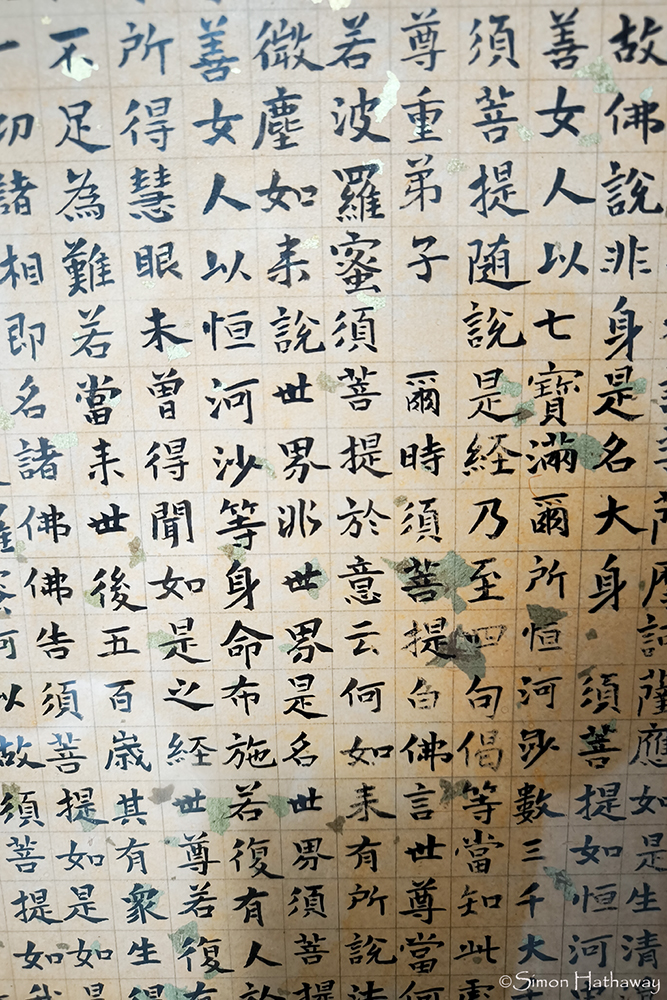
“Subhuti, suppose there are good men and good women who in the morning give in charity as many bodies as there are grains of sand in the Ganges River, then in the afternoon again give in charity as many bodies as there are grains of sand in the Ganges River, and then in the evening also give in charity as many bodies as there are grains of sand in the Ganges River, and go on giving bodies in charity this way for countless hundreds of thousands of myriads of millions of eons. Now suppose there are people who hear this Sutra, believe in it, and do not oppose it. The blessings of these latter people surpass those of the former; how much the more so if they copy the sutra, accept and hold it, read and recite it, and explain it to others!”
Commentary:

As mentioned a few times in the preceding parts, the core of Buddhism is to see things as they are and do things without one’s mind dwelling on anything.

This part means that people who, unable to see things as they are, do things with their minds dwelling on what they see and hear, might build up good karma that is to come to a halt someday, but they cannot attain enlightenment, the final goal of Buddhism through which they can enjoy eternity, no matter how many good things they may do.

In contrast, those who, seeing things as they are, can do everything without their minds dwelling on it, through this Sutra, can attain enlightenment and can enjoy permanent blessings.

This is why the blessings of these latter people surpass those of the former.

The key point of this part is that doing many good things with one’s mind dwelling on what one does is not as good as doing an ordinary thing without one’s mind dwelling on what one does. This doesn’t mean that we should not give things in charity but that we should give things in charity without our minds dwelling on anything.

In the same way, reading this Sutra countless times with one’s mind dwelling on words is not as good as reading a single word without one’s mind dwelling on it.

©Boo Ahm

All writing ©Boo Ahm. All images ©Simon Hathaway

Zen

Q. How do you accept the impermanence of life in Buddhism?

A. Buddhism says that permanence and impermanence of everything depends upon our perspective. Buddhism sees all things as waves in the ocean and the essence of the things as the ocean. Each wave has its own life span, size, shape, and is impermanent, but its essence is one as water and permanent. Every wave is impermanent, but water is permanent. Seeing your life as a wave, it is impermanent, but seeing it as water in the ocean, it is permanent. The purpose of Buddhism is to help people to realise the permanent aspect of their lives.

This is why ancient masters would say that all the countless things are different from each other, and nothing is the same as any other thing, but at the same time, all things are the same, and nothing is different from any other thing.

Student: “What is impermanent?”

Master: “A flower.”

Student: “What is permanent?”

Master: “A flower.”

©Boo Ahm

All writing ©Boo Ahm. All images ©Simon Hathaway

Zen

Caoshan’s “Love Between Parent and Child” (3)

Caoshan was once asked by a monastic, “A child went back to her parent. Why didn’t the parent pay attention to her?” Caoshan said, “It is quite natural just like that.” The monastic said, “Then where is the love between parent and child?” Caoshan said, “The love between parent and child.” The monastic said, “What is the love between parent and child?” Caoshan said, “It cannot be split apart, even when hit with an axe.”

Student: “A child went back to her parent. Why didn’t the parent pay attention to her?”

Master: “Because you can’t perceive it.”

Student: “How does the parent pay attention to her?”

Master: “Nothing and no one can harm her.”

Commentary:

A lost child cannot feel loved until he turns back to his parent.

©Boo AhmAll writing ©Boo Ahm. All images ©Simon Hathaway

Zen

The Diamond Sutra (57)

Part 14-15

“Subhuti, if Bodhisattvas perform acts of charity with their minds dwelling on things, they are similar to people who have gone into darkness and can see nothing.” “If Bodhisattvas perform acts of charity with their minds not dwelling on things, they are like people with sight in the sun­light, seeing all sorts of shapes things.” “Subhuti, in the future, if there are good men and good women who are able to accept and hold this sutra, read and recite it. the Realised One will know and see all of these people by means of the Buddha’s wisdom; all of them will achieve infinite, boundless merits.”

Commentary:

‘Doing something with one’s mind dwelling on things’ means being unable to see things as they are and being deluded by illusions, or forms and words when one does something. No matter how many acts of charity you may perform, although the acts of charity may be worth praising morally and help to build up good karma, they are nothing to do with true merit, enlightenment if you perform such acts with your mind dwelling on things.

On the contrary, doing something without one’s mind dwelling on things signifies seeing things as they are, that is, seeing things as the Buddha. Being able to accept and hold this Sutra, reading and reciting it implies that this Sutra leads people to do things without their minds dwelling on things. ‘The Realised One will know and see all of these people who are able to accept and hold this sutra, read and recite it, by means of the Buddha’s wisdom’ means that all of these people will attain enlightenment, the Buddha’s wisdom. This is to achieve infinite, boundless merits.

Student: “How can I achieve infinite, boundless merits?”

Master: “Read this Sutra without your mind dwelling on words.”

©Boo Ahm

All writing ©Boo Ahm. All images ©Simon Hathaway
Zen

Q. How can I train my mind to be stronger than my emotion so that I don’t lose myself?

A. You should not think that your mind is separate from your emotions. You should know that your mind, your emotions and yourself are one. As long as you are entrenched in the thought that they are different from each other and try to make your mind stronger than your emotions, you cannot achieve your goal no matter how hard you may try.

All you have to do, to escape from being swayed by your emotions and losing yourself, is to realise what the root is from which they come. When you realise what the root is, you become aware that all things, including them, are essentially the same just as all waves in the ocean that appear different from each other are essentially one as water in the ocean. Then, you can’t lose yourself even for a moment, and your emotions turns out to be beautiful things to make you happy, not obstacles to overcome.

©Boo Ahm

All writing ©Boo Ahm. All images ©Simon Hathaway
Zen

Caoshan’s “Love Between Parent and Child” (2)

Caoshan was once asked by a monastic, “A child went back to her parent. Why didn’t the parent pay attention to her?” Caoshan said, “It is quite natural just like that.” The monastic said, “Then where is the love between parent and child?” Caoshan said, “The love between parent and child.” The monastic said, “What is the love between parent and child?” Caoshan said, “It cannot be split apart, even when hit with an axe.”

Student: “When did the child come back to the parent?”

Master: “The child has never left the parent’s breast.”

Student: “Why can’t the love between parent and child be split apart even with an axe?”

Master: “Because there is no love since there is no between them.”

Commentary:

Love is not love, it is just called as such.

©Boo Ahm

All writing ©Boo Ahm. All images ©Simon Hathaway
Zen

The Diamond Sutra (56)

Part 14-14

“Subhuti, the Dharma obtained by the Realised One is neither real nor unreal.”

Commentary:

The Dharma obtained by the Realised One means the true-Self realised by the Realised One. The Dharma, the true-Self cannot be obtained, or lost, firstly because it is formless and nameless and secondly because we are the Dharma itself. We cannot obtain the Dharma any more than we can obtain the universe.

In fact, the Dharma, whilst including all without exception, is the state so free from illusions that it is beyond description and admits of no words such as real and unreal.

Student: “What is the Dharma obtained by the Buddha?”

Master: “Answering your question is distorting it.”

©Boo Ahm

All writing ©Boo Ahm. All images ©Simon Hathaway

Zen

The Buddha said, “Better than a thousand hollow words, is one word that brings peace.” What is the one word that brings peace?

There is no distinction between one word that brings peace and hollow words. In fact, what matters is that although every single word brings peace, we cannot enjoy the peace because we cannot recognise it. The point is not what one word that brings peace is but how we can discern and enjoy the peace that every word brings.

According to the Buddha’s teaching, we should hear every word as it is without being deluded by the illusion of it. In other words, you should hear all words not as words but just as the function of the universe that is one with you. Then, you come to realise that all words, from others, or from ourselves, are your own words, which are referred to as words that bring peace.

Student: “What is a word that brings peace?”

Master: “You have already said it.” 

©Boo AhmAll writing ©Boo Ahm. All images ©Simon Hathaway
Zen

All the Universe is in This (2)

When Master Haesan visited Master Tooja, Master Tooja, handing a cup of tea to Haesan, said, “All the universe is in this.” On receiving it, Haesan, pouring the tea out of the cup, asked, “Where is all the universe now?” Master Tooja said, “A cup of tea is wasted.”

Student: “Where is all the universe when Haesan poured the tea out of the cup?”

Master: “Haesan showed it.”

Student: “If Haesan showed it, why did Tooja say that a cup of tea was wasted?”

Master: “Because you don’t see it.”

Commentary:

Trying to see the universe beyond what is seen and heard is like trying to find a rabbit horn.

©Boo Ahm

All writing ©Boo Ahm. All images ©Simon Hathaway
Zen

The Diamond Sutra (55)

Part 14-13

“Subhuti, the Realised One is one who speaks genuinely, one who speaks truly, one who speaks as it is, one who speaks without deception, one who speaks without contradiction.”

Commentary:

What matters here is how we can hear and comprehend what the Buddha, the Realised One speaks genuinely. As I have said that the Buddha is not enlightened until we get enlightened, the Buddha speaks genuinely only when we can hear genuinely. No matter how genuinely the Buddha preaches, his words cannot be genuine words but rather Mara’s words unless we can accept them genuinely.

In order to apprehend his Dharma talk, we, keeping his words ‘Not a word did I say’ in mind, should not be deluded by words. Instead, we should see and hear each of his words as the function of the true-Self. When we can see and hear each of his words as the function of the true-Self, we can realise that all, including ourselves, what we see and hear is the same as each of his words, as the function of the true-Self. Only when we can hear and see everything as such can we hear the Buddha’s genuine words genuinely.

Student: “What are the words the Buddha spoke genuinely?”

Master: “Not words.”

©Boo Ahm

All writing ©Boo Ahm. All images ©Simon Hathaway