A. Frankly speaking, I don’t think I can give you a correct answer because I have not either had or studied any other religion for as long as I have had Buddhism. To the best of my knowledge, all religions worship gods although they pray at different places to different gods on different days, or dates in different ways.
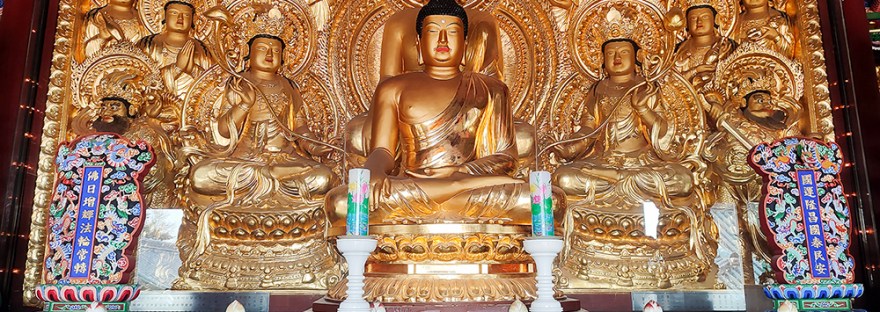
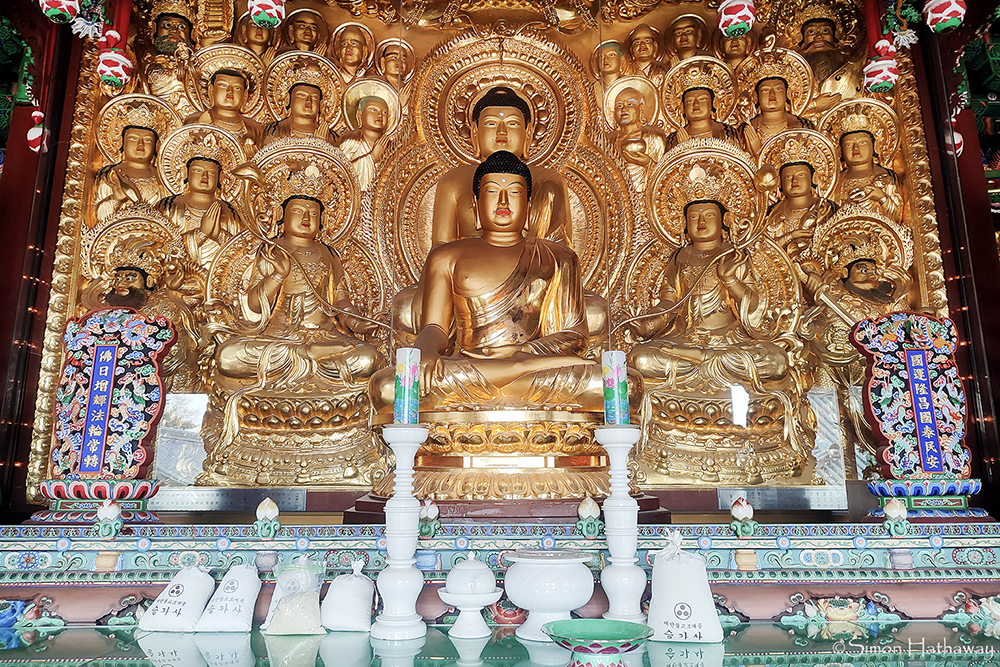
However, Buddhism has no god to worship, or pray to, although Buddha statues in temples may cause people to think that Buddhism worships the Buddha as its god. In fact, it is not for the purpose of worshipping but in honour of the historical Buddha as a great teacher that temples have Buddha statues. Buddhism is not a religion that worships and prays to a god for happiness and an eternal life but a religion that leads people to realise that everything, including themselves, is a perfect being.
“Once upon a time, Nam-jeon asked a lecturer monk, “What sutra do you teach?” And the lecturer replied, “I lecture on the Future Buddha Sutra” Then, Nam-jeon asked, “When will the Future Buddha come?” The lecturer replied, “At present he is in Heaven, but he will come soon.” Then Nam-jeon said, “There is no Future Buddha in heaven, and there is no Future Buddha under the earth.”
Student: “Where is the Future Buddha if he is neither in heaven nor under the earth?”
Master: “He is in the future.”
Commentary:
The Buddha is the Future Buddha until you see him.
“Subhuti, by way of analogy, if a person’s body is as large as Mount Sumeru, what do you think? Would you say that his body is large?” Subhuti said, “It is very large, World Honoured One, because the Buddha called that which is not a body the large body.”
Commentary:
Mount Sumeru is the most grandiose mountain in the countless worlds that symbolises the centre of the universe in Buddhism. We should understand why the Buddha said that a person’s body is as large as Mount Sumeru.
As mentioned in Part 10-4, when we don’t dwell on anything, or when we see and hear things as they are without being deluded by words, there is not a single word even though our eyes and ears are full of light and sound. When there is not a word in our seeing and hearing, there is not a single thing even though our eyes and ears are full. That there is not a thing in our seeing and hearing means to see and hear things like dreams just as the Buddha told us to at the end of this Sutra.
Then, a person’s body is not a person’s body, and Mount Sumeru is not Mount Sumeru, but they are just illusionary images like dreams. In other words, seeing everything like a dream is compared to seeing everything like a rabbit-horn that is not real but illusionary. There is no difference between a large rabbit-horn and a small one, although they appear to be different from each other, since they are not real but imaginary. In the same way, when we don’t dwell on anything, there is no difference between a person’s body and Mount Sumeru because both of them are no more than rabbit-horns. This is why the Buddha called that which is not a body the large body, and why ancient masters would say that we should be able to put Mount Sumeru into a mustard seed.
A. Every effect has its own cause. There is no effect without cause. Even a cause is also an effect of other causes. Everything is cause and effect at the same time. It follows that our birth is also an effect of causes we made, although we don’t remember what they are, and is simultaneously a cause for another effect.
Then, can we say that a person doesn’t choose to be born if his birth is the result of the causes he made previously? If his life doesn’t happen to be a life that he wants, it sounds more reasonable to say that he made a wrong choice, rather than say that he didn’t choose to be born.
Baizhang was asked by Yunyan, “Master, you work on details all day. Who are you doing it for?” Baizhang said, “There may be someone who requires it.” Yunyan said, “Why don’t you let that person take care of it?”
Baizhang said, “Because that person may not have the means of making a livelihood.”
Student: “Why doesn’t the person have the means of making a livelihood?”
Master: “Because all people take care of him.”
Student: “What happens if we don’t take care of him?”
Master: “He never cares.”
Commentary:
When a servant doesn’t serve his master well, the consequence will eventually come back to haunt the servant.
“They (Bodhisattvas) should raise the mind without dwelling on anything.”
Commentary:
This is one of the scriptures best known as the core of this Sutra. Let me give you an easier and more detailed explanation regarding not dwelling on anything.
What would happen if there were no words at all? All that reaches our eyes and ears would appear to be one that is nameless, changeless, boundless and formless. It would be perfection itself. In fact, the word ‘perfection’ may not be suitable to depict it, not only because it is also a word created by our imagination, but also because there would be nothing to compare with it. Nothing would happen in this state. It follows from this that in such a state there are no birth, no ageing, no illness and no death since there is nobody to go through such things.
That is actually the foundation, the source and the root of everything, and there is nothing beyond this. This is referred to as the true-Self, Emptiness, Oneness, the Buddha, the Pure land.
We sentient beings break the Oneness into many with words such as the sky, the earth, the universe, human beings, a tree, a bird and so forth. The reason why there are countless things, including the sky, the earth, human beings, a tree, bird, and the universe, is that we have broken Oneness into many with words. All the countless things created with words are called forms in Buddhism. The realm of form refers to the mundane world, which is full of a host of things, occurrences and endless change, including birth, ageing, illness and death. In fact, nothing, good, or bad, can happen unless we divide, or break Oneness into many, that is, unless we classify what reaches our eyes and ears with words. This is why the Buddha said that everything is created in our minds.
However, none of the words mentioned above are real, innate, or intrinsic but artificial, extrinsic and imaginary. The sky has never said that it is the sky, and no tree has never said, “I am a tree. Call me a tree.” The sky is the sky because we named it sky, and a tree is a tree only because we named it tree and imagine it as such. In fact, there is nothing at all such as a tree, the sky and the like. They are not real but imaginary forms. This is why the Buddha said that we can see the true-Self if we see things just like dreams and why an ancient master said that even if we recite the word ‘fire’ hundreds of times, it never burns our lips.
Dwelling on things means to look upon such imaginary forms and names as substantive, that is, to see things only as different and separate from each other without realising that they are essentially one, Emptiness. This is referred to as being deluded by illusions, words.
So, ‘They should raise the mind without dwelling on anything’ means that although we use numerous words when seeing and hearing things, we, not deluded by the words attached to them, should be able to see and hear them in both ways; as many, forms and as Oneness at the same time. This is to see many as one, to see forms as Emptiness, and to see things as the Buddha. When we can see things in this way, it can be said that we divide Oneness into many, and when we cannot see things in both ways like this, it can be said that we break Oneness into many just as if we broke it by mistake against our will.
When we divide Oneness into many, they are not conflicting with each other, no matter how many pieces it is divided into, because we can reassemble them into Oneness, the original form easily at any time. When we break it into many, they are always at odds with each other, because we don’t know how to put them back together. This is why ancient masters, when explaining the way of seeing things, advised that we should chew a thing well but should not break it so that we may enjoy its flavour fully.
Student: “How can I stop dwelling on things?”
Master: “Don’t be deluded by words.”
Student: “How is it when we are not deluded by words?”
Master: “A stone woman gave birth to a baby.”
Student: “It doesn’t make any sense. Why do you talk such nonsense?”
A. The core of Buddhism is to realise that we, as perfect beings, are one with the Buddha. Being protected by the Buddha means realising that we are one with all other things as Emptiness, the true-Self, that is, we are always surrounded and protected by the true-Self, the Buddha. There is nothing but the true-Self and nothing to inflict harm upon us. Whether we are protected by the Buddha or not depends on whether or not we realise that we are one with the Buddha.
It is not because the Buddha is prejudiced but because the Bodhisattvas have realised they are one with the Buddha whilst sentient beings haven’t that the Buddha protects the Bodhisattvas well.
One day Master Jojoo asked a kitchen-steward monk who was in charge of cooking vegetables, “Do we eat raw vegetables or cooked ones today?” The kitchen-steward monk picked up some of them and showed them to the master.
Student: “What did the kitchen-steward monk mean by showing the master some of the vegetables?”
Master: “He showed the best food which we can avoid hunger with for the rest of our lives at a bite.”
Commentary:
We never pass a day without having the best food, but it doesn’t work for us because we don’t digest it.
“For this reason, Subhuti, all Bodhisattvas should have a mind that is pure and clear like this, and should not have a mind that dwells on forms; they should not have a mind that dwells on sound, scent, flavour and touch, or Dharma.”
Commentary:
Bodhisattvas are not separate from the true-Self but are the functions of the true-Self. All of us are essentially Bodhisattvas but we are confused into thinking that we are sentient beings because we have a mind that dwells on forms, that is, because we, being deluded by forms, cannot see things as they are. Therefore, the Buddha said that all Bodhisattvas should have a mind that is pure and clear.
A pure and clear mind that doesn’t dwell on forms; sound, scent, flavour and touch, or Dharma implies a mind that is not deluded by illusions; forms and sounds. When we have a pure and clear mind, that is, when we are free from being deluded by illusions, we are said to have reached the Pure land that is free from birth, ageing, illness and death. We should know that the Pure land, or the true-Self is not so far away that it takes untold effort and time to reach. In the same way that the Avatamsaka Sutra says sentient beings cannot see the Buddha because they, not aware that things are essentially formless, are swayed by forms when they see things, we sentient beings are striving to reach the Pure land which we are already in, or to see the true-Self that is always before and with us, because we have a mind that dwells on forms and sounds.
Once a young monastic asked his master what the Pure land was like. The master said that it doesn’t have a single blade of grass. When the young monastic asked how he could go there, the master answered that he would be wrong even if he moved a single step.
Here ‘a single blade of grass’ implies a single illusion, and the thought that he should go somewhere else to reach the Pure land is also an illusion.
A. Wisdom in Buddhism signifies the ability to see things as they are without being deluded by illusions, that is, the realisation that everything is empty.
He who has the wisdom to see and hear things as they are, is referred to as a man who has transcended birth and death because he sees them just as illusions, or as an idle person with no work to do since he sees whatever he does as empty. So, a life of wisdom means a peaceful and stable life free from the fear and worries that we sentient beings encounter in our lives.








 Zen Fools