Questions & Koans

Zen

The Diamond Sutra (28)

Part 9-2

“Subhuti, what do you think—can a saint entertain the thought, ‘I have attained sainthood’?”

Subhuti said, “No, World Honoured One. Why? There is no state called sainthood. World Honoured One, if saints were to entertain the notion, ‘I have attained saint­hood,’ that would be fixation on the image of self, the image of person, the image of sentient being, and the image of spirit.”

“World Honoured One, you say I have attained absorption in non-contention better than anyone else, and I am the saint most detached from desire. However, I do not entertain the thought that I am a saint detached from desire.”
Commentary:

A true saint, aware that everything is empty, is so freed from being deluded by any images that he is far from having not only the thought of having attained sainthood but also that of being detached from desire. When we can see everything as it is without being deluded by images and words, there is nothing that is not empty. This means that there is nothing that is not the true-Self when seen as it is. That is, the difference between the true-Self and illusions is determined by our perspectives. Sainthood and the Buddha are no more than illusions when we are deluded by their names and images. Even greed and desire are the true-Self when seen as they are. We should know that illusions are not different from the true-Self, and Mara is not separate from the Buddha. When we can see things as they are, everything is the Buddha, whilst everything is an illusion when we are deluded by images and words. This is why it is said that illusions are no other than enlightenment and why ancient masters would say that we should kill the Buddha and regard the Buddha and Patriarchs’ words as an enemy.

Student: “If we kill the Buddha, how can we see the Buddha?”

Master: “What can be killed is not the Buddha.”

©Boo Ahm

All writing ©Boo Ahm. All images ©Simon Hathaway

Zen

Q. If everything is empty, is it also empty to have an amour with a person other than one’s spouse?

A. When everything is empty, there is no exception at all. From the moral perspective, an amour may be undesirable and blameworthy, but it is undeniable that it is also empty from the Buddhist perspective. However, it doesn’t mean that morality is unimportant and negligible. It is so indispensable for keeping our societies stable that everyone should comply with the morals of the society he belongs to regardless of his religion.

It means that morality is quite different from religion. The former always changes and differs depending on the times and culture. What couldn’t be accepted morally in the past can be common and even popular in our society today. Until some years ago, for example, adultery was often treated as a kind of crime, but nowadays such criminalisation is abolished in most countries. However, the latter signifies unchangeable truth; everything is empty.

In other words, whatever we may do is the function of the universe regardless of whether it is moral, or immoral. The first Patriarch Bodhidharma, when asked if a butcher whose job was to violate the first precept against killing could attain enlightenment, answered, “Once one has realised that everything is empty, one is beyond karma even if one kills living things.” This signifies that from the Buddhist perspective, everything, even killing, is empty without exception.

©Boo Ahm

All writing ©Boo Ahm. All images ©Simon Hathaway
Zen

Sosan’s ‘A phrase beyond right and wrong’

A monastic asked Master Sosan, “Is there a phrase beyond right and wrong?” The master answered, “Yes, there is.” The monastic said, “What is it?” The master said, “A patch of isolated cloud never reveals its ugly appearance.”

Student: “Why is ‘A patch of isolated cloud never reveals its ugly appearance’ a phrase beyond right and wrong?”

Master: “Because it is formless.”

Student: “A patch of isolated cloud is a form as well.”

Master: “What you see is a distorted ugly appearance.”

Commentary:

A phrase beyond right and wrong appears ugly due to your eye disease.

©Boo Ahm

All writing ©Boo Ahm. All images ©Simon Hathaway

Zen

The Diamond Sutra (27)

Part 9-1

“Subhuti, what do you think—can a stream-enterer think, ‘I have attained the fruition of stream-entering’?” Subhuti said, “No, World Honoured One. Why? A stream-enterer is called one who enters the stream, yet does not enter anything. One does not enter form, sound, scent, flavour, feeling, or phenomena—this is called a stream- enterer.” “Subhuti, what do you think—can a once-returner entertain the thought, ‘I have attained the fruition of once-returning’?” Subhuti said, “No, World Honoured One. Why? A once-returner is called one who goes and comes back once, but really has no going or coming—this is called once-returning.” “Subhuti, what do you think—can a non-returner entertain the thought, ‘I have attained the fruition of non-return’?” Subhuti said, “No, World Honoured One. A non-returner is called one who does not come back, yet in reality there is no return, and that is the reason for the name non-returner.”

Commentary:

The primary principle of the Buddha’s teaching is that the essence of everything, ourselves included, is empty.

‘Stream-enterer’, ‘once-returner’ and ‘non-returner’ are names representing the degree of practice that was given to the Buddha’s disciples according to how ripe their practice was. How ripe their practice was depended on how deeply they understood Emptiness, that is, how good they were at seeing and hearing things as they are without being deluded by illusions.

When everything is seen and heard as it is, or when everything is empty, there is nothing to enter, nowhere to go to and come from, and even no thought of no return. If a stream-enterer, for example, believing that there is a fixed stage of practice called ‘stream-enterer’, had thought that he achieved it, he would not have been a stream-enterer but no better than an ordinary person who was deluded by the illusion of ‘stream-enterer’.

That is why Subhuti said that a stream-enterer does not enter anything, that a once-returner really has no going or coming and that a non-returner is called one who does not come back, yet in reality there is no return.

So, ancient masters would say that there is the Buddha to see, Dharma teaching to learn and enlightenment to attain before you get enlightened, but that there is no Buddha to see, no Dharma teaching to learn and no enlightenment to attain after you get enlightened.

Student: “If everything is empty and there is no enlightenment to attain, why do we have to strive to attain enlightenment?”

Master: “Because you are deluded by illusions, words.”

©Boo Ahm

All writing ©Boo Ahm. All images ©Simon Hathaway

Zen

Q. What is the meaning of ‘Lust and greed are all Buddhas’ mother. All Buddhas are children of lust and greed’?

A. When we say that everything is empty, it means that lust and greed are also empty. Saying that lust and greed are also empty implies that lust and greed are also the Buddha since Emptiness is another name of the Buddha. Lust and greed are not different and separate from the Buddha, but they are one and inseparable from each other.

It can be said that lust and greed contain the Buddha and that the Buddha is hidden in lust and greed. This is why it is said that lust and greed are all Buddhas’ mother. When they are seen and heard as they are, they appear and sound as the Buddha. So, once upon a time when a monastic asked his master how he could remove his lust and greed, the master answered, “Why do you want to discard such a good thing?”

©Boo Ahm

All writing ©Boo Ahm. All images ©Simon Hathaway

Zen

Guishan Brings a Mirror (2)

When Yangshan was abbot of a monastery at Donping, Guishan sent a letter and a mirror to him. During his talk in the dharma hall, Yangshan received the letter, held up the mirror, and said to the assembly, “Guishan has sent a mirror. Tell me, is this Guishan’s mirror or Yangshan’s mirror? If you say it’s Yangshan’s mirror, I say Guishan sent it. If you say it’s Guishan’s mirror, I say it’s in Yangshan’s hand. If you can say a word, I will keep it. If you can’t say a word, I will destroy it.”

Yangshan said this three times. No one in the assembly responded, and Yangshan struck the mirror.

Student: “Why did Yangshan destroy the mirror?”

Master: “In order to let the assembly know the owner of the mirror.”

Student: “Who in the world is the owner?”

Master: “He never speaks.”

Commentary:

It is not a king but his people who quarrel about the ownership of land.

©Boo Ahm

All writing ©Boo Ahm. All images ©Simon Hathaway

Zen

The Diamond Sutra (26)

Part 8-3

“Subhuti, that which is called Buddha Dharma is not Buddha Dharma.”

Commentary:

‘That which is called Buddha Dharma is not Buddha Dharma’ signifies that Buddha Dharma is just a name, an imaginary label created by people and not the essence of it, because it is originally nameless, boundless and formless. It is changeless since it is formless. It has no beginning and no end because it is changeless and boundless. This is why it is referred to as eternity itself and perfection itself. There is nothing that doesn’t belong to it because it is boundless. For this reason, in Buddhism, it is said that everything is equal as the Buddha and that the Buddha is everywhere all the time.

Seen from this perspective, what is called a flower is essentially not a flower. It is a flower because we named it a flower and blooms and withers because we think it does. This is why the historical Buddha said that everything is an illusion created by our minds.

So, seeing what is changeless, nameless and boundless when we see things is seeing the Buddha. He who can see in this way can see the Buddha all the time. This is why a Bodhisattva in the Avatamsaka Sutra said, “Whenever I want to see the Buddha, I can see Him anytime. However, never does He come to me, nor do I go to Him.”

Student: “What is Buddha Dharma?”

Master: “No one can hide it.”

Student: “Why don’t you show it to me if no one can hide it?”

Master: “Showing it is rather hiding it.”

©Boo Ahm

All writing ©Boo Ahm. All images ©Simon Hathaway
Zen

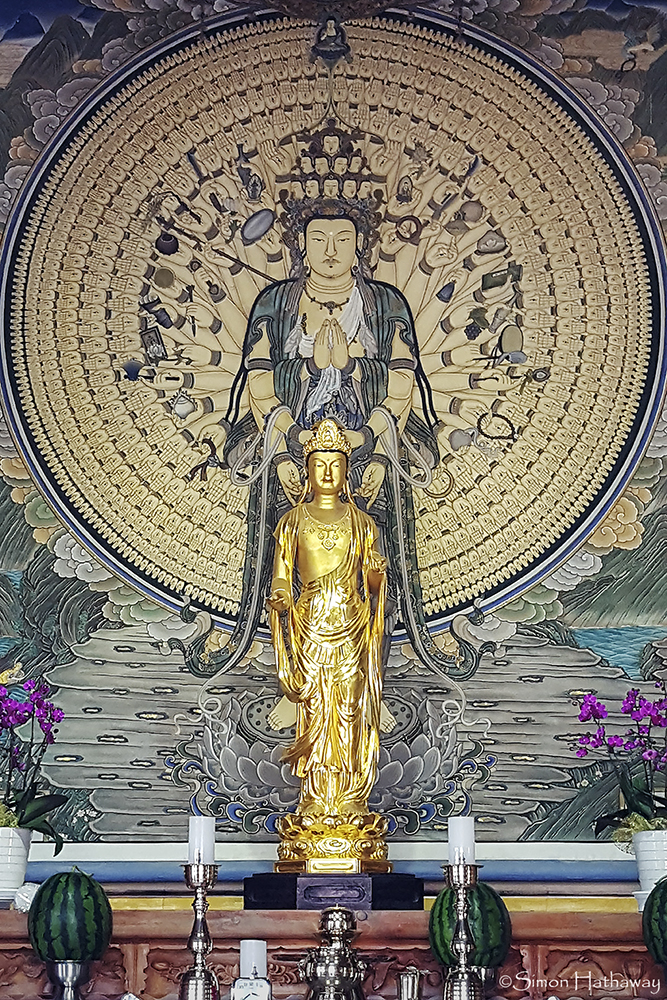
Q. What is the meaning of ‘If one, seeing the Buddha, has no mind to be near him, this one is one who, knowing the Buddha, sees the true Dharma’ in the Avatamsaka Sutra?

A. The Buddha is the state in which everything is one. In this state everyone is at one with everything as the Buddha. If someone sees the Buddha and wants to approach him, he is not seeing the Buddha but being deluded by an illusion of the Buddha.

What you can be close to, or far away from, is not the Buddha. No matter how hard you may push him away, you cannot be separated from it. No matter how hard you may pull him, it never becomes closer to you because there is no other Buddha than yourself and because the Buddha is formless. This is why the wise who see the true Dharma, the true-Self that is the true-Buddha are never tempted to follow the Buddha nor are they scared away by Mara.

©Boo Ahm All writing ©Boo Ahm. All images ©Simon Hathaway
Zen

Even if I get my tongue cut out, I can’t violate what the nation prohibits. (3)

When a monk asked Master Sukshang, “What’s the meaning of the Patriarch’s coming from the west?”, the master clapped his teeth. The monk didn’t make sense of the meaning and asked Master Goobong, “What’s the meaning of the master’s clapping his teeth?” after Master Sukshang passed away. Goobong said, “Even if I get my tongue cut out, I can’t violate what the nation prohibits.”

Student: “Why did the master clap his teeth?”

Master: “Because of toothache.”

Student: “What is it that the nation prohibits?”

Master: “It prohibits people from breaking one into many.”

Student: “What happens when we violate the national law?”

Master: “We cannot avoid illness and death.”

Student: “Did the master have toothache because he violated the national law?”

Master: “No, you have it.”

Commentary:

One with earache is liable to take praise for blame.

©Boo Ahm

All writing ©Boo Ahm. All images ©Simon Hathaway

Zen

The Diamond Sutra (25)

Part 8-2

“Why? Subhuti, it’s because all the Buddhas, and the Dharma of unexcelled complete perfect enlightenment of all the Buddhas, come from this Sutra.”

Commentary:

This Sutra here, as mentioned earlier, doesn’t mean the text made of words on paper but Emptiness, the true-Self. This is why all the Buddhas and the perfect enlightenment of all the Buddhas come from this Sutra. The point is how to recognise and read the Sutra. Everyone has this Sutra, which is shared by all sentient beings and the Buddha. This Sutra explains everything exactly. We can’t put it down even for a moment, and it is open before us all the time and is as readable in a dark place as it is in a light place. The wise can read this Sutra at midnight without any light while the foolish can’t read it even in broad daylight. Enlightenment can be referred to as the ability to read this Sutra.

Student: “Where is this Sutra from?”

Master: “I am very sorry I cannot tell it to you.”

©Boo Ahm

All writing ©Boo Ahm. All images ©Simon Hathaway