Questions & Koans

Zen

The Diamond Sutra (7) – Second Commentary

Part 2-1
At that time the venerable Subhuti was in the assembly. He rose from his seat, uncovered his right shoulder, knelt on his right knee, joined his palms together in respect, and said to the Buddha, “It is rare and marvellous, Buddha. You always have the Bodhisattvas in mind, protect them well and entrust them well with the Dharma.”

Commentary:
Here, we must deeply contemplate what Subhūti saw and why he expressed such awe and reverence toward the Buddha—even though the Buddha had not spoken a single word. Subhūti had seen the true-Self, the Tathāgata, the true essence of the Buddha that the Buddha had always sought to reveal to his disciples. He called it “rare and marvellous” because the true-Self is utterly free from defilements, beyond worldly conception, and perfect in a way that is extremely difficult to recognise with an ordinary, worldly perspective. This is why the ancient masters warned that no matter how beautifully or nobly someone may describe the Tathāgata (or the true-Self), such words inevitably fall short—or worse, may even defile it. Anyone who understands Subhūti’s words must also recognise that Subhūti’s own act of reverence was itself rare and marvellous as well.

Disciple: “What is it that is rare and marvellous?”
Master: “The Buddha showed it, and now you are showing it too.”
Disciple: “What is it?”
Master: “It is the most common and abundant.”
Disciple: “Why is it called rare if it is so common and abundant?”
Master: “Because many seek it, but few ever see it.”
Disciple: “Then what exactly is it?”
Master: “Come alone tomorrow, and I’ll tell you.”

“He protects all Bodhisattvas well” means the Buddha is not showing favouritism by guarding only Bodhisattvas. In truth, everything is always within the Buddha—the Tathāgata—and nothing can ever be outside of it. Just as no form can escape emptiness, no being can escape the embrace of the Buddha. Bodhisattvas who realise this know they are always protected within the field of the Tathāgata and thus are free from harm. Sentient beings who do not realise this live lives filled with anxiety and illusions. This is why, in the Lotus Sutra, the Buddha compared sentient beings to a rich man’s son who, not knowing his father is the wealthiest man in the world, lives the life of a beggar.

Disciple: “How does the Buddha protect the Bodhisattvas?”
Master: “They cannot leave his embrace.”
Disciple: “How can I enter the Buddha’s embrace?”
Master: “Don’t take a single step.”

“He entrusts the Dharma well to the bodhisattvas” means the Buddha guides Bodhisattvas to enlightenment and thereby transforms them into Tathāgatas like himself. He entrusts them not just with preaching the Dharma, but with embodying the Dharma—so that their every action and word is indistinguishable from the Buddha’s own. The aim of Buddhism is not to worship the Buddha, but to realise that we ourselves are the Buddha. This is how we truly repay the Buddha’s grace.

Disciple: “How does he entrust the Dharma to the Bodhisattvas?”
Master: “He helps them realise there is nothing to entrust.”

Just as the historical Buddha did, we must come to see that our friends, families, neighbours, and coworkers are constantly revealing something rare and marvellous. Not only they, but we ourselves are the Dharma—we are the Tathāgata, the Buddha. This is what Śākyamuni Buddha strove to help people awaken to.

What is rare and marvellous?
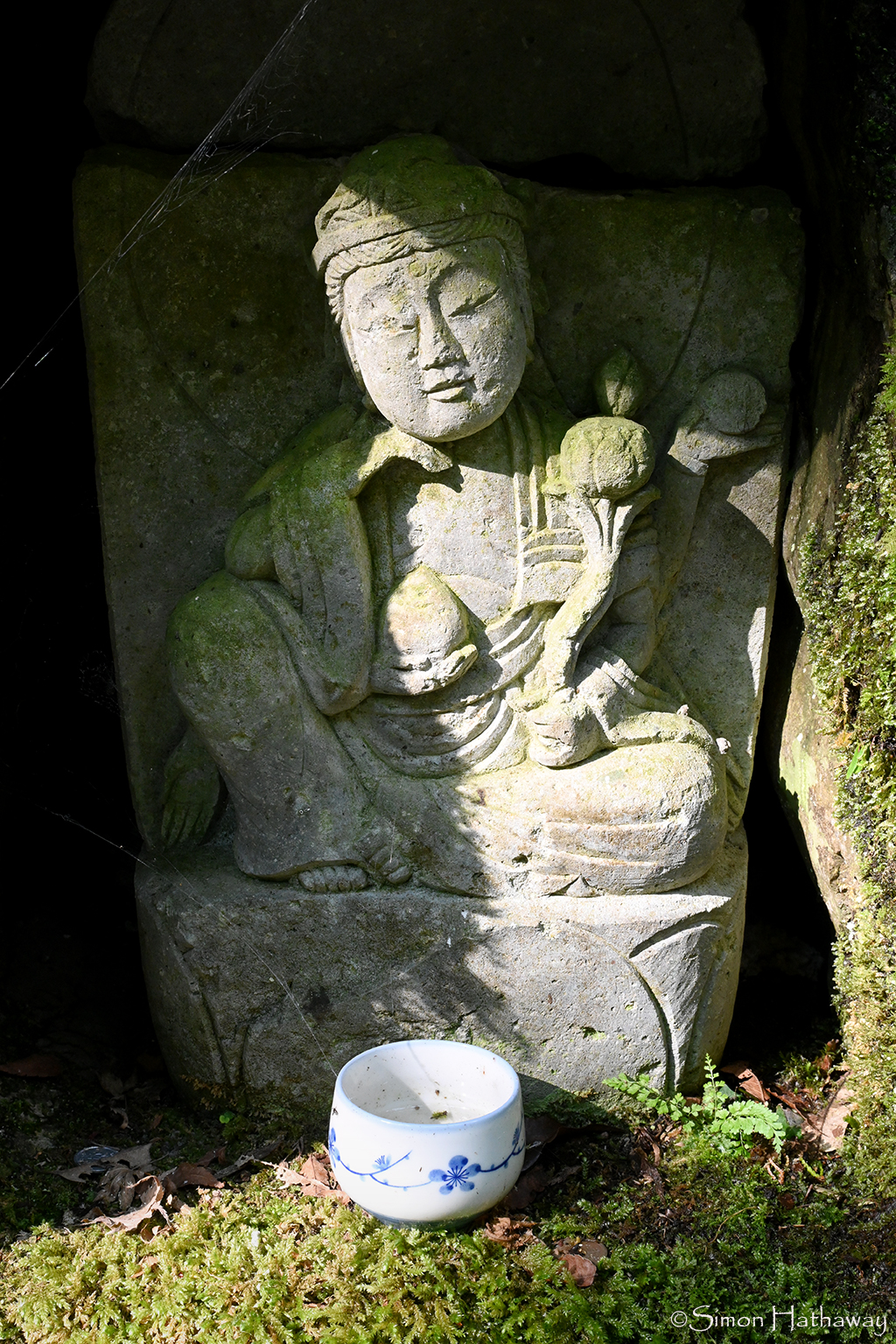
If the teacup before your eyes is rare and marvellous, you will see the Buddha.

©Boo Ahm

All writing ©Boo Ahm. All images ©Simon Hathaway

Zen

How can we know that there is no mind?

‘There is no mind’ doesn’t mean that there is no mind but that there is no specific thing called mind that has a certain form because there is nothing that is not mind.

Mind is formless but contains everything. So, we should know that there is only mind instead of ‘there is no mind’.

©Boo Ahm

All writing ©Boo Ahm. All images ©Simon Hathaway

Zen

The World-Honoured One’s enlightenment (2)

The World-Honoured One saw the morning star and attained enlightenment.

He stated:
“Through the star, I got enlightened,
But upon attaining enlightenment,
I saw it was not truly a star.
I do not follow things,
Nor am I without denying them.”

Student: “What is it if it is not a star?”
Master: “No one knows what it is, but everything is the function of it.”

Commentary:
When a star is not a star, we are not human beings as well.

©Boo Ahm

All writing ©Boo Ahm. All images ©Simon Hathaway

Zen

The Diamond Sutra (6) – Second Commentary

Part 1-6
Upon finishing his begging, he returned to his dwelling and ate. He put away his robe and bowl, washed his feet, laid down a mat, and sat on it.

Commentary:
Whatever action the Buddha performed, its purpose was always to guide people towards realising the true-Self. Even seemingly simple acts—folding his robe, placing his alms bowl aside, washing his feet, laying out his seat, and sitting on it—were no exception.

There was once a monk who had practised under a renowned master for many years. He felt frustrated, believing that the master had never given him any teachings, and repeatedly asked for instruction. Each time, the master promised he would teach him, yet his demeanour and actions never changed. Over time, the master never offered any explicit guidance the disciple expected, and eventually, the monk’s patience wore thin. One day, the monk said to the master, “For over ten years I’ve been by your side, asking for teachings. You always said you would teach me, but in all that time you’ve never truly given me any instruction. I’ve decided to leave and seek another teacher.” The master solemnly replied, “How dare you say I haven’t taught you anything? When you brought me meals, I ate them and taught you as I ate. When you brewed me tea, I drank it and taught you as I drank. What I’ve shown you—nothing else—is the teaching.” But the monk, still failing to grasp the master’s intention, remained firm in his decision to leave. As he turned to go, the master called out to him. The monk turned his head, and the master said, “There is nothing beyond this.” In that moment, the monk awakened.

This story reveals that just as the historical Buddha taught through his simple acts—folding his robe, sitting on a mat—the great master was teaching the monk through ordinary actions like eating and drinking tea, each revealing Buddha-nature. After ten years, the young monk finally saw what had always been in front of him.

From this, we understand that every action the Buddha performed—from putting on his robe to sitting down—was itself a profound teaching. In truth, we are all constantly showing one another the true-Self, but fail to recognise it. The Buddha always felt sorry that sentient beings failed to recognise the true-Self whilst facing it all the time.

Disciple: “What did the young monk see in the master’s actions?”
Master: “It is still seen even now.”
Disciple: “What is it?”
Master: “I’m tired today. Come back tomorrow.”

Do not blame what is hidden.
If your eyes are sharp,
it is clearly revealed, even at midnight.
If your eyes are blind,
you cannot see it, even in broad daylight.

©Boo Ahm

All writing ©Boo Ahm. All images ©Simon Hathaway
Zen

It is said that the true-Self is revealed — why, then, can’t we see it?

It is not because it is unseen but because we can’t recognise it whilst seeing it. The true-Self is non-duality that is formless and nameless. We have divided it into countless pieces according to forms by using countless words and covered it with names, words.

We have been so addicted to forms and words that we always see the classified and named surface and fail to see the original non-duality. This is why ancient masters would say that we should not be deluded by words and see and hear things without attaching any names, or words.

©Boo Ahm

All writing ©Boo Ahm. All images ©Simon Hathaway

Zen

Before The World-Honoured One’s leaving Tusita Heaven (2)

The World-Honoured One had already been born in the royal palace before leaving Tusita Heaven, and even before emerging from his mother’s womb, he had already delivered all sentient beings in the world.Student: “Where is the Buddha now?”
Master: “He is still in Tusita Heaven.”

Commentary:
Not only the Buddha but all sentient beings have never left Tusita Heaven.

©Boo Ahm

All writing ©Boo Ahm. All images ©Simon Hathaway

Zen

The Diamond Sutra (5) – Second Commentary

Part 1-5
When mealtime came one day, the Buddha put on his robe, picked up his rice bowl, and went to the city of Sravasti to beg for alms. As he begged, he visited each home within the city in turn.

Commentary:
The story of the Buddha going out for alms is as ordinary and common as people going to the market or preparing a meal. This signifies that the Buddha’s teaching is not found in some extraordinary place, but within the simple and everyday acts of daily life.

In Chapter 29 of this sutra, the Buddha tells his disciples: “If someone says that the Tathāgata comes or goes, sits or lies down, that person does not understand the teaching I have given. Why? Because the Tathāgata neither comes from anywhere nor goes anywhere. That is why he is called the Tathāgata.” This means that we must be able to recognise the Buddha-nature—the Tathāgata—that neither comes nor goes, neither sits nor lies—within the Buddha’s seemingly ordinary, everyday actions.

There is a dialogue between the Buddha and his disciple Ānanda that illustrates how we should interpret this teaching of the Buddha.

One day, as the time for alms-round approached, the Buddha said to Ānanda, “When you go for alms, follow the path of the Seven Buddhas of the past.”
Ānanda asked, “What is the path of the Seven Buddhas of the past?”
The Buddha simply said, “Ānanda.”
Ānanda replied, “Yes, Master.”
The Buddha then said, “Go and beg for alms.”

Through this brief exchange, the Buddha was not only revealing the Tathāgata (Buddha-nature) to Ānanda, but also instructing him to never cease his effort to recognise the Tathāgata, even while on his alms-round. In truth, since all things and all beings possess the same Buddha-nature, we must learn to see the Tathāgata not only in the Buddha’s actions but also in our own and our neighbours’ everyday lives. This is what it means to see and hear all things just as they are—with complete clarity. To train ourselves to see and hear in this way is the essence of Zen practice.

Disciple: “Master, what does the Buddha mean when he says, ‘Go and beg for alms’?”
Master: “When a wealthy man sends his child out to beg, his intention is not in the begging itself.”
Disciple: “Then what is his intention?”
Master: “To teach his child how to manage the wealth that he will one day inherit.”
Disciple: “And what is that wealth?”
Master: “Bring me a cup of tea.”

The Buddha who begged for alms 2,500 years ago— who can now offer him food today?

©Boo Ahm

All writing ©Boo Ahm. All images ©Simon Hathaway

Zen

Why does the Buddha have nothing to uphold, or violate?

The Buddha that symbolises the enlightened is aware that everything is empty just like dreams. For him, everything, including himself, is one as Emptiness.

In the state of Emptiness, there is no ‘I’ to obey, or violate precepts, no sin to commit and no virtue to uphold. If he happens to have anything to keep, or discard, he can’t be referred to as the Buddha.

©Boo Ahm

All writing ©Boo Ahm. All images ©Simon Hathaway

Zen

Master Yeomgwan’s Buffalo Horn Fan (1)

One day, Master Yeomgwan called his attendant and said, “Bring me the buffalo horn fan.”
The attendant replied, “The fan is completely broken.”
The master then said, “If the fan is broken, bring the buffalo to me.”
The attendant had no response.

Student: “What is the buffalo fan?”
Master: “It can blow fiery heat away by fanning once.”

Commentary:
All people have it, but few can use it.

©Boo Ahm

All writing ©Boo Ahm. All images ©Simon Hathaway
Zen

The Diamond Sutra (4) – Second Commentary

Part 1-4
Thus did I hear. One time, the Buddha was staying in Jeta Grove in Sravasti, residing with 1,250 great monks.

Commentary:
As mentioned earlier, “to hear in this way” means to listen to things as they truly are (in their suchness). Let me explain a bit more about “seeing and hearing things as they are.”

Suppose I hand you a cup filled with something and say, “Drink this as it is.” How would you drink it to truly follow my instruction?

Naturally, you would drink it without adding anything like sugar or salt, and without removing any of its original contents.

Likewise, when I say to see and hear things as they are, it means to perceive things without attaching any words, including names—those imaginary labels we use to describe the form, or define the identity of what we see and hear. These labels are neither innate nor essential; they are artificial and external, created by humans.

For example, a flower was not a flower until we called it so. It never declared, “I am a flower; call me a flower.” Nor did it ever mention its colour or size, yet we arbitrarily attach labels like “flower”, “red”, “yellow”, “pink”, “big”, or “small”.

When you hear in this way—that is, when you see and hear everything as it truly is, unswayed by forms or words—all distinctions between things vanish, and all things become nameless. This is called non-duality, Buddha-nature, or emptiness. In this state, there is only non-duality, only Buddha-nature, and everything seen by the eyes or heard by the ears is merely a manifestation of Buddha-nature.

When you see and hear in such truth, reading a sentence like, “At one time, the Buddha was staying at the Jetavana monastery in Śrāvastī, together with twelve hundred and fifty great monks,” allows you to feel the Buddha-nature in every single word. This is not merely reading a historical account of the Buddha but directly encountering the Buddha. It is not just picking up black beans from white paper but reading the sutras in their truest sense.

Do not forsake the Buddha right before your eyes while chasing the Buddha who dwelt in Śrāvastī’s Jetavana monastery 2,500 years ago.

Disciple: “What is the Buddha before me?”
Master: “To answer would be to diminish not only you but myself as well.”

©Boo Ahm

All writing ©Boo Ahm. All images ©Simon Hathaway