
Part 13-3
“What do you think, Subhuti—is there any doctrine that the Realised One has preached?” Subhuti said to the Buddha, “World Honoured One, there is no doctrine that the Realised One has preached.”
Commentary:
The purpose of the Buddha’s preaching was to reveal the formless and nameless true-Self through the expedient means of words. Our purpose in reading the scriptures must align with this: to see the essence of our existence —the true-Self (Buddha-nature, Emptiness, Buddha).
However, sentient beings have a long-standing habit of clinging to words and forms. If the Buddha says, “All things are empty,” they cling to the phrase ‘all things are empty’. If he says, “Do not cling,” they cling to the command ‘do not cling’. Knowing this, in the preceding section (parts 13-1, 2), the Buddha warned his disciples not to be deceived by his expedient words, saying, “The Perfect Wisdom that the Buddha himself speaks of is not Perfect Wisdom; it is merely named Perfect Wisdom.” Following this, he spoke even more forcefully, stating that he has never taught any Dharma at all.
If we take the text literally and believe there is no Dharma taught, how should we view the Sutra we are reading now? If we simply accept ‘there is no Dharma taught’ as a factual statement, we are once again being deceived by words.
The Avatamsaka Sutra says, “By vainly discriminating the Dharma explained in words with meagre wisdom, obstacles arise, and one fails to know their own mind.” Ancient masters also said, “The words of the Buddha cannot be engraved on paper or stone.” In short, the Buddha spoke words that are not words to reveal the true-Self that cannot be captured in writing. If sentient beings try to understand this through discrimination based on shallow intellectual knowledge, they will ultimately fail to understand.
Bodhidharma once said, “If you know that words are not words, then speaking all day long is the Way. But for those who follow words, even a whole day of silence is not the Way.” This means that whether you are reading the Sutra, or living your daily life, you must see every word and phrase as the functioning of the true-Self. If you can see and hear this way, you will see the Buddha in every word and phrase of the Sutra. Furthermore, you will realise that everything you see and hear—including your own speech and every sound you create—is the functioning of the true-Self.
When this happens, you cannot help but see the true-Self at every moment, everywhere; you cannot avoid it even if you try.
Thus, Bodhidharma said:
When one knows, the Dharma follows the person.
When one does not know, the person follows the Dharma.
When the Dharma follows the person, even what is not Dharma becomes Dharma.
When the person follows the Dharma, even the Dharma becomes non-Dharma.
When the person follows the Dharma, all Dharma is false.
When the Dharma follows the person, all Dharma is true.
He further warned that reading the Sutras while only following the words without knowing this principle is useless by saying, “If you do not see your own true-Self, there is no benefit in chanting the Buddha’s name, reciting Sutras, performing rituals, or keeping the precepts.”
Disciple: “If there is no Dharma taught by the Buddha, what is the Buddha’s teaching?”
Master: “His teaching is not words.”
Disciple: “If it is not words, then what is it?”
Master: “It is not difficult to tell you, but I fear you will misinterpret it.”
Disciple: “Please tell me.”
Master: “His teaching is words.”
Koan:
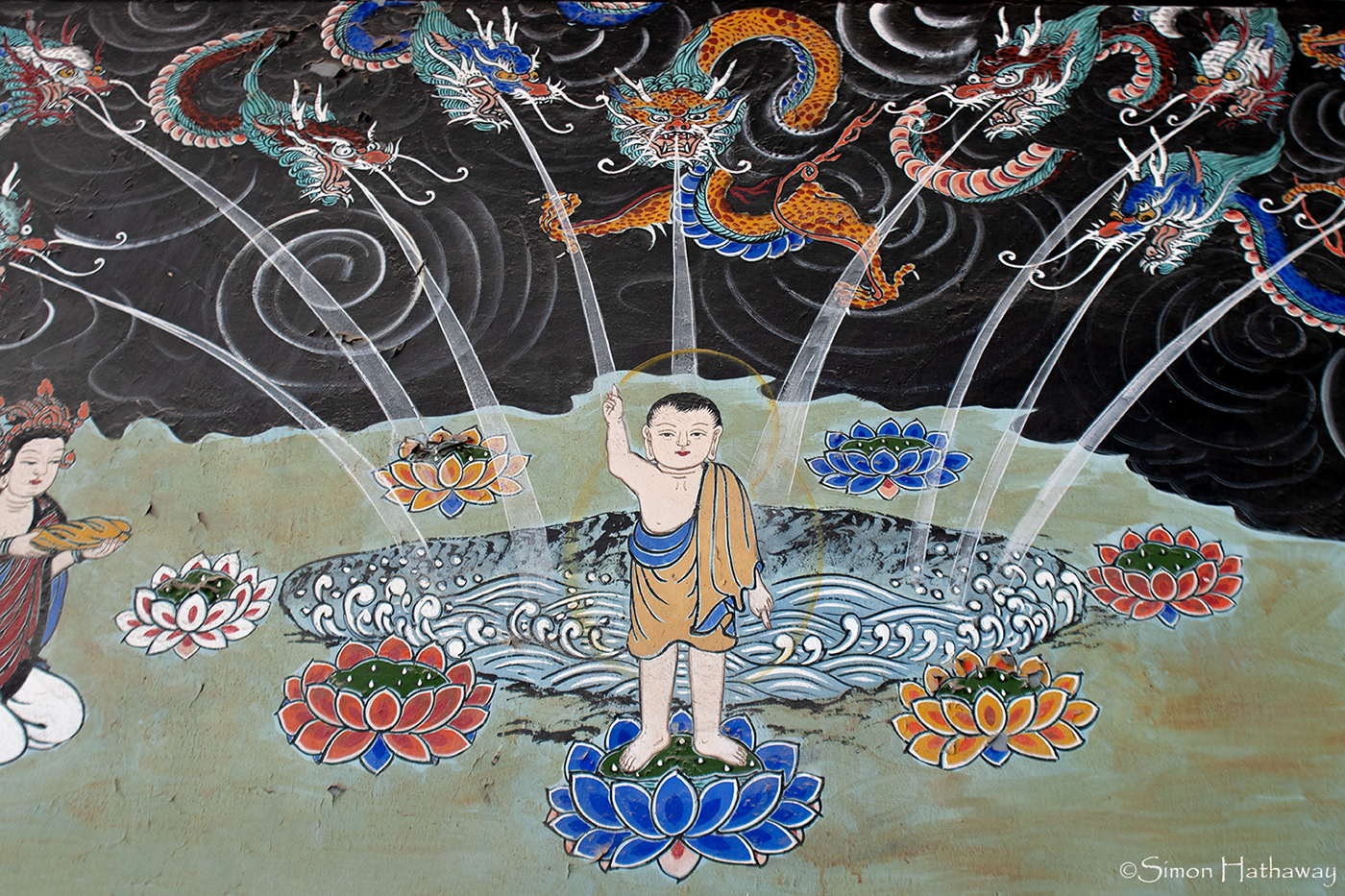
A monk asked Master Joshu, “It is said that the Supreme Way is not difficult; it only avoids choosing. What is it not to choose?” Joshu: “In the heavens and on earth, I alone am the honoured one.” Monk: “That itself is still choosing.” Joshu: “You dimwit! Where is the choosing?”
Question 1: Why did Joshu say, “In the heavens and on earth, I alone am the honoured one,” in response to the monk’s question?
Question 2: Why did the monk respond to Joshu by saying, “That itself is still picking and choosing”?
Question 3: If you were in that monk’s position, how would you respond to Joshu’s remark, “You dimwit! Where is the choosing?”
©Boo Ahm
All writing ©Boo Ahm. All images ©Simon Hathaway

 Zen Fools