Uncategorized

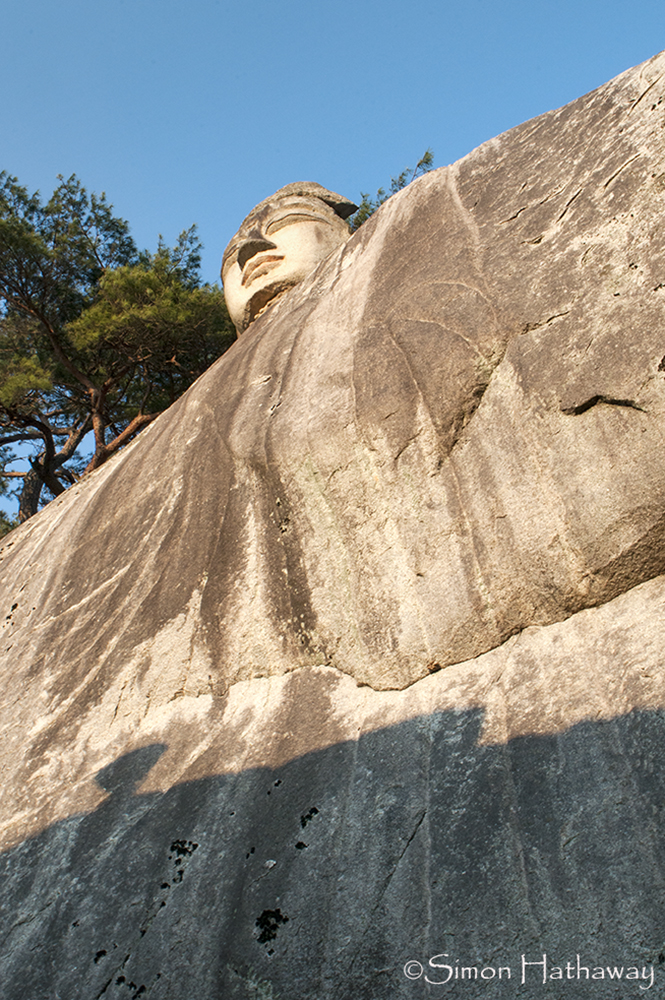
Bodhidharma sat facing the stone wall

Bodhidharma sat facing the stone wall.

The Second Patriarch, Suika, stood long in the thick snow. Finally, he severed his own arm and presented it to Bodhidharma. He said, “Your student cannot pacify his mind. You, the First Patriarch, please, give me peace of mind!” The First Patriarch replied, “Bring that mind, I will calm it down!” The Second Patriarch said, “I search for it everywhere, but I cannot find it!” Bodhidharma replied, “I have already pacified it for you!”

_SRH2211a_thumb


Student: “Why did Bodhidharma sit facing the stone wall?”
Master: “Because there was nothing else to be seen.”
Student: “How did he pacify the Second Patriarch, Suika’s mind?”
Master: “He just showed the stone wall to him.”

Commentary:
Do you want to see the stone wall that Bodhidharma showed to the Second Patriarch?
Break down the wall before you and it will reveal itself.

©Boo Ahm
All writing ©Boo Ahm. All images ©Simon Hathaway http://ow.ly/i/wzQ5a

Uncategorized

Q. What Sutra would you recommend as the greatest?

Q. What Sutra would you recommend as the greatest?

A. If you read the Sutras, you can find that all Sutras have a common scripture that says, “This is the greatest of the Sutras, so those who possess and recite it shall be given unimaginable merit.” Why do you think that the Sutras have the same comment? Which is really the greatest of them when each of them insists that it is the greatest of all the Sutras?

SRH_9029a_thumb


You should know that the Sutra mentioned as the greatest here is not the book itself but our mind. All the Sutras that can be seen outside are from the main Sutra, our mind, just as everything comes from the same root, our mind. The greatest Sutra is no other than our mind. Each of us has his or her own Sutra. All the Sutras made of paper are auxiliary Sutras that help us to understand our own Sutra.

Therefore, there is no superiority or inferiority among the Sutras since, whatever Sutra you may choose, it is part of your own Sutra. In fact, our life itself is the Sutra, so it is said that everything we hear or see is a Dharma talk or the gate to the final goal, our true Self.

©Boo Ahm
All writing ©Boo Ahm. All images ©Simon Hathaway http://ow.ly/i/wEI5P

Uncategorized

Q. How can we do nothing?

Q. How can we do nothing?

A. Supposing you are asked what you did yesterday, how will you answer? You may say, “I didn’t do anything yesterday. I just took a rest all day.” Yes, you did something. You took a rest. That is what you did. I think you did a lot of things during your rest; you had meals, drank coffee and watched TV. You might say that you did nothing but sleep all day long. Yes, you still did something. You slept all day. That is what you did.

One more question. What are you doing now? You may say, “I am not doing anything now. I am just sitting.” Yes, you are doing something. You are sitting. That is what you are doing. You may say, “I am just lying in my bed.” Yes, you are lying in your bed. That is what you are doing. We seem to be doomed to keep doing something without stopping even for a moment as long as you are alive.

In fact, when ancient masters advised their students to do nothing, they never meant that they should do nothing or make no movement at all like a dead body, but told them to realise that all they did, whatever it was, was empty. In short, ‘You should do nothing’ means ‘You should realise that all your actions are empty’. Then, whatever you may do, you are doing nothing.

When all your actions are empty, the results of them are also empty. Then you won’t be too proud or attached when doing good or achieving great success, nor will you despair or be frustrated when experiencing failure. You, then, can enjoy your life as if you were watching a movie.

When you think that you did something good, after doing good to one of your friends in need, you can be proud of your act, and that will remain in your memory. Someday the situation reverses: you are in need and he is very well off. You may ask him for help, expecting him to pay you back for your help but he may turn down your request. How would you feel then? It is likely that you will feel more ashamed and even betrayed because of the memory of the former favour that you granted him. Even if he gives you help as you expect, you are likely to take his help for granted, and not to be as grateful to him for his help as to some other person whom you’ve never helped.

SRH_5576a_thumb


Your good act can bring you a negative result in this way. In the end, you can get hurt by the good deeds that you do. So, masters would say that doing a good thing is not as good as doing nothing. They, however, didn’t mean that we should not do good, but that we should realise that our good deeds are empty and not keep them in our memory.

We should not let even the right hand itself, not to mention the left hand, know what it does.

Don’t try to do nothing.
It will add yet another action.
How could you do nothing when not knowing how to do nothing?
How would it not be difficult to try to do something that you don’t know?
If you know that life is not different from death,
you can be said to do nothing even if you work hard all day with sweat dripping from your forehead
and wrestle all night with illusions.

©Boo Ahm
All writing ©Boo Ahm. All images ©Simon Hathaway http://ow.ly/i/wEGlG

Uncategorized

Q. Which has it, and which hasn’t it?

Q. Which has it, and which hasn’t it?

Hogen of Seiryo came to the hall to speak to the monks before the midday meal. He pointed with his finger to the bamboo blinds. At this moment two monks rose and rolled the blinds up. Hogen observed, “One has it, the other hasn’t it.”

Student: “Which has it, and which hasn’t it?”
Master: “You have it.”

P1100282a_thumb


Commentary:
The master doesn’t have it, but the student has it.
What on earth is it?
If you don’t know what the student has, it’s because you also have what the student has.

©Boo Ahm
All writing ©Boo Ahm. All images ©Simon Hathaway http://ow.ly/i/wzOEY

Uncategorized

Q. I am very frustrated that my son is addicted to alcohol and drugs. Shall I turn a blind eye to his bad actions while thinking of them as empty?

Q. I am very frustrated that my son is addicted to alcohol and drugs. Shall I turn a blind eye to his bad actions while thinking of them as empty?

A. To see your suffering as empty is wisdom, and to see others’ suffering as yours is compassion. You should be able to see your son’s problem as yours and at the same time, see your suffering caused by him as empty.

It is very easy and natural that you, as a parent, look upon his problem as yours. However, seeing your suffering as empty is not easy. Especially when he doesn’t follow but rather resists and defies your advice given with love and patience, and gets worse and worse, you are very likely to lose your head and even feel frustrated like you do now.

017_8985a_thumb


Remember that seeing such challenges as empty is wisdom. You should not let your life be spoiled by your son’s life. If your life is swayed and spoiled by his life, you are not leading your life but led by it because you don’t know that everything is empty. Only when you can see the challenges as empty can you be happy and continuously remain as a firm pillar for him to depend upon.

©Boo Ahm
All writing ©Boo Ahm. All images ©Simon Hathaway http://ow.ly/i/wuSZG

Uncategorized

A Secret Book

A secret book

Once upon a time a man had a book that was treasured as an heirloom in his family which had been passed on for generations. The book held the secret of enjoying eternal happiness, and the secret was to possess nothing; we can enjoy everlasting happiness only when we possess nothing.

His family, from generation to generation, always tried to live as simply as possible to live up to what the book said, but no one in the family lived an eternal life. Why do you think no one in the family could make the secret come true?

017_9996a_thumb


The key mistake they made was to keep the secret book with them to the end without discarding it. What they got from the great book handed down generation after generation was not eternal happiness but only a needy life after all. Which is to blame for it, the family or the book?

When everything is empty, there are no exceptions.

©Boo Ahm
All writing ©Boo Ahm. All images ©Simon Hathaway http://ow.ly/i/wqSnY

Uncategorized

Q. Student: “How would the universe answer its own question if the universe asked itself, ‘What is it?’?”

Q. Student: “How would the universe answer its own question if the universe asked itself, ‘What is it?’?”

A. Master: “That is your question.”

SRH_3206a_thumb


Commentary:
He tries to earn money by selling his thing in another’s name to a buyer while not knowing that another and the buyer are himself.
Although seemingly nice deals are done one hundred times, he doesn’t make any money.

©Boo Ahm
All writing ©Boo Ahm. All images ©Simon Hathaway http://ow.ly/i/wmEVA

Uncategorized

Q. I sometimes feel that I am losing my mind. What can I do to feel better?

Q. I sometimes feel that I am losing my mind. What can I do to feel better?

A. Do you happen to know what you are and what your mind is when you feel that you are losing your mind? Do you happen to know how you are different from your mind? Your problem, like others’, is that you don’t know who is losing what or what is happening, although you feel that you are losing your mind.

What is the mind that you feel you are losing? The thought that you feel that you are losing your mind is none other than the action of your mind. Above all, observe carefully how you are losing your mind. Try to know clearly either what you are, or what your mind is. In the course of observing, you will feel much better, and you will get permanent happiness if you come to realise clearly either you or your mind.

017_8715a_thumb


Student: “I feel that I am losing my mind. What shall I do in order not to lose my mind?”
Master: “Hold it firmly.”
Student: “How can I hold it firmly?”
Master: “Let go of it.”
Student: “How can I let go of it?”
Master: “Are you holding it now?”
Student: “No, I am not. I don’t know how to hold it.”
Master: “If you are not holding it now, you already let go of it. Your problem is not knowing what you feel you are losing.”

©Boo Ahm
All writing ©Boo Ahm. All images ©Simon Hathaway http://ow.ly/i/vB4KW

Uncategorized

Q. What does enlightenment have to with happiness?

Q. What does enlightenment have to with our happiness?

A. As I have mentioned previously, we are living in a world of memory that is called the realm of form. Form means the imaginary lines produced by us. We are living in a world of countless complicated imaginary lines that we have drawn and are drawing constantly. The problem is that we often stumble over the imaginary lines and can’t move freely because we are caught by the lines.

_SRH5790a_thumb


Attaining enlightenment is to realise that everything is an imaginary line, an illusion. When we can clearly realise that all things are just imaginary lines, we don’t stumble over or are not caught by the lines any longer. We can erase all the lines at will, and draw our own lines for the sake of our convenience, instead of struggling to fit into the lines drawn by others. In other words, we can enjoy our life by drawing the lines that suit us best.

So, enlightenment enables us to enjoy much more happiness than before.

Student: “What is the difference in my life before and after enlightenment?”
Master: “Before enlightenment, your life leads you, but after enlightenment you lead your life.”

©Boo Ahm
All writing ©Boo Ahm. All images ©Simon Hathaway http://ow.ly/i/vB4Bs

Uncategorized

Q. Why did the master say that his assistant forsook him?

Q. Why did the master say that his assistant forsook him?

A. Echu, called Kokushi, the teacher of the emperor, called his attendant, Oshin, three times and three times Oshin answered, “Yes!” Kokushi said, “I thought that I had forsaken you, but in reality you forsook me!”

Student: “Why did the master say that his assistant forsook him although he answered three times when the master called him three times?”
Master: “Because one of them is deaf.”
Student: “Which is deaf?”
Master: “Regardless of which of them is deaf, it is certain that you are deaf.”

017_8723a_thumb


Commentary:
The poor student thinks that it not because he is deaf but because his master doesn’t say the answer that he can’t hear the answer.

©Boo Ahm
All writing ©Boo Ahm. All images ©Simon Hathaway http://ow.ly/i/vB4Sr