
The World-Honoured One had already been born in the royal palace before leaving Tusita Heaven, and even before emerging from his mother’s womb, he had already delivered all sentient beings in the world.Student: “Where is the Buddha now?” Master: “He is still in Tusita Heaven.”
Commentary: Not only the Buddha but all sentient beings have never left Tusita Heaven.
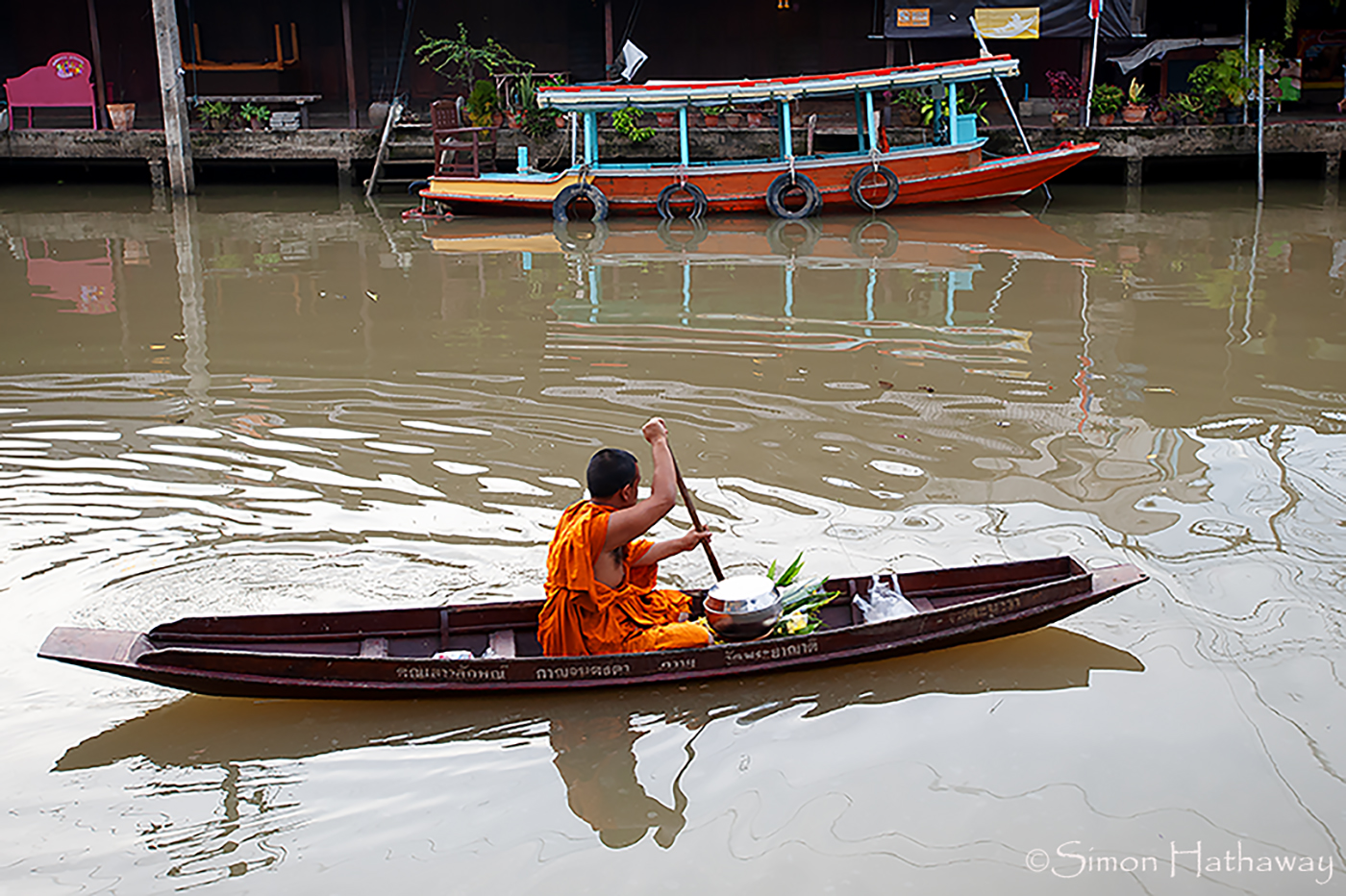
Part 1-5 When mealtime came one day, the Buddha put on his robe, picked up his rice bowl, and went to the city of Sravasti to beg for alms. As he begged, he visited each home within the city in turn.
Commentary: The story of the Buddha going out for alms is as ordinary and common as people going to the market or preparing a meal. This signifies that the Buddha’s teaching is not found in some extraordinary place, but within the simple and everyday acts of daily life.
In Chapter 29 of this sutra, the Buddha tells his disciples: “If someone says that the Tathāgata comes or goes, sits or lies down, that person does not understand the teaching I have given. Why? Because the Tathāgata neither comes from anywhere nor goes anywhere. That is why he is called the Tathāgata.” This means that we must be able to recognise the Buddha-nature—the Tathāgata—that neither comes nor goes, neither sits nor lies—within the Buddha’s seemingly ordinary, everyday actions.
There is a dialogue between the Buddha and his disciple Ānanda that illustrates how we should interpret this teaching of the Buddha.
One day, as the time for alms-round approached, the Buddha said to Ānanda, “When you go for alms, follow the path of the Seven Buddhas of the past.” Ānanda asked, “What is the path of the Seven Buddhas of the past?” The Buddha simply said, “Ānanda.” Ānanda replied, “Yes, Master.” The Buddha then said, “Go and beg for alms.”
Through this brief exchange, the Buddha was not only revealing the Tathāgata (Buddha-nature) to Ānanda, but also instructing him to never cease his effort to recognise the Tathāgata, even while on his alms-round. In truth, since all things and all beings possess the same Buddha-nature, we must learn to see the Tathāgata not only in the Buddha’s actions but also in our own and our neighbours’ everyday lives. This is what it means to see and hear all things just as they are—with complete clarity. To train ourselves to see and hear in this way is the essence of Zen practice.
Disciple: “Master, what does the Buddha mean when he says, ‘Go and beg for alms’?” Master: “When a wealthy man sends his child out to beg, his intention is not in the begging itself.” Disciple: “Then what is his intention?” Master: “To teach his child how to manage the wealth that he will one day inherit.” Disciple: “And what is that wealth?” Master: “Bring me a cup of tea.”
The Buddha who begged for alms 2,500 years ago— who can now offer him food today?
The Buddha that symbolises the enlightened is aware that everything is empty just like dreams. For him, everything, including himself, is one as Emptiness.
In the state of Emptiness, there is no ‘I’ to obey, or violate precepts, no sin to commit and no virtue to uphold. If he happens to have anything to keep, or discard, he can’t be referred to as the Buddha.
One day, Master Yeomgwan called his attendant and said, “Bring me the buffalo horn fan.” The attendant replied, “The fan is completely broken.” The master then said, “If the fan is broken, bring the buffalo to me.” The attendant had no response.
Student: “What is the buffalo fan?” Master: “It can blow fiery heat away by fanning once.”
Commentary: All people have it, but few can use it.
Part 1-4 Thus did I hear. One time, the Buddha was staying in Jeta Grove in Sravasti, residing with 1,250 great monks.
Commentary: As mentioned earlier, “to hear in this way” means to listen to things as they truly are (in their suchness). Let me explain a bit more about “seeing and hearing things as they are.”
Suppose I hand you a cup filled with something and say, “Drink this as it is.” How would you drink it to truly follow my instruction?
Naturally, you would drink it without adding anything like sugar or salt, and without removing any of its original contents.
Likewise, when I say to see and hear things as they are, it means to perceive things without attaching any words, including names—those imaginary labels we use to describe the form, or define the identity of what we see and hear. These labels are neither innate nor essential; they are artificial and external, created by humans.
For example, a flower was not a flower until we called it so. It never declared, “I am a flower; call me a flower.” Nor did it ever mention its colour or size, yet we arbitrarily attach labels like “flower”, “red”, “yellow”, “pink”, “big”, or “small”.
When you hear in this way—that is, when you see and hear everything as it truly is, unswayed by forms or words—all distinctions between things vanish, and all things become nameless. This is called non-duality, Buddha-nature, or emptiness. In this state, there is only non-duality, only Buddha-nature, and everything seen by the eyes or heard by the ears is merely a manifestation of Buddha-nature.
When you see and hear in such truth, reading a sentence like, “At one time, the Buddha was staying at the Jetavana monastery in Śrāvastī, together with twelve hundred and fifty great monks,” allows you to feel the Buddha-nature in every single word. This is not merely reading a historical account of the Buddha but directly encountering the Buddha. It is not just picking up black beans from white paper but reading the sutras in their truest sense.
Do not forsake the Buddha right before your eyes while chasing the Buddha who dwelt in Śrāvastī’s Jetavana monastery 2,500 years ago.
Disciple: “What is the Buddha before me?” Master: “To answer would be to diminish not only you but myself as well.”
The Buddha is essentially formless and nameless. The Buddha is no more than an imaginary label to be used for the sake of convenience to explain the state free from forms and words. To see and experience the state in the flesh is enlightenment.
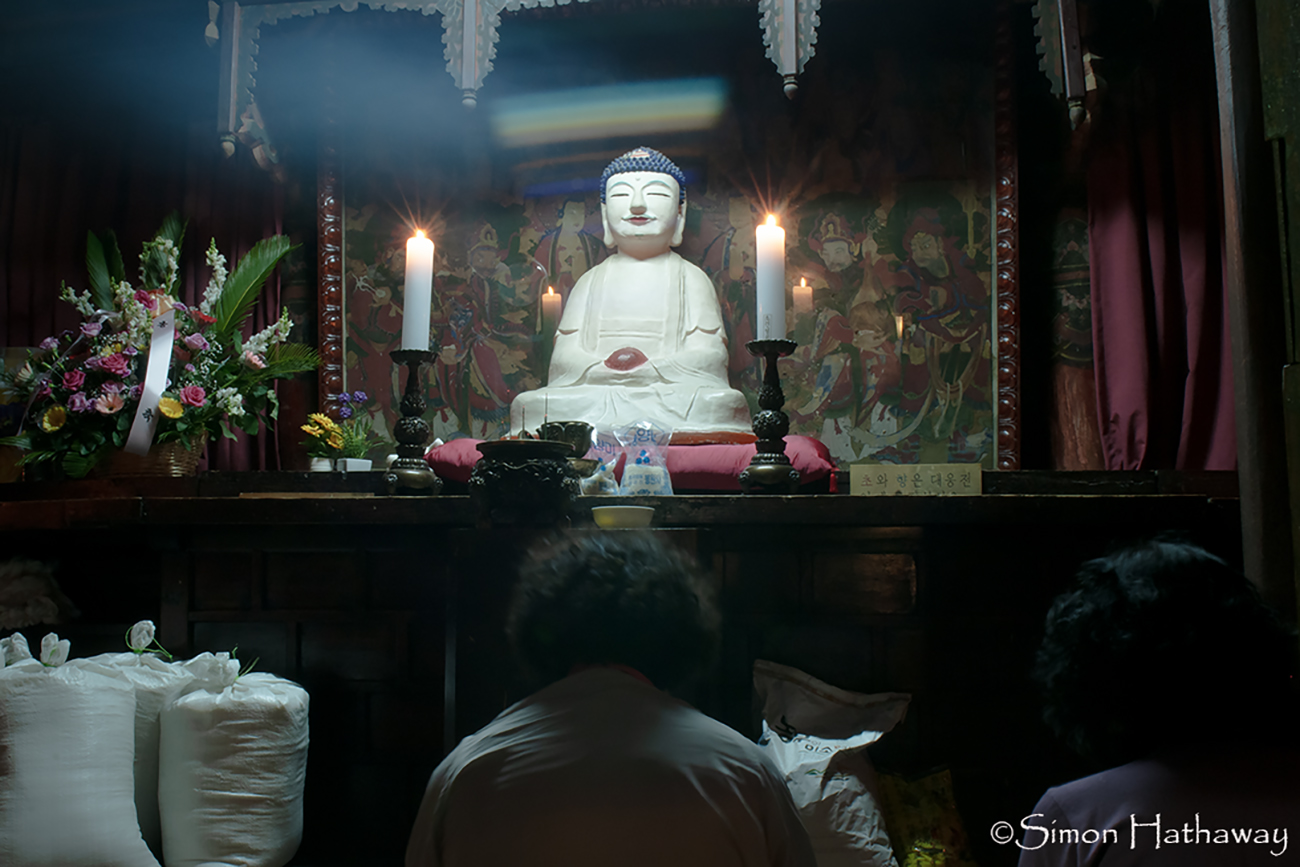
Making and following an image of the Buddha is creating and being attached to the illusion of the Buddha. This is to run counter to the Buddha’s teaching. This is why the ancient masters would say that we should kill the Buddha if we meet him.
The World-Honoured One had already been born in the royal palace before leaving Tusita Heaven, and even before emerging from his mother’s womb, he had already delivered all sentient beings in the world.
Student: “Then, why was the Buddha born in India 2,500 years ago?”
Master: “In order to show that He was in the royal palace before leaving Tusita Heaven.”
Commentary: The Buddha never moves at all, but there is no place out of His reach.
Part 1-3 Thus did I hear. One time, the Buddha was staying in Jeta Grove in Sravasti, residing with 1,250 great monks.
Commentary: As mentioned in Chapter 1-1, “Thus have I heard” refers to hearing without being deluded by words or appearances, listening as it is, in its true nature. It means hearing all sounds as they are, or hearing them as empty. While we tend to categorise sounds into things such as “birdsong”, “thunder”, or “a child crying”, listening as it is means, as the saying goes, “even if the ears are full, there are no words”. This means hearing any sound without attaching words that distinguish or divide it.
This kind of hearing is also described as hearing the unheard, listening without being swayed by words, or regarding all sounds as the function of the true-Self—referred to in Chapter 1-2 as “Tathagata”, “the true-Self”, “Buddha”, “Emptiness”, or “Non-Duality”. In this state, the listener and the object of hearing become one, resulting in hearing without hearing.
This is how one listens to the Buddha’s dharma talks. If one can hear everything in this way, one can hear the Buddha’s dharma talks anytime, anywhere, and cannot stop hearing them even for a single moment. Such a state is said to be reaching the Pure Land, and once reached, one cannot escape from it.
Disciple: “What is it like when one hears in this way?” Master: “I can’t help but answer your question?” Disciple: “Why can’t you help but answer my question?” Master: “Because no one can deceive you.”
Hearing others’ words about it a hundred times—How could this compare to hearing it directly once?
Zen meditation is a kind of Buddhist practice to attain enlightenment. When we say that we practise Zen meditation, it is really difficult for us to know whether or not we are practising correctly because our practice is happening invisibly in our mind. Many people don’t know where they are heading and why they should go the way they are going
Practising correctly is much more important than practising hard because the harder you practise incorrectly the farther away you can become from your goal, enlightenment. You had better stop such practice since it can harm your life rather than benefit it.
Many people seem to be wandering aimlessly through the woods. To avoid such a common mistake, we should remember the following. Enlightenment is very clear and concrete, not vague like a wild-goose chase.
In order to reach the final goal, you should not believe blindly in what so-called masters say, but assume a critical attitude until you are persuaded logically. Buddha, while alive, used to say to his disciples, “Don’t believe blindly in what I say to you now, but contemplate it to see whether it makes sense to you. If it makes sense to you, accept it, but if it doesn’t, don’t accept it but bring it back to me and ask it of me again.”
Likewise, you should not blindly accept what masters say. When coming across what doesn’t make sense to you, you should go on to ask for further explanation until you find it understandable and acceptable.
If it happens that you can’t get a satisfactory answer, you don’t have to follow such a master. In fact, in many cases, masters say a few words that are difficult to understand, and pretend to make a very important and meaningful message (in reality, most of them even themselves don’t know what they say). Laymen treasure them and cling to them without knowing the meaning while just believing they are very valuable. They think themselves to be to blame for not being able to understand the message. The vaguer their message sounds, the more respectful they are of it while thinking its meaning is too deep for them to understand.
You should not accept Zen in that way. When a master delivers important words, he should explain to you in detail to the extent that you have sufficient intellectual understanding: why he says so and what viewpoint you should have to understand his words. If he doesn’t, he is of no help to you.
You should clearly know the reason why you should practise by asking yourself or masters.
When you undertake a certain kind of Zen practice, you also should know why you should choose it.
You should have your practice checked often since you are apt to go in the wrong direction, because it is not tangible, invisible and scentless. If you practise correctly, you progress step by step and you become more and more confident in your practice. You can feel yourself changed. Then, you can be sure that enlightenment is not vague but very clear.
Master Seok-sang said during a dharma talk, “One must know the single phrase transmitted separately outside the doctrinal teachings.” At that moment a monastic stepped forward and asked, “What is the single phrase?” Seok-sang replied, “It is not a phrase.”
Master Woonmoon said, “Only when it is not a phrase does it become a phrase.”
Student: “Who can recognise a phrase that is not a phrase?” Master: “A man without eyes and ears.”
Commentary: A phrase is not a phrase but a gate. Don’t read it but enter it.