The core of Buddhism is to see everything, whether hardships or happiness, as it is, or as the function of the true-Self. The hardships are not hardships on their own, but they are hardships because we look upon them as hardships and call them as such.
When encountering hardships, we, above all, should remember that we are being deluded by forms and words, and try to see the situation where we are placed just as it is. Trying to see the situation as it is, is not only a good practice but a good way to handle the hardships.
A monk asked Dongshan, “Of the Three Bodies, which one doesn’t fall into numbers?” Dongshan replied, “I have always been earnest with it.”
Later, the monk asked Choshan, “What did Dongshan mean by saying ‘I have always been earnest with it’?” Choshan answered, “Cut off your head and bring it to me.” The monk asked Sulbong the same question he had asked Dongshan. Then, Sulbong hit the monk’s mouth with his staff and said, “I have been in Dongshan’s, too.”
Student: “What is the meaning of Choshan’s cruel words?”
Master: “Choshan grasped Dongshan’s meaning, and you don’t understand Chosan’s meaning.”
“Why? This person will have no image of self, no image of person, no image of a being, no image of a liver of life. Why? The image of self is not a characteristic; the image of person, the image of a being, and the image of a liver of life are not characteristics. Why? Being freed from all images, he is called the Buddha.”
Commentary:
In this context, this person refers to one who listens to, believes, understands, and upholds the scriptures correctly, according to the Buddha’s teachings, without being deceived by words or external appearances. Such a person has transcended all forms and realises that everything seen and heard—including themselves—is the Buddha-nature and the scripture itself.
The Avatamsaka Sutra states:
“It is not a body, yet a body is spoken of;
It is not an arising, yet an arising is manifested.
Only when there is no body and no arising
Is this called the Supreme Body of the Buddha.”
Just as this verse suggests, the ‘body’ is not a body but is merely called a ‘body’, and ‘arising’ is not an arising but is merely called ‘arising’. The true nature of everything, including ourselves, is that there is neither a physical body nor a point of origin; this emptiness is the true appearance of everything. This is referred to as the appearance of the Buddha (the true-Self).
When one views everything in this light, as the Avatamsaka Sutra says:
“The act of seeing, the object seen,
And even the seer must all be eliminated.
Only then does one not destroy the True Dharma;
Only such a person shall truly know the Buddha”
By seeing everything as it truly is without being deceived by forms or sounds, the distinction between the observed object and the observing self vanishes. Seeing everything as a non-dual, unified Buddha-nature is what it means to truly see the Buddha and to correctly hear, believe, and uphold the Sutras.
As the Buddha stated in the Avatamsaka Sutra, “I now see all sentient beings everywhere, and behold, they all possess the wisdom and virtuous marks of the Buddha. It is only because of their delusions and attachments that they fail to realise it” we are inherently Buddhas, but like a king dreaming he is a beggar on the street, we are lost in a sea of afflictions, delusions, and attachments, forgetting our true identity. This state is called being a sentient being. Just as a king wakes up to realise he was never a beggar, the purpose of this scripture—and of Buddhism itself—is to see everything clearly, realising that the sea of suffering is the Pure Land and that we ourselves are the Buddha.
Disciple: “If being free from all forms and names is what we call Buddha, how then can I recognise the Buddha?”
Master: “Your own eyes and ears must first leave form and name behind.”
Only when you know
That the Buddha is not the Buddha,
Will you truly see the Buddha.
The Koan:
Master Dazhu said, “When the body, speech, and mind are pure, it is said that the Buddha has appeared in the world. When the body, speech, and mind are impure, it is said that the Buddha has perished.”
Question: When the body, speech, and mind are pure and the Buddha has appeared in the world, what is it like?
Saying that there is no ‘I’ to be called ‘I’ means that the image that we regard as ‘I’ is the function of the true-Self, just as winds are the function of air. Pain is also the function of the true-Self that is beyond positive and negative.
We may regard pain as a guard who protects us from more serious illness by warning us of its approach. Try to see beyond pain.
A monk asked Dongshan, “Of the Three Bodies, which one doesn’t fall into numbers?” Dongshan replied, “I have always been earnest with it.”
Later, the monk asked Choshan, “What did Dongshan mean by saying ‘I have always been earnest with it’?” Choshan answered, “Cut off your head and bring it to me.” The monk asked Sulbong the same question he had asked Dongshan. Then, Sulbong hit the monk’s mouth with his staff and said, “I have been in Dongshan’s, too.”
Student: “Why did Dongshan say, ‘I have always been earnest with it’?” Master: “Because you fell into numbers.”
Commentary: Nothing falls into numbers unless you push it to fall into numbers.
Part 14-4 “If, in the final five hundred years of the coming world, a sentient being hears this sutra, believes in it, understands it, accepts it and upholds it, he will be the rarest.”
Commentary: In part 14-3, Subhuti states that while he can easily understand, believe, and uphold the teachings of this Sutra, it will be rare for sentient beings to do the same long after the Buddha’s passing. Now, 2,500 years later, we must ask ourselves: “Are we truly listening to, believing, and upholding this Sutra as the Buddha intended, without being deceived by mere words?”
According to Bodhidharma: “If you are blind to your own numinous nature, you will not escape the cycle of reincarnation, no matter how busy you are with chanting or poring over scriptures. Those who have not seen their true-Self may spend all day reading sutras, chanting, and practising sitting meditation without ever lying down, believing these external acts to be the Buddhadharma. However, such people are actually slandering the Dharma.”
The true Sutra is not the printed text or written characters; it refers to the true-Self. Everything, including ourselves, is the true-Self (Buddha-nature). To read the Sutra while being deceived by ink and paper—failing to realise that you yourself are the Sutra—is to go against the Buddha’s teaching, which urges us to transcend words and forms to realise our innate true-Self.
One day, Master Woongeo asked a monk, “What Sutra are you reciting?” The monk replied, “The Vimalakirti Sutra.” The Master said, “I didn’t ask you about the Vimalakirti Sutra; I asked what Sutra you are reciting.” Master Woongeo was not asking about the physical book made of paper; he was asking if the monk was aware that everything, including himself, is the true Sutra.
When we truly understand the Sutra that is always open, readable without a lamp even in pitch-black darkness, and cannot be burned by fire or soaked by water, every movement and every silence is the Sutra itself. Master Yabo described the state of upholding this Sutra as follows:
“Walking, staying, sitting, and lying down, Dressing and eating. Beyond these, what else could there be?” He meant that our daily lives are, in themselves, the act of upholding the Sutra.
Student: “How can I receive and uphold this Sutra?” Master: “To try to uphold it is, in fact, to discard it.” Student: “I still do not understand what you mean.” Master: “Ask me again.” Student: “How can I receive and uphold this Sutra?” Master: “Just take good care of that.”
Since there is nothing that is not the Sutra, Why light a lamp at midday to read it? Though you read and copy it all your life, If you wrestle only with letters, it is but the talk of demons.
Koan: While Master Yaksan was reading a Sutra, a monk asked, “Master, you usually tell people not to read Sutras. Why are you reading one yourself?” Yaksan replied, “I am merely shading my eyes.” The monk asked, “May I follow your example?” Yaksan said, “In your case, you should be able to see through even a cowhide.”
Question: What is the meaning of Yaksan’s statement, “In your case, you should be able to see through even a cowhide”?
If there is anything for him to cut, or attain, he is still a sentient being. The enlightened means people who can see things as empty, or as they really are. When everything is empty, there is nothing to cut, or attain. So, the enlightened are those who has attained the ability to see things as empty.
However, they never think in the least that they have attained the ability, because they see it as empty as well. This is why we say that there is nothing for the enlightened to attain, or cut.
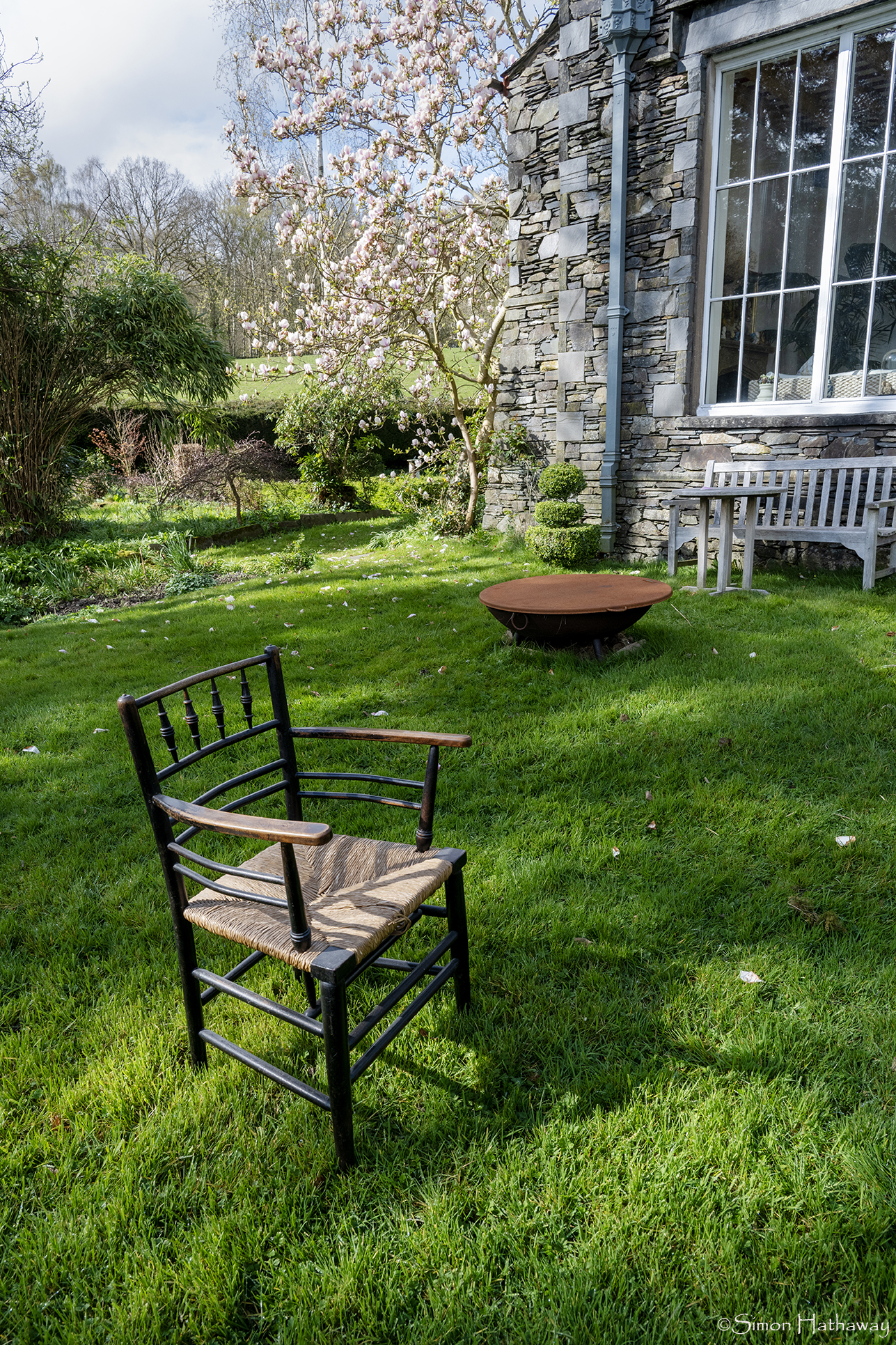
Master Buban, pointing to a chair, said to his disciples, “If you know the chair, it is more than enough to encompass the universe.” Later Master Woonmoon said, “If you know the chair, it is far apart as the heaven and earth.”
Student: “Then, should we know a chair, or not?”
Master: “You should be neither aware nor unaware of it.”
Student: “How is it when I am neither aware nor unaware of it?”
Master: “A chair is a chair, and a table is a table.”
Commentary:
If you know the chair, it is not a chair. When a chair is not a chair, the Buddha land is not the Buddha land.
“World Honoured One, it is not difficult for me to hear this Sutra, believe in it, understand it, and accept and hold it now.”
Commentary:
We must understand what Subhuti meant when he said, “It is not difficult to hear, believe, understand, accept, and uphold a sutra such as this.” As mentioned many times, ‘this Sutra’ refers not to letters printed on paper or silk, nor to characters carved on wood or stone, but to the true-Self (Emptiness) itself.
As the Avatamsaka Sutra says, “Wherever one goes, the Buddha appears before them, preaching the wondrous Dharma through various expedient means to benefit all sentient beings”, when we can see the Buddha who is always with us and become one with the Buddha, everything we see appears as the Buddha and everything we hear is heard as a Dharma talk. The Lotus Sutra tells us that whatever we read or speak of—whether it be books, political discourse, wealth, or occupations—it all becomes a Dharma talk. When every action we take and every sound we make becomes a Dharma talk, we ourselves become the Sutra itself wherever we are. Since our words become the Buddha’s words, it is not difficult to carry the Sutra with us at all times.
Venerable Prajnadhara, the 27th Patriarch and teacher of Bodhidharma, once attended a ceremony hosted by the King of East India. When the King asked, “Everyone else is reciting the Sutras; why are you the only one not reciting them?” the Patriarch replied: “When I breathe out, I do not involve myself with various karmas; when I breathe in, I do not dwell in the realms of the five aggregates (skandhas). In this way, I am constantly reciting hundreds of billions of volumes of sutras.” This is a perfect example of what it truly means to receive, uphold, and recite the Sutra.
When we see all things as they truly are, everything we see and hear appears as the Sutra. Every blade of grass becomes the Sutra. Even if we do not try to uphold it, the Sutra follows us; we are always with it, and it cannot be separated from us for even a moment. However, mistaking letters for the Sutra while failing to see the true Sutra before our eyes is to be deluded as if in a dream. If one tries to recite the Sutra in this literal way, it becomes a demon’s talk. No matter how long you carry, read, or copy it, you will never see the true Sutra. Thus it is said: “If the Sutra follows the person, even what is not the Sutra becomes the Sutra; if the person follows the Sutra, the Sutra becomes a demon’s talk.”
That is why ancient masters would say: “For one who does not know what the Sutra is, upholding it is harder than lifting a great mountain; for one who clearly knows the Sutra, it is easier than lifting a feather.”
Thus, knowing that I myself am the Sutra (the Buddha) is what it means to uphold the sutra. Seeing everything as the Buddha and hearing every sound as the Buddha’s Dharma talk is what it means to read the Sutra. Acting and speaking with the realisation that all our deeds and sounds are the functioning of the Buddha is what it means to preach the four-line Verse and give a Dharma talk to others.
Disciple: “Why is it so difficult to obtain, hear, believe, know, and uphold this Sutra?”
Master: “While you are waving it about like that, how can you say it is difficult to uphold?”
The sutra covers your eyes,
So you cannot see this Sutra;
Only when you discard all Sutras
Will you see this Sutra.
Koan:
A monk asked Master Yunmen, “What is the entirety of the Buddha’s lifelong teachings?”
Yunmen replied: “Answering with a single word.”
Question: What is the meaning of Yunmen’s reply, “Answering with a single word”?
We can’t see the essence of ourselves, because we are deluded by illusions. The most persistent of all illusions that we are most attached to is the illusion of ‘I’. This is why ancient masters would say that the illusion of ‘I’ is the most difficult to remove.
The essence of Buddhism is to discover the true-Self by discarding the false self, the illusion of the self. Remember that the true-Self cannot be removed, or discarded while the illusion of the self can.