The Buddha’s teaching is not to quieten our mind, but to realise that our mind is already stillness itself.

©Boo Ahm
All writing ©Boo Ahm. All images ©Simon Hathaway
Master Jin-gak said, “Time flows like water, and worrisome worldly affairs are so badly entangled that they cannot be disentangled. The smokeless fire of the heart keeps burning day by day. How can you escape from being burnt by the flames?”

Student: “How can we disentangle the entangled worldly affairs?”
Master: “Brush away dust from them and look carefully at them.”
Commentary:
Trying to untangle tangled turtle-hair makes it more entangled.
©Boo Ahm
All writing ©Boo Ahm. All images ©Simon Hathaway
Part 17-4
Subhuti, in reality there is no state in which the Realised One attained unexcelled complete perfect enlightenment. Subhuti, if there were a state in which the Realised One attained unexcelled complete perfect enlightenment, then Dipankara Buddha would not have given me the prediction, ‘In a future age you will be a Buddha named Shakyamuni.’
Because there was in reality no state in which I attained unexcelled complete perfect enlightenment, therefore Dipankara Buddha gave me the prediction, saying, ‘In a future age you will be a Buddha named Shakyamuni.’

Commentary:
If the Realised One had thought that he attained enlightenment, Dipankara Buddha would not have approved of the Realised One’s enlightenment, because it means that the Realised One, not escaping from being deluded by illusions, was attached to the illusion of enlightenment.
Those who are free from all forms through enlightenment have no form of ‘I’ as well as no form of enlightenment. When there are no ‘I’ and no enlightenment, who can attain what?
Student: “Why is it conventional wisdom that the Buddha attained the unexcelled complete perfect enlightenment?”
Master: “Because you misunderstand it.”
©Boo Ahm
All writing ©Boo Ahm. All images ©Simon Hathaway

A. Let’s suppose that there is a curious lump of gold that looks different according to the angle of view. Some people say that it is a flower, some believe that it is a bird, and some think that it is an apple. Many other names can also be given to it.

Saying that everything is an illusion means that a flower, a bird and an apple are all illusions, labels created by your discrimination and not the essence of it. Saying that everything is empty signifies that the essence of everything, regardless of whatever it is called, is gold.
Our problem is that we, deluded by its superficial shape, can see only a flower, a bird and an apple without realising that the essence of them is gold. This means that we are deluded by illusions without realising gold. So, realising that everything is an illusion means realising that everything is much more valuable than we have thought that it is, because it implies that everything is gold. Enlightenment is to see the true value and beauty of everything that we have missed seeing so far.
©Boo Ahm
All writing ©Boo Ahm. All images ©Simon Hathaway
Master Jin-gak said, “Time flows like water, and worrisome worldly affairs are so badly entangled that they cannot be disentangled. The smokeless fire of the heart keeps burning day by day. How can you escape from being burnt by the flames?”

Student: “What is the cause of worrisome entangled worldly affairs?”
Master: “Time flowing like water.”
Student: “Why is time an entangled worldly affair?”
Master: “Because all worldly affairs result from it.”
Commentary:
Sentient beings’ lives struggle with time like a rabbit-horn.
©Boo Ahm
All writing ©Boo Ahm. All images ©Simon Hathaway
Part 17-3
“Subhuti, what do you think—when the Realised One was with Dipankara Buddha, was there any state of attaining unexcelled complete perfect enlightenment?”
“No, World Honoured One. As I understand the meaning of what the Buddha says, when the Buddha was with Dipankara Buddha there was no state of attaining unexcelled complete perfect enlightenment”
The Buddha said, “That is so. That is so.”

Commentary:
Being able to see and hear everything as it is, is referred to as enlightenment, which the Buddha is said to have attained and which we try to attain as well.
Prior to attaining enlightenment, it is the final goal of all Buddhists. However, once we have learned to see things as they are through enlightenment, everything looks as it is, that is, everything looks one as Emptiness from that moment on. Then, we come to realise that enlightenment is not enlightenment but is only called enlightenment and that the action of saying ‘enlightenment’ is the function of the true-Self.
This is why it is said that there is no Dharma to learn, no Buddha to see and no enlightenment to attain once we get enlightened, although all of them appear to exist before enlightenment.
This is to see what the Buddha wanted to show to us through his talk.
This is to see and hear the Buddha in each word we encounter, which is referred to as making dead words alive.
Student: “Why was the Realised One with Dipankara Buddha if he didn’t attain enlightenment from Him?”
Master: “I was almost deluded once, too.”
©Boo Ahm
All writing ©Boo Ahm. All images ©Simon Hathaway
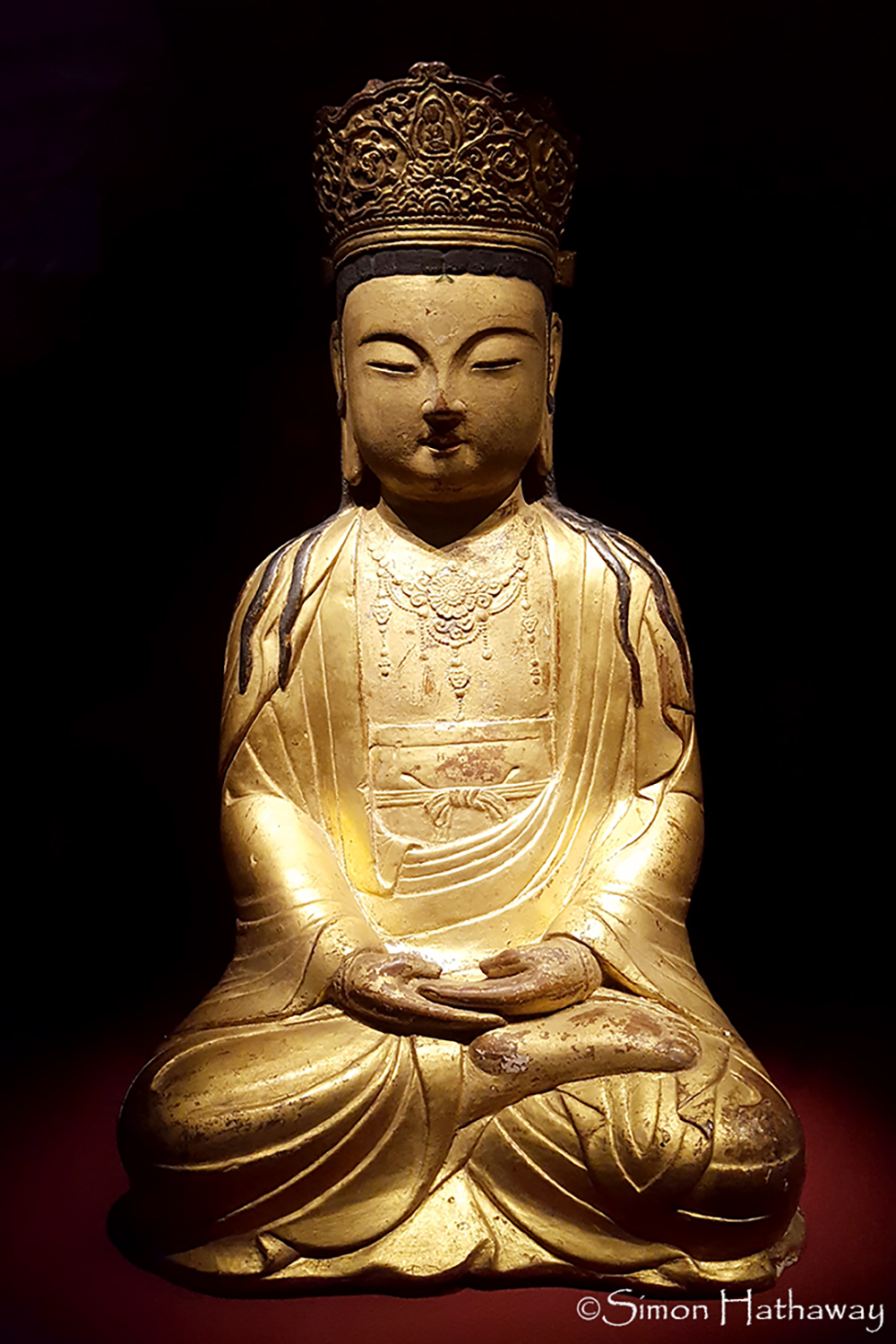
Master Joshu asked a monastic, “Have you ever read the Lotus Sutra?” The monastic said, “Yes, I have.” The master said, “How do you comprehend the words ‘A Buddhist garment is a borrowed name, and a meditation room deceives people’?” When the monastic was on the point of offering a bow, the master asked the monastic, “Are you wearing a Buddhist garment?” The monastic answered, “Yes, I am.” The master said, “Don’t deceive me.” The monastic said, “How can I avoid deceiving you?” The master said, “Don’t accept my words.”

Student: “Why did Joshu say, ‘Don’t deceive me’ when the monastic said that he was wearing a Buddhist garment since he was really wearing one?”
Master: “Joshu meant a seamless garment whilst the monastic meant a seamed one.”
Commentary:
A garment made of the Sutra is seamless.
©Boo Ahm
All writing ©Boo Ahm. All images ©Simon Hathaway
Part 17-2
“What is the reason? Subhuti, if bodhisattvas have an image of a self, an image of a person, an image of a being, or image of a liver of life, then they are not bodhisattvas.” “What is the reason? Subhuti, it is not because there is any dharma to realise that one should have a mind to attain unexcelled complete perfect enlightenment.”

Commentary:
Bodhisattva is a name for ones who, having attained enlightenment, are free from being deluded by images and words. This is why the Buddha said that if bodhisattvas have an image of a self, an image of a person, an image of a being, or image of a liver of life, then they are not bodhisattvas.
Although the Buddha said that we should realise the dharma and attain unexcelled complete perfect enlightenment, in reality there is no dharma to realise and no unexcelled complete perfect enlightenment to attain because everything is empty. He used such words as expedient means to lead sentient beings to the realisation that everything is empty. So, ancient masters would say that there are the true-Self to see, dharma to realise and enlightenment to attain before enlightenment, but that there are no true-Self to see, no dharma to realise and no enlightenment to attain after enlightenment since everything, including ourselves, appears to be one as emptiness.
Student: “Why do we have to attain enlightenment if there is actually no enlightenment to attain?”
Master: “Medicine is not medicine anymore when a patient is well, but it is necessary until he is cured perfectly.”
©Boo Ahm
All writing ©Boo Ahm. All images ©Simon Hathaway
A. This means that we don’t have to seek the true-Self since it is one with us, and we can’t separate, or escape from it even for a moment. We are facing and surrounded by it all the time.

The problem is that we cannot recognise it whilst facing it because we are deluded by the illusions created through discrimination. When we stop discriminating, we can see things as they are. Then, the true-Self is seen spontaneously although we make no effort to see it.
©Boo Ahm
All writing ©Boo Ahm. All images ©Simon Hathaway