A. It is not physical light that comes from fire, or electricity but the ability to see and hear things as they are without attaching any names to them. To those who can see things as they are, there is no distance and no difference between darkness and lightness. Seeing what is before their eyes is not different from seeing what is thousands of miles away, nor is seeing darkness different from seeing light. So, the Buddha’s light is another name of the eye of wisdom, enlightenment.
Student: “What is the eye of wisdom?”
Master: “It can see behind you without turning your head.”
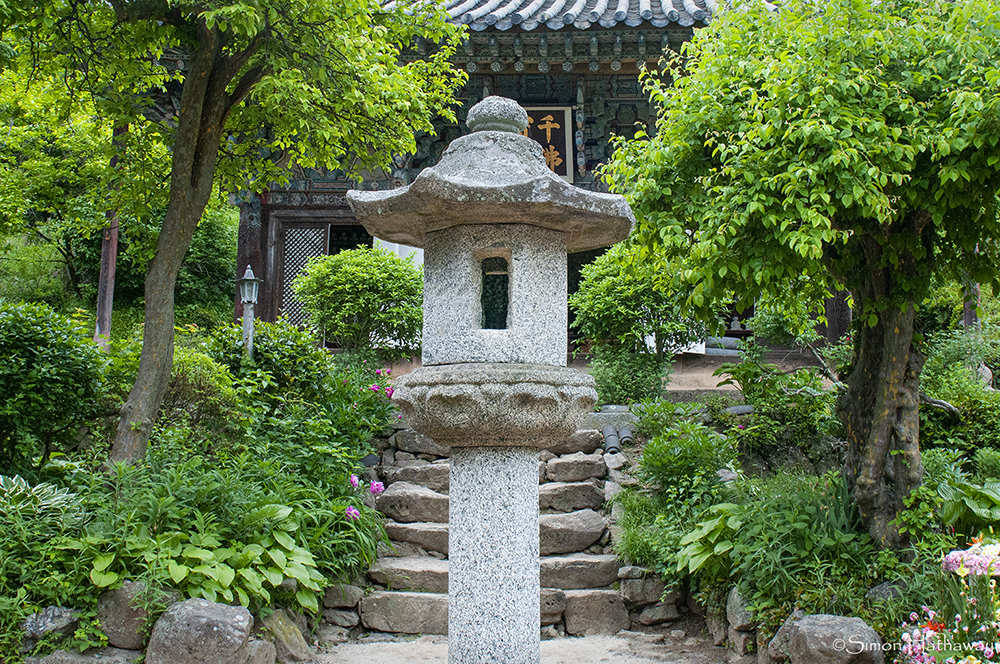
A monk asked Joshu, “What is the meaning of the Patriarch’s coming from the West?” Joshu said, “A cypress in the garden.” The monk said, “Please, don’t teach people with something outside.” Joshu said, “I never teach people with something outside.” The monk asked again, “Then, what is the meaning of the Patriarch’s coming from the West?” Joshu said, “A cypress in the garden.” Later after Joshu’s death, a monk asked Gakchulja, one of Joshu’s students, “They say that your master Joshu said, ‘A cypress in the garden’. Is it true?” The student said, “No, my late master never said such words.” The monk said, “However, all people say that your master Joshu said, ‘A cypress’ as an answer to the question ‘What is the meaning of the Patriarch’s coming from the West?’ Why do you say that he didn’t say such words?” The student answered politely, “Please don’t defame my late master. He never said such words.”
Student: “Joshu’s student said that Joshu had not said ‘a cypress’, and the monk argued that Joshu had said it. Who is right?”
Master: “It is the one who didn’t say.”
Student: “Who is it?”
Master: “It is the one who heard.”
Commentary:
One who hears what cannot be heard doesn’t say a word.
The master left Daigu and returned to Obaku who, seeing him come, remarked, “When will there be an end to the comings and goings of this fellow?” Rinzai said, “It is only because of your grandmotherly kindness.” Then, after the usual courtesies, he stood to attend to Obaku. The latter asked where he had come from and the master replied, “The other day you were kind enough to send me to Daigu for an interview.” Obaku asked, “What did Daigu say?” Rinzai then related what had happened, whereupon Obaku said, “How can I wait for this fellow to come here and give him a harsh blow?” Rinzai said, “You don’t have to wait for him to come. Give it to him right now!” and punched Obaku accordingly, who said, “This madman who comes here to stroke the tiger’s whiskers.” Rinzai gave a Katsu and Obaku called, “Attendant, bring this madman into the monks’ quarters.”
Commentary:
With the words ‘When will there be an end to the comings and goings of this fellow?’ Obaku was testing the result of Rinzai’s trip to Daigu. Although their literal meaning is ‘If you spend time coming and going only following words, when can you finish your practice?’, Obaku was asking Rinzai if he knew that these words were the function of the true-Self. Rinzai, aware of Obaku’s intention, didn’t hesitate to respond by saying, “It is only because of your grandmotherly kindness.” Rinzai not only expressed his gratitude to Obaku but also revealed the true-Self. With the phrase ‘How can I wait for this fellow to come here and give him a harsh blow?’ it may appear as if Obaku blamed and found fault with Daigu, but Obaku was testing Rinzai’s enlightenment. He was asking Rinzai if he knew that this fellow, seemingly referring to Daigu, was the true-Self because everything is the true-Self. Conscious of Obaku’s intention, Rinzai said, “You don’t have to wait for him to come. Give it to him right now!” because he knew that Obaku meant the true-Self by ‘this fellow’ and so revealed the true-Self by punching him. Rinzai showed that his hitting Obaku was not different from Obaku’s hitting Daigu when everything is one as the true-Self. Obaku approved Rinzai’s enlightenment by saying, “This madman who comes here to stroke the tiger’s whiskers.”
A. According to the Avatamsaka Sutra, all forms, everything is an expedient the Buddha presents sentient beings with. This is why ancient masters would say that we could attain enlightenment if we can simply see or hear only a single thing as it is. In other words, there is no other true-Self than what we see and hear every day.
Everything we see and hear every moment is the form and the sound of the true-Self. It is not because the true-Self hides itself, but because we are deluded by illusions that we don’t recognise it. The best expedient I recommend is to try to see and hear things as they are, that is, to see and hear things without attaching any names to them. If you can see just a single thing as it is, that is the end of your practice.
A monk asked Joshu, “What is the meaning of the Patriarch’s coming from the West?” Joshu said, “A cypress in the garden.” The monk said, “Please, don’t teach people with something outside.” Joshu said, “I never teach people with something outside.” The monk asked again, “Then, what is the meaning of the Patriarch’s coming from the West?” Joshu said, “A cypress in the garden.” Later after Joshu’s death, a monk asked Gakchulja, one of Joshu’s students, “They say that your master Joshu said, ‘A cypress in the garden’. Is it true?” The student said, “No, my late master never said such words.” The monk said, “However, all people say that your master Joshu said, ‘A cypress’ as an answer to the question ‘What is the meaning of the Patriarch’s coming from the West?’ Why do you say that he didn’t say such words?” The student answered politely, “Please don’t defame my late master. He never said such words.”
Student: “If you had been in Joshu’s student’s shoes, what would you have said if you had been asked what Joshu had said?”
Master: “I would have said, ‘He didn’t say a word’.”
Commentary:
The Buddha said, “Not a word did I say” but this doesn’t mean that he was dumb.
The master went to Daigu, who asked where he had come from. The master replied that he came from Obaku. Daigu asked, “And what did Obaku have to say?” Rinzai replied, “I asked him three times what the essence of Buddhism was, and three times he beat me. I do not know whether I was at fault or not.” Daigu said, “When Obaku, like a good old grandmother, has taken all this trouble over you, you still come here asking me whether you were at fault or not?” Upon hearing these words, Rinzai had the great awakening, and said, “After all, there is nothing much to Obaku’s Buddha-Dharma.” Daigu grabbed him and said, “You little devil still wetting your bed! You come here saying you do not know whether you were at fault or not, and now you say that after all there is nothing much to Obaku’s Buddha-Dharma. What have you seen? Speak quickly, speak quickly!” Rinzai, while Daigu was still grabbing him, gave him three punches to the ribs. Daigu released him and said, “Your master is Obaku. This has nothing to do with me.”
Commentary:
Daigu’s comment ‘When Obaku, like a good old grandmother, has taken all this trouble over you, you still come here asking me whether you were at fault or not?’ means, “Obaku, like a good old grandmother, has so much compassion for you that he answered your question by revealing the core of Buddhism instead of using words for the purpose of making you feel the essence of Buddhism in person. However, you still mistake his kind teaching as a rod and ask me whether you were at fault or not.” Upon hearing these words, Rinzai realised that they were the function of the true-Self and that they were not different from Obaku’s hitting. After enlightenment, when Rinzai said, “After all, there is nothing much to Obaku’s Buddha-Dharma”, he didn’t mean to belittle Obaku but meant to reveal the true-Self by saying, “Now I know what Obaku showed me. There is nothing special since I already have it.” Then, Daigu, to reconfirm Rinzai’s enlightenment, asked him, “What have you seen? Speak quickly, speak quickly!” Rinzai lost no time in responding to the question by revealing the true-Self through giving him three punches to the ribs. Feeling confident of Rinzai’s enlightenment, Daigu sent him back to Obaku, telling him that his enlightenment should be attributed to Obaku, not to him and that Obaku was his master.
A. The true-Self is not only in our bodies, but it is everywhere and there is no place free from it. Everything is the true-Self and there is nothing that is not the true-Self. Actually, we cannot stop seeing and hearing it even for a moment nor can we escape from it even for a moment.
Our problem is that we cannot recognise it while seeing and hearing it, because we are deluded by illusions created by us. That is, we are so intoxicated with discriminating the shapes and sizes of the waves in sea that we cannot realise that all waves are just part of the sea as water. In short, we cannot see the sea and water whilst floundering in the sea.
Choshin said, “People said that the Buddha transmitted the dharma to Mahakasyapa in secret and shared his seat with him. The people attending the talk should have spat in the Buddha’s face. Because they didn’t do that, their offspring are still in calamity now.”
Student: “What is the error that these ancient people made?”
Master: “They misled their offspring into believing that the Buddha did what he hadn’t done.”
Commentary:
What is valuable cannot be either transmitted or hidden.
When Rinzai was a new monk in Obaku’s community, his behaviour was simple and direct. The head monk recommended him, saying, “He is a new monk, yet he differs from all the others.” The head monk then asked him, “How long have you been here?” Rinzai replied, “For three years.” The head monk asked, “Have you been for an interview yet?” Rinzai said, “Never. I do not know what to ask.” The head monk said, “Why do you not go and ask the reverend head of the monastery what the essence of Buddhism is?” Rinzai accordingly did as bid, but even before he had finished speaking, Obaku hit him. Rinzai withdrew. When the head monk asked him how the interview had gone, he said, “Even before I had finished speaking, the master hit me. I do not understand.” The head monk said, “Simply go and ask again.” Rinzai did so and Obaku hit him again. It happened again in this way a third time, with Rinzai questioning and then being hit. Rinzai went to the head monk and said, “You had the kindness to send me to question the master. Three times I asked, and three times I was beaten. I am afraid that I am obstructed by my previous karma, and do not understand his deep intention. So, for the time being, I am resigning and am leaving.” The head monk said, “If you are going, you have to take leave of the master.” Rinzai bowed his acceptance and left. The head monk went at once to the master Obaku and said, “That young monk who came and questioned you is really suited for the Dharma. When he comes to take leave of you, find a way for him to continue. Planting for times to come, he will grow into a big tree that will give shade to all men.” When Rinzai came to take leave, Obaku said to him, “You must not go anywhere else but to Daigu who lives near the shoals of Goan. He will explain to you.”
Commentary:
Every time Rinzai asked Obaku the essence of Buddhism, Obaku responded by hitting him without using saying any words, which means that he showed the essence of Buddhism to him by means of hitting him. Given that Obaku led him directly to the essence of Buddhism without any verbal explanation, he seems to have been aware of Rinzai’s latent capacity. When Obaku found that his expedient didn’t work then, he told Rinzai to go to see Daigu, since Obaku was sure that Daigu was capable of helping Rinzai. Sending Rinzai to Daigu was another expedient used by Obaku. Here, the head monk deserves credit for having arranged an interview between Obaku and Rinzai and for having encouraged Rinzai to have the interview.
A. You cannot do the right thing because there is no such thing. What is the right thing? What is the right thing to one man can be the wrong thing to another and what is the right thing today can be the wrong thing tomorrow and the other way around.
Everything is neutral and nothing itself argues that it is right. A right thing is a right thing not because it is right in essence but because you, or others think of it as right. Originally there is no right thing, because that is just an illusion, an imaginary thing like time. We tie ourselves with such imaginary ropes and struggle to escape from them later. In Buddhism they are called illusions. Perfect escape from them is referred to as Nirvana, or enlightenment.