Questions & Koans

Uncategorized

Q. Which has it, and which hasn’t it?

Q. Which has it, and which hasn’t it?

Hogen of Seiryo came to the hall to speak to the monks before the midday meal. He pointed with his finger to the bamboo blinds. At this moment two monks rose and rolled the blinds up. Hogen observed, “One has it, the other hasn’t it.”

Student: “Which has it, and which hasn’t it?”
Master: “You have it.”

P1100282a_thumb


Commentary:
The master doesn’t have it, but the student has it.
What on earth is it?
If you don’t know what the student has, it’s because you also have what the student has.

©Boo Ahm
All writing ©Boo Ahm. All images ©Simon Hathaway http://ow.ly/i/wzOEY

Uncategorized

Q. I am very frustrated that my son is addicted to alcohol and drugs. Shall I turn a blind eye to his bad actions while thinking of them as empty?

Q. I am very frustrated that my son is addicted to alcohol and drugs. Shall I turn a blind eye to his bad actions while thinking of them as empty?

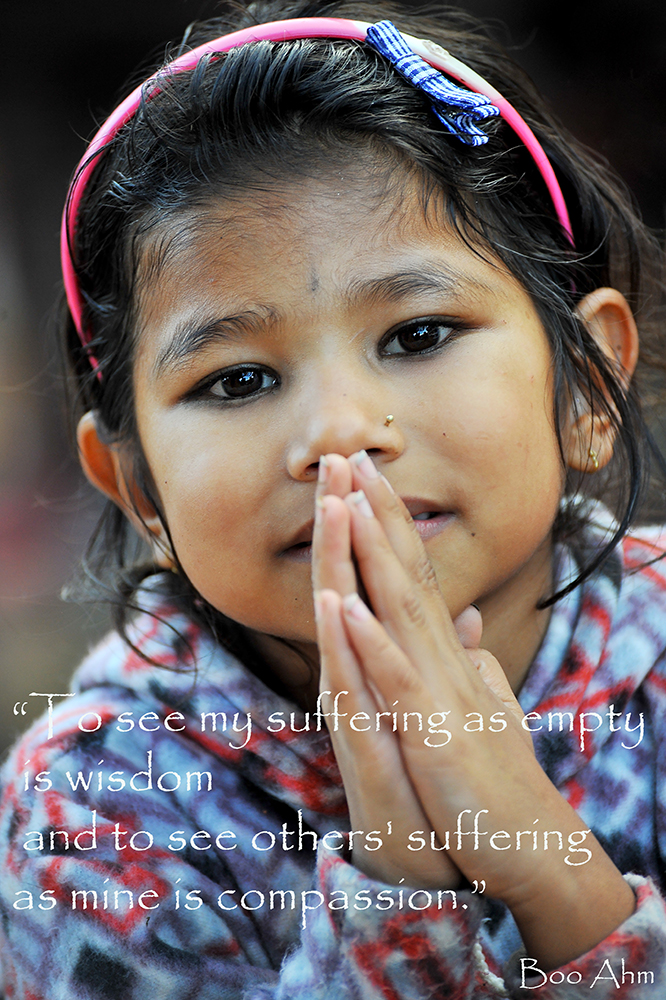
A. To see your suffering as empty is wisdom, and to see others’ suffering as yours is compassion. You should be able to see your son’s problem as yours and at the same time, see your suffering caused by him as empty.

It is very easy and natural that you, as a parent, look upon his problem as yours. However, seeing your suffering as empty is not easy. Especially when he doesn’t follow but rather resists and defies your advice given with love and patience, and gets worse and worse, you are very likely to lose your head and even feel frustrated like you do now.

017_8985a_thumb


Remember that seeing such challenges as empty is wisdom. You should not let your life be spoiled by your son’s life. If your life is swayed and spoiled by his life, you are not leading your life but led by it because you don’t know that everything is empty. Only when you can see the challenges as empty can you be happy and continuously remain as a firm pillar for him to depend upon.

©Boo Ahm
All writing ©Boo Ahm. All images ©Simon Hathaway http://ow.ly/i/wuSZG

Uncategorized

A Secret Book

A secret book

Once upon a time a man had a book that was treasured as an heirloom in his family which had been passed on for generations. The book held the secret of enjoying eternal happiness, and the secret was to possess nothing; we can enjoy everlasting happiness only when we possess nothing.

His family, from generation to generation, always tried to live as simply as possible to live up to what the book said, but no one in the family lived an eternal life. Why do you think no one in the family could make the secret come true?

017_9996a_thumb


The key mistake they made was to keep the secret book with them to the end without discarding it. What they got from the great book handed down generation after generation was not eternal happiness but only a needy life after all. Which is to blame for it, the family or the book?

When everything is empty, there are no exceptions.

©Boo Ahm
All writing ©Boo Ahm. All images ©Simon Hathaway http://ow.ly/i/wqSnY

Uncategorized

Q. Student: “How would the universe answer its own question if the universe asked itself, ‘What is it?’?”

Q. Student: “How would the universe answer its own question if the universe asked itself, ‘What is it?’?”

A. Master: “That is your question.”

SRH_3206a_thumb


Commentary:
He tries to earn money by selling his thing in another’s name to a buyer while not knowing that another and the buyer are himself.
Although seemingly nice deals are done one hundred times, he doesn’t make any money.

©Boo Ahm
All writing ©Boo Ahm. All images ©Simon Hathaway http://ow.ly/i/wmEVA

Uncategorized

Q. I sometimes feel that I am losing my mind. What can I do to feel better?

Q. I sometimes feel that I am losing my mind. What can I do to feel better?

A. Do you happen to know what you are and what your mind is when you feel that you are losing your mind? Do you happen to know how you are different from your mind? Your problem, like others’, is that you don’t know who is losing what or what is happening, although you feel that you are losing your mind.

What is the mind that you feel you are losing? The thought that you feel that you are losing your mind is none other than the action of your mind. Above all, observe carefully how you are losing your mind. Try to know clearly either what you are, or what your mind is. In the course of observing, you will feel much better, and you will get permanent happiness if you come to realise clearly either you or your mind.

017_8715a_thumb


Student: “I feel that I am losing my mind. What shall I do in order not to lose my mind?”
Master: “Hold it firmly.”
Student: “How can I hold it firmly?”
Master: “Let go of it.”
Student: “How can I let go of it?”
Master: “Are you holding it now?”
Student: “No, I am not. I don’t know how to hold it.”
Master: “If you are not holding it now, you already let go of it. Your problem is not knowing what you feel you are losing.”

©Boo Ahm
All writing ©Boo Ahm. All images ©Simon Hathaway http://ow.ly/i/vB4KW

Uncategorized

Q. What does enlightenment have to with happiness?

Q. What does enlightenment have to with our happiness?

A. As I have mentioned previously, we are living in a world of memory that is called the realm of form. Form means the imaginary lines produced by us. We are living in a world of countless complicated imaginary lines that we have drawn and are drawing constantly. The problem is that we often stumble over the imaginary lines and can’t move freely because we are caught by the lines.

_SRH5790a_thumb


Attaining enlightenment is to realise that everything is an imaginary line, an illusion. When we can clearly realise that all things are just imaginary lines, we don’t stumble over or are not caught by the lines any longer. We can erase all the lines at will, and draw our own lines for the sake of our convenience, instead of struggling to fit into the lines drawn by others. In other words, we can enjoy our life by drawing the lines that suit us best.

So, enlightenment enables us to enjoy much more happiness than before.

Student: “What is the difference in my life before and after enlightenment?”
Master: “Before enlightenment, your life leads you, but after enlightenment you lead your life.”

©Boo Ahm
All writing ©Boo Ahm. All images ©Simon Hathaway http://ow.ly/i/vB4Bs

Uncategorized

Q. Why did the master say that his assistant forsook him?

Q. Why did the master say that his assistant forsook him?

A. Echu, called Kokushi, the teacher of the emperor, called his attendant, Oshin, three times and three times Oshin answered, “Yes!” Kokushi said, “I thought that I had forsaken you, but in reality you forsook me!”

Student: “Why did the master say that his assistant forsook him although he answered three times when the master called him three times?”
Master: “Because one of them is deaf.”
Student: “Which is deaf?”
Master: “Regardless of which of them is deaf, it is certain that you are deaf.”

017_8723a_thumb


Commentary:
The poor student thinks that it not because he is deaf but because his master doesn’t say the answer that he can’t hear the answer.

©Boo Ahm
All writing ©Boo Ahm. All images ©Simon Hathaway http://ow.ly/i/vB4Sr

Uncategorized

Q. Is Zen supposed to be very difficult?

Q. Is Zen supposed to be very difficult?

A. Zen is neither difficult nor easy in itself, but neutral like all other things. Whether it is difficult or easy depends on the view of each of us. What matters is whether you can enjoy it or not.

017_8550a_thumb


I’d like to tell you to enjoy Zen in your everyday life like playing chess. All chess players want to win all their games. None of us, however, like to play chess with a 5-year-old child who has just barely managed to learn the basic rules about how to move chess pieces, even though we can win every game easily. The reason that we do not enjoy it is that we are not challenged by difficulties that are thrilling and, at the same time, we think playing with him is not helpful in improving our ability. We like to play with similar or higher-grade players because then we can enjoy more challenges. The reason that we are willing to accept such difficulties is that we can enjoy a sense of thrill and we think that the challenge we face with higher-grade players can elevate our ability.

Likewise, when you feel that you are facing a difficult time in your Zen practice, that is, when you seem to be stagnant without any progress, you should think that you are having such a hard time because you are making a lot of progress. Then, you can enjoy even such difficulty.

©Boo Ahm
All writing ©Boo Ahm. All images ©Simon Hathaway http://ow.ly/i/vMDYI

Uncategorized

Q. If everything is empty, why don’t people look at me in that way?

Q. If everything is empty, why don’t people look at me in that way?

A. What matters now is not whether or not others see you as empty, but whether you yourself can see things in that way. If you can see things as empty, you will not care about what others think of you, because you will know that not only they but also their way of seeing you is empty.

_SRH0449a_thumb


However, if you can’t see things as empty, you will still have problems even if all other people around you can see everything including you as empty. You might still be discontent even if they see you as empty. When you are hungry, you yourself should eat food in order to meet your hunger. No matter how much food others may eat, you can’t avoid feeling hungry unless you yourself try food.

©Boo Ahm
All writing ©Boo Ahm. All images ©Simon Hathaway http://ow.ly/i/vMDDn

Uncategorized

Q. How did the boy become enlightened when Gutei raised up his finger?

Q. How did the boy become enlightened when Gutei raised up his finger?

A. Gutei raised his finger whenever he was asked a question about Zen. A boy attendant began to imitate him in this way. When a visitor asked the boy what his master had preached about, the boy just raised his finger.

Gutei heard about the boy’s mischief, seized him and cut off his finger with a knife. As the boy screamed and ran out of the room, Gutei called to him. When the boy turned his head to Gutei, Gutei raised up his own finger. In that instant, the boy was enlightened.

When Gutei was about to die, he said to the assembled monks, “I received this one-finger Zen from Tenryu. I used it all my life and yet could not exhaust it” and then he passed away.

017_8721a_thumb


Student: “How did the boy become enlightened when Gutei raised up his finger?”
Master: “Nothing special at all. The boy saw what I am showing to you now.”
Student: “What is it?”
Master: “You are showing it to me now.”
Student: “What is the one-finger Zen that Gutei received from his master Tenryu?”
Master: “That is nothing special, very common.”
Student: “Can I get it, too?”
Master: “You already have it.”
Student: “How can I know that I also have it?”
Master: “Can’t you raise your finger?”

Commentary:
Why aren’t we as wise as Gutei even though all of us have the same ten fingers as Gutei did?”
The wise are not concerned with such fingers.
Don’t say that Gutei passed away. He hid himself in his finger.

Boo Ahm
All writing ©Boo Ahm. All images ©Simon Hathaway http://ow.ly/i/vMDfz