A monk asked Master Suksang, “Why can’t I see your face although we are this close to each other?” Suksang answered, “I’ve never hidden myself, which is all around the world.” The monk, failing to grasp this answer, asked Master Sulbong about Suksang’s answer. Sulbong answered, “What is not Suksang?”
Student: “If Suksang is everywhere just as Sulbong said, what is he like?”
Master: “Like a monkey.”
Commentary:
When seeing all figures of birds and flowers being embroidered, you should be able to see the needle.
“Subhuti, that which is called Buddha Dharma is not Buddha Dharma.”
Commentary:
The phrase “That which is called Buddha Dharma is not Buddha Dharma” signifies that all things are inherently Empty (the true-Self). In their true essence, they have no names, no boundaries, and no forms; they are One. The terms ‘Buddha Dharma’ ‘the true-Self’ ‘Emptiness’ ‘the Buddha’ ‘the Middle-Path’ are merely expedient means—names borrowed from worldly language to explain this truth. We must not be deceived by the words and mistake Buddha-Dharma for something with a specific, tangible form. In short, one can only attain enlightenment by not being deceived by words and appearances.
For instance, the statement ‘All things are Empty’ is the core teaching of Buddhism. If we truly understand this, the very words “All things are Empty” must also appear and sound empty to us. In other words, we must perceive these words not as mere language, but as the functioning of Emptiness (the true-Self) itself. Once you truly comprehend the Diamond Sutra, it should no longer appear as Sutra but as Emptiness.
Similarly, Emptiness is simply another name for Buddha. To say ‘All things are Empty’ is to say ‘All things are Buddha’. These names are given for convenience to describe that which is nameless, formless, boundless, infinite, and eternal. Do not be fooled by the word ‘Buddha’ into thinking of Him as an omnipotent being with a specific physical form.
Therefore, when you see the word ‘Buddha’ or hear the name ‘Buddha’, you must be able to see and hear the formless Emptiness beyond the name and image. If you worship the Buddha as a specific entity (like a statue), that is idolatry, not Buddhism. This is why ancient masters would say, “If you meet the Buddha, kill the Buddha.” The Buddha’s teaching to Subhuti regarding the Buddha Dharma carries the same meaning as saying ‘What is called the Buddha is not the Buddha’.
The Buddha was teaching us how to see and hear the true-Self (Buddha-nature) in everything we encounter in daily life. For example, when looking at a flower, applying the teaching would be: “Subhuti, what is called a flower is not, in fact, a flower.” This is seeing and hearing things as they truly are. To see everything in this way is to reach the state described in the Avatamsaka Sutra: “I see Buddhas as numerous as motes of dust in every direction, yet they do not come here, nor do I go there.”
Consider the encounter between Master Dazhu Huihai and Master Mazu:
Mazu asked, “Where do you come from?”
Huihai replied, “From Dayun Temple in Yuezhou.”
Mazu asked, “What do you intend to do by coming here?”
Huihai said, “I have come to seek the Buddha Dharma.”
Mazu remarked, “You ignore the treasure in your own house and leave it behind to run elsewhere. I have nothing here; what Buddha Dharma are you seeking?”
Huihai bowed and asked, “What is my own treasure?”
Mazu replied, “That which is asking me right now is your treasure. It is complete with everything, lacking nothing, and you can use it freely. Why do you seek it outside?”
At those words, Huihai realised that his original mind did not depend on sensory knowledge. Everything in this world is the Buddha Dharma, and we ourselves are Buddha Dharma itself. We simply fail to recognise it because we are deceived by appearances.
As the Avatamsaka Sutra says: “Just as the nature of space is one, so are the Buddha’s form and voice; they pervade all of space, yet each sentient being sees and hears them differently according to their own heart and wisdom.” The Buddha is everywhere, but we miss Him even when He is right before our eyes. The effort to see and hear everything as it is, is practice, and reaching this state is called entering the Pure Land, seeing the Buddha, and attaining Enlightenment.
Disciple: “What is the Buddha Dharma?”
Master: “No one can hide it.”
Disciple: “If no one can hide it, why can’t I see it?”
Master: “Because you turn away from the Buddha-Dharma right before your eyes to search for it elsewhere.”
Since the Buddha Dharma is not the Buddha Dharma,
What is the Buddha-Dharma?
The Buddha-Dharma veils the eyes,
Making it impossible to see the true Buddha Dharma.
Koan:
When a monk asked National Teacher Huizhong, “What is the great meaning of the Buddha-Dharma?”
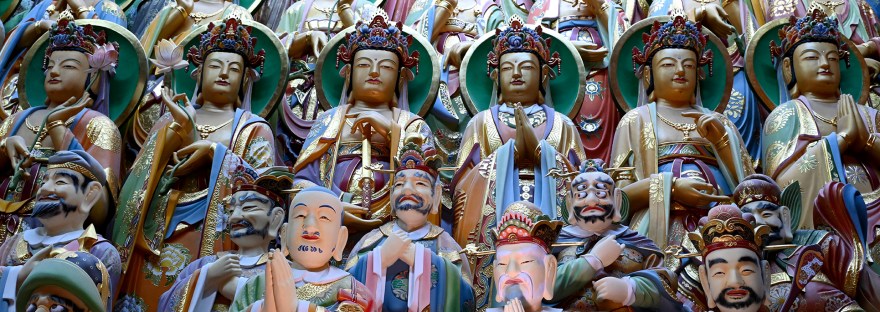
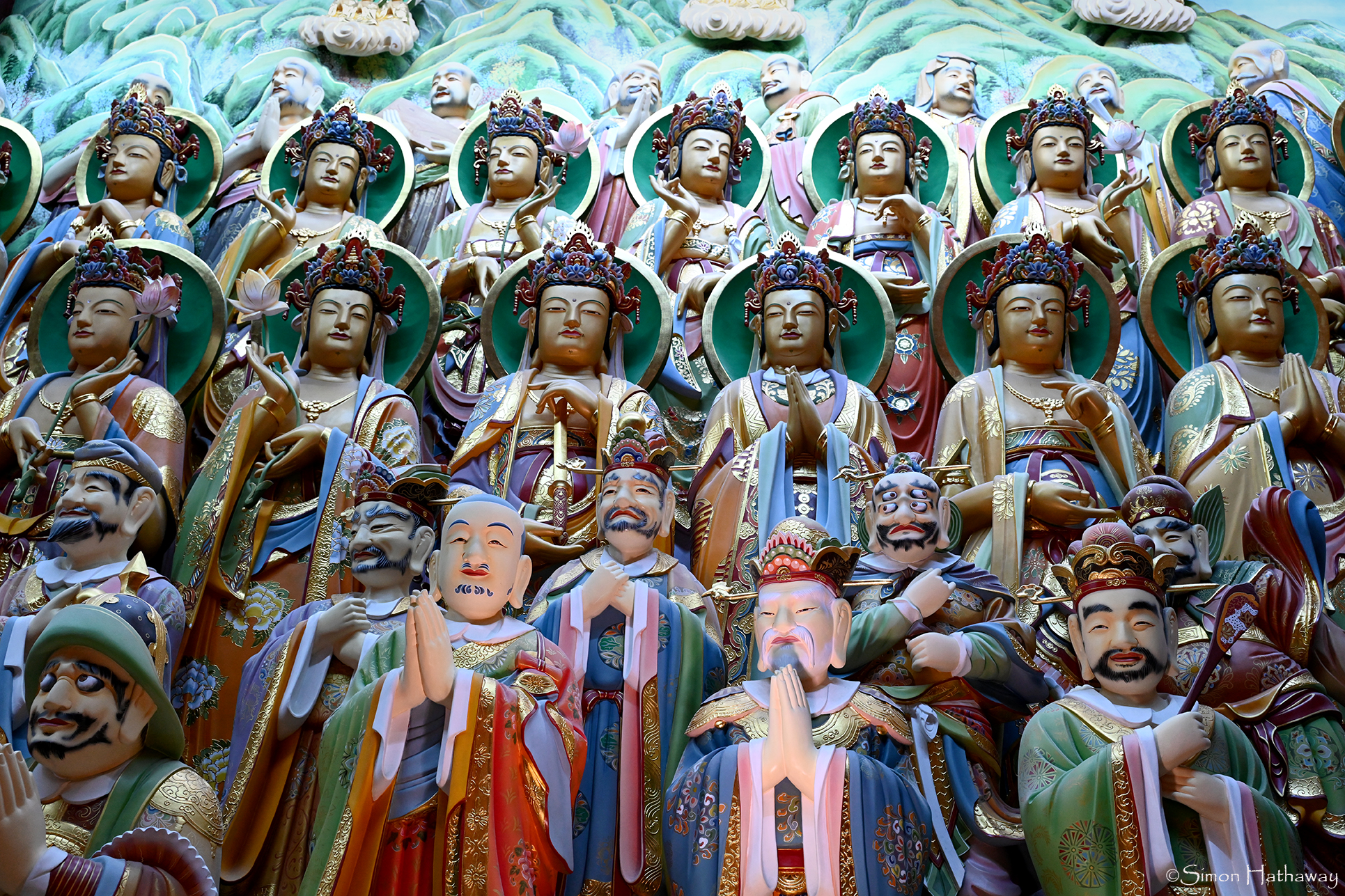
The National Teacher replied, “The many Bodhisattvas inside the Manjushri Hall.”
The monk said, “I do not understand.”
The National Teacher replied, “The Thousand Hands and Eyes of Great Avalokiteshvara.”
Question 1: What is the meaning of “The many Bodhisattvas inside the Manjushri Hall”?
Question 2: What is the meaning of “The Thousand Hands and Eyes of Great Avalokiteshvara”?
You should not follow them but realise what they are pointing to. Treasuring and sticking to them is being deluded by them. This is, as mentioned many times before, why the Buddha said that He didn’t say even a single word.
For example, there is a very common and popular sentence ‘everything is empty’ which is the core of Buddhism. If we truly understand this, we should know that the words ‘everything is empty’ are also empty, that they are not words anymore but the function of Emptiness and that there is nothing to treasure and follow.
There was a man whose mother was suffering from incurable illness. No matter how much he wanted to help his mother, there was nothing he could do. He felt like running away with his mother to somewhere free from such an illness and said to his mother, “Mum, let’s run away to somewhere.” Hearing this, she just made a pale smile without any words.
Student: “How can we go the place without illness and death and this world?”
Master: “It is just like going to Britain whilst in London.”
Commentary:
The wise can get there without moving a single step while the foolish can’t go there despite wandering even by air, or by ship for decades.
“Why? Subhuti, it’s because all the Buddhas, and the Dharma of unexcelled complete perfect enlightenment of all the Buddhas, come from this Sutra.”
Commentary:
The Sutra spoken of here, as mentioned previously, is not the collection of sentences written or printed on paper, but refers to Emptiness, which is our Mind or the true-Self.
Another saying used to describe this Sutra is: ‘Every person possesses this Sutra; it has neither form nor name, and no one knows how to read it. If “I” (ego) exists, it cannot be read. But if one can read it through, one will enter the principle and accord with non-birth. When that happens, one neither debates the Bodhisattva path nor strives to achieve Buddhahood’. In short, knowing how to read this Sutra means knowing the true-Self, the Buddha-nature, which signifies enlightenment.
As the Buddha said, ‘Everything is created by the Mind alone’. Not only the Buddha and the Sutra, but everything has emerged from this Sutra (Mind), and nothing exists outside of it.
The fact that everything emerged from this Sutra means that everything is the Sutra, and in other words, everything is the function of this Sutra that is the true-Self, meaning everything is the Buddha. This is why the Sutra is called another name for the Buddha, and the names of all things are the names of the Buddha.
Therefore, each of us is a Sutra and we must be able to read our own Sutra, as well as all surrounding Sutras, including the Parents Sutra, Siblings Sutra, Husband Sutra, Son Sutra, Daughter Sutra, and Friend Sutra.
Here is a story that illustrates that the Sutras printed on paper are not the true Sutras:
Master Goryeong Shinchan, after becoming a monk at Daejungsa Temple in his hometown of Fukuzhou and studying scholasticism, embarked on a journey for enlightenment and attained enlightenment under Master Baizhang. He then returned to Daejungsa and attended to his old master.
One day, his old master asked Shinchan to scrub his body while bathing. As Shinchan rubbed his back, he remarked, “The Buddhist shrine is truly wonderful, but the Buddha is not efficacious.” When the master turned his head to look intently, Shinchan added, “The Buddha may not be efficacious, but he is emitting light.”
Another day, the old master was reading a Sutra by the window when a bee that had entered the room kept bumping against the paper window, trying to get out. Seeing this, Shinchan said, “The world is so vast and wide, yet it does not seek to leave, only trying to bore through old paper. It will only be able to leave in the Year of the Donkey.” With this remark, he gently provoked his master, suggesting that being attached to the words and letters on the paper Sutra means being trapped forever in the ocean of suffering.
Upon hearing this, his master closed the Sutra and asked, “Who did you meet during your travels? When I compare you with what you used to be, your words are truly different!”
Shinchan replied, “Master Baizhang taught me the place to rest. Now I only wish to repay the compassionate grace of my Master.”
The old master then informed the assembly to prepare for an offering and requested Shinchan to give a Dharma talk. Shinchan ascended the Dharma seat and proclaimed: “The divine light shines alone, free from the six sense organs and six illusions. The body manifests the true eternal nature (the true-Self), unconstrained by letters. The original nature of the Mind is untainted, inherently and spontaneously perfect. If one is not led astray by false thoughts, one is immediately the Buddha.” Upon hearing this revelation of what the true Sutra is, his master felt awakened and said, “How could I have imagined that I would hear such words of ultimate principle in my old age?”
This story tells how the old master, who had only seen the Sutra written on paper, was finally able to read the True Sutra thanks to his disciple.
The True Sutra that every one of us possesses can never be put down, is always spread out before us, and can be read anywhere, regardless of whether it is bright or dark. Ancient masters would say, ‘A wise person can read this Sutra without any inconvenience even in the darkest midnight, but a foolish person cannot read it even in broad daylight.’ Constantly striving to read this Sutra is practice.
Disciple: “What is the True Sutra?”
Master: “Thank you for showing it to me and reading it.”
Everything emerges from this Sutra,
All Buddhas emerge from this Sutra,
And unexcelled complete perfect enlightenment also emerges from this Sutra.
Yet, all calamities also emerge from this Sutra,
Do not let it become the gate of calamity.
Koan:
This took place when Master Goryeong Shinchan was studying under his master. One day, the master was reading a Sutra by the window when a bee kept bumping against the paper window, trying to get out. Seeing this, Shinchan remarked:
“The world is so vast and wide, yet it does not seek to leave, only trying to bore through old paper. It will only be able to leave in the Year of the Donkey.”
His master closed the Sutra.
Question 1:
What was the reason Master Shinchan spoke in this manner to his master?
Question 2:
How must Shinchan’s master act to be able to exit into the vast world?
Buddhism doesn’t say that we shouldn’t rely on words and letters but that we should use them well and wisely as expedient means. Words and letters are like a finger pointing to the moon and not the moon itself.
When hearing, or reading words ‘Everything is from the mind’, we should not be attached to these words, thinking that they are the core of Buddhism. Instead, we should see them not only as words but also as the function of the mind as well, because the words are also the function of the mind when everything is mind.
A monk asked Master Suksang, “Why can’t I see your face although we are this close to each other?” Suksang answered, “I’ve never hidden myself, which is all around the world.” The monk, failing to grasp this answer, asked Master Sulbong about Suksang’s answer. Sulbong answered, “What is not Suksang?”
Student: “Why can’t the monk see Suksang’s face although they are close to each other?”
Master: “Because he thinks that he is close to the master.”
Commentary:
A distance of a hair’s breadth leads to a gap as wide as heaven and earth.
“Subhuti, what do you think—if someone gives seven kinds of treasures in charity that are sufficient to fill a billion-world universe, would this person gain many blessings?” Subhuti said, “Very many, World Honoured One. Why? These blessings are not of the nature of blessing; therefore, the Realised One says the blessings are many.” The Buddha said, “If anyone accepts and holds even a single four-line verse from this Sutra, and tells it to others, the blessing exceeds the aforementioned.”
Commentary:
To accept, uphold, and expound a four-line verse from this Sutra does not mean merely handing over a Sutra printed on paper or silk, or carved on wood or stone, nor does it mean memorising its characters and telling others. If one reads the Sutra merely following the words, it is said to become the discourse of a demon.
The Avatamsaka Sutra states, “Appearing before us in every place, the Buddha expounds the wondrous Dharma through various skilful means, bringing benefit to all sentient beings.” In the same way, when we see the Buddha who is always with us, when we become one with the Buddha, and when everything we see appears as the Buddha and when everything we hear sounds as the Dharma talk, then, as the Lotus Sutra says, ‘The moment one realises the true-Self, any word—whether from books we read, political discourse, wealth, or one’s profession—becomes the Dharma talk.’ We must understand that everything we see and hear is the Buddha and his Dharma, and that all our actions and sounds are none other than the Dharma talk of the four-line verse.
When this is realised, wherever we go, we ourselves are the Sutra, and our every word is the Buddha’s Dharma talk. This is what it means to constantly carry the Sutra and to expound the four-line verse to others.
To achieve this, when reading the Sutra, one must never be deceived by the words but must discern the true-Self that the words point to. Therefore, Subhuti’s saying, ‘These blessings are not of the nature of blessing; therefore, the Realised One says the blessings are many’ means that true blessing is seeing the true-Self. The Buddha’s intention when speaking the word ‘blessing’ was not the literal word itself, but a term to reveal the Buddha-nature. If accepted as the secular notion of blessing according to the words, it would be described by a limiting term like ‘many’. But if a four-line verse is accepted as the Buddha intended and transmitted to others, that blessing is infinite, transcending the description of ‘many’ ‘few’ ‘much’ or little’.
Here is a good example regarding blessing.
This is an anecdote about Bodhidharma, who came to China and met Emperor Wu of Liang, known as the ‘Emperor of the Buddhist Dharma.’
Emperor Wu: “I have built a thousand monasteries, erected a thousand pagodas, and provided offerings to over twenty thousand monks. How great is the blessing I have accumulated?”
Bodhidharma: “None.”
Patriarch Bodhidharma directly showed the true blessing, but Emperor Wu failed to recognise it. He later regretted it and composed the following poem. One must understand the meaning of Bodhidharma’s answer, “None” in order to transmit a four-line verse:
Alas! I saw him with my eyes yet failed to recognise him,
I met him yet failed to serve him.
We stood face to face yet I did not see him,
Both then and now, I am filled with resentment and regret.
Disciple: “What is a four-line verse?”
Master: “It cannot be written down.”
Disciple: “I don’t know.”
Master: “You have already said it.”
The Seven Treasures filling the three-thousand-great-thousand world,
And the four-line verse—
Only when there is no hair’s breadth of difference between them
Can one enjoy the Buddha’s blessing.
Koan:
A monk asked National Teacher Huizhong, “What is the mind of the ancient Buddha?”
Huizhong replied, “Walls, broken tiles, and pebbles.”
Question:
What is the meaning of National Teacher Huizhong’s answer to the monk’s question?
There is a well-known saying that we shouldn’t try to find mind with mind. The core of the Buddhist teaching is non-duality, Oneness. Don’t try to find something that is different and separate from what you see and hear. Reaching something, or somewhere means connecting yourself with the thing, or the place that is separate from you.
Remember that when you find yourself groping for the true-Self with your thoughts, your thoughts are no other than the function of the true-Self that you are struggling to reach. This is why ancient masters would say, “Why do you ask me where the food is that you are chewing in your mouth?”.
There was a man whose mother was suffering from incurable illness. No matter how much he wanted to help his mother, there was nothing he could do in this world. He felt like running away with his mother to somewhere free from such an illness and said to his mother, “Mum, let’s run away somewhere.” Hearing this, she just made a pale smile without any words.
Student: “Is there anywhere else beyond here where we can escape illness and death?”
Master: “There is.”
Student: “Where is it?”
Master: “Not far.”
Commentary:
It is neither far nor near because there is no distance at all.