Once upon a time, Nam-jeon asked a scholastic monk, “What sutra do you teach?” And the monk replied, “I lecture on the Future Buddha Sutra.” Then, Nam-jeon asked again, “When will the Future Buddha come?” The monk replied, “At present he is in Heaven, but soon he will come.” Then Nam-jeon said, “There is no Future Buddha in heaven, and there is no Future Buddha under the earth.”
Student: “When will he come?”
Master: “He neither goes nor comes.”
Commentary:
The Buddha is the Future Buddha until you recognise the Buddha.
“Subhuti, I, the Realised One know and see all. All these sentient beings will attain infinite blessing this way.”
Commentary:
The infinite blessing is not given by the Buddha nor can it be taken away by someone else. We are already the infinite blessing itself and are surrounded by it at the same time. What matters is whether we can recognise it or not. So, attaining infinite blessing this way refers to discerning infinite blessing on reading, or hearing the Buddha’s words and not getting it anew from outside. The Buddha’s teaching is that everything seen and heard is nothing but infinite blessing and that anyone can enjoy it only if we can recognise it by seeing all things as they are in the same way the Buddha sees all things.
What should be engraved on our hearts is that ‘all things’, without exception, includes not only these words we are reading now but also ourselves.
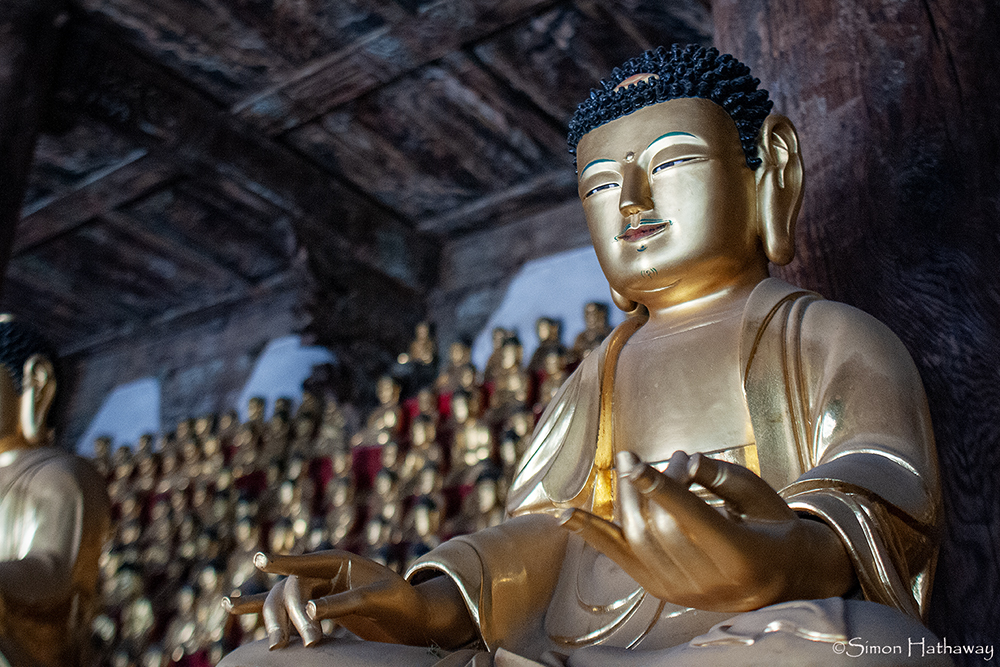
A. These words are saying that we should not be deluded by the images of the Buddha and patriarchs, by seeing them as they are, because they are just imaginary figures created by your imagination. The essence of their being is not only formless as emptiness but also one with yours.
If you, thinking that there is any other Buddha than yourself, try to follow him to be with him, it is to be deluded by the illusion of the Buddha. You should never make the mistake of allowing yourself, the true Buddha to follow and worship the illusion of the Buddha.
Once upon a time, Nam-jeon asked a scholastic monk, “What sutra do you teach?” And the monk replied, “I lecture on the Future Buddha Sutra.” Then, Nam-jeon asked again, “When will the Future Buddha come?” The monk replied, “At present he is in Heaven, but soon he will come.” Then Nam-jeon said, “There is no Future Buddha in heaven, and there is no Future Buddha under the earth.
Student: “Where is the Future Buddha?” Master: “Nam-jeon showed him.”
Commentary: There is no other Buddha than the Buddha right before our eyes.
Subhuti said to the Buddha, “World Honoured One, will any sentient beings develop genuine faith by hearing these words?” The Buddha said to Subhuti, “Don’t talk in that way. In the last five hundred years after the death of me, the Realised One, there will be those who keep the precepts and do good deeds, conceive faith in these words and consider it to be true. You should know that because those people have planted roots of goodness, not with one, two, three, four, or five Buddhas, but with infinite thousands of myriads of Buddhas, they will conceive pure faith on hearing these words for even a moment.”
Commentary:
To plant roots of goodness with infinite thousands of myriads of Buddhas means to see all the Buddhas, to attain enlightenment by seeing all things as they are, and to conceive pure faith means that we become faith itself through realising that we are the Buddha itself.
The key point of this paragraph is how we ourselves can be those who the Buddha predicted would conceive pure faith upon reading, or hearing these words. No matter how many people may conceive pure faith, it is of no use at all if we can’t conceive pure faith. No matter how many Buddhas others may have planted roots of goodness with, it is not as good as if we see a single Buddha upon reading, or hearing these words at this moment.
The aim of Buddha’s talks such as this is not to let us accumulate knowledge through literal understanding about certain facts but to lead us to conceive pure faith by planting roots of goodness through seeing and hearing his words as they are. Put simply, the Buddha’s intention in delivering his talk is to show the true-Self rather than to state certain facts.
So, keeping it in mind that the Buddha said, “Not a word have I said” on his deathbed lest we should be deluded by his words, we should try to see and hear what is beyond words hidden in each of his words instead of being satisfied with intellectual understanding. This is why ancient masters would say that the Sutras are no better than Mara’s talk if we are deluded by words.
Student: “How can I plant roots of goodness with infinite thousands of myriads of Buddhas?”
Master: “Don’t be deceived by the words not preached by the Buddha.”
Student: “Who has planted roots of goodness with infinite thousands of myriads of Buddhas?”
Master: “They are those who can see the Buddha upon hearing, or reading these words.”
A. If you can see everything as empty by attaining enlightenment, you can know that everyone, including your late parents, whether alive or dead, is in the Pure Land. This implies that once you attain enlightenment, you can lead not merely your parents but also all your ancestors to the Pure Land.
This is why it is said in Buddhism that if one family member becomes a monastic, all of his or her family members, including his or her ancestors, are well off in Heaven.
Dongshan told the assembly at the end of the summer training period, “When summer ends and autumn begins, go straight to a place where there is not an inch of grass for ten thousand miles.” No one in the assembly could respond. Later, a monastic told Shishuang about it. Shishuang said, “Why didn’t you say, ‘There is grass everywhere one step outside the gate’?”
Student: “Where is the place where there is not an inch of grass for ten thousand miles?”
Master: “Dongshan and Shishuang showed it.”
Student: “Where is it?”
Master: “It is where you can do nothing.”
Commentary:
The Buddha prefers doing nothing to doing a good thing.
The Buddha said to Subhuti, “All forms are illusory; if you see that forms are not characteristics, then you see the Realised One.”
Commentary:
Here the Buddha tells a more concrete way to recognise the true-Self. ‘If you see that forms are not characteristics, then you see the Realised One’ means that when you see a flower, for instance, if you see that the flower is not a flower, when you see a person, if you see that the person is not a person, that is, if you see that whatever you see and hear is not what you have thought and believed it is, then you can see the true-Buddha, the Realised One, or the true-Self. Put more easily, if we can see everything without attaching any words to it, we can see the real Buddha instead of being deluded by the illusions of the physical features of the historical Buddha. We should know that the real Buddha is originally formless and nameless and that he neither was born nor passed away. Identifying the Buddha with any form is idolatry, which is to dwell on a form and to be deluded by an illusion. This is why ancient masters would say that we should kill the Buddha if we meet him.
What matters here is that the way to see the real Buddha explained above is the way to see ourselves. We should see ourselves in the same way we see the Buddha. The true-Self is the essence of not only the historical Buddha but also everything, including us. Being able to see the real Buddha means being able to see everything as the Buddha. It also implies to see the essence of our being, to realise that we are the eternal and perfect Buddha.
If ‘the universe is neutral and perfect’ meant that nothing happens that we don’t want and that we neither have to do our best nor have to be responsible for anything, we human beings would be no better than robots. Then, we might be free from all suffering, but at the same time, it wouldn’t be possible for us be happy, that is, we wouldn’t be able to enjoy things such as a sense of fulfilment, or greatness that enable us to feel dignified and valuable, either.
In order not to make humans like robots, God endowed them with the right to make decisions and the responsibility for their decisions. In other words, God gave us the privilege of being able to feel happiness and sadness. However, we don’t see the universe as it is and are troubled by suffering because we mistake the perfect world for an imperfect burning house. So, God sent his son to lead us to realise that the burning house is no other than the Kingdom of Heaven by seeing everything as it is. God sent his only son to us so that he might teach us how to make the best of the privilege of being able to feel happiness and sadness. This is evidence that the universe is perfect.
Student: “What is the perfect aspect of human beings?”
According to the Sutras, Buddha once said, “I transmit the true Dharma that I have, to my student, Mahakasyapa.” before the congregation one day. Regarding this, a monk asked Master Heung-hwa, “What did Buddha transmit to Mahakasyapa then?” The master answered, “One person transmitted falsely, and ten thousand people transmitted truly.”
Student: “Why did the one person transmit falsely?”
Master: “Because of his compassion.”
Student: “Why did the ten thousand people transmit truly?”