
A. They can in the same way that you do. Your question shows how you are addicted to illusions. Why do you think they can’t practice because they can’t see and hear? If they had no sight, how could they feel that they can’t see? If they had no hearing, how would they realise that they are deaf? The blind and the deaf see and hear in a different way from ours, and have illusions of their own making in their way. If they think they are blind or deaf, the thoughts are also illusions. If they try to realise where such thoughts come from, that is a good Zen practice. They are as likely to reach the final goal, enlightenment, as you are.

Category: final goal
Q124. I always struggle with continuous thoughts during meditation. Will they disappear with time?
A. No, they won’t disappear in that way. You can’t win the fight.
When a thought arises, you can’t lock it in even with thousands of locks, can’t tie it up even with thousands of ropes, or destroy it even with a heavy hammer.
![]()
Don’t distinguish it as either good or bad, and also don’t try to stop it. Distinguishing between good and bad is adding one more thought to the existing thoughts, and trying to stop them is strengthening them. Fighting with thoughts is like fighting with shadows as long as you don’t realise the root. Leave them alone and just trace them back to their root. All the various thoughts are from the same root. The moment you realise the root of the thoughts, they will lose their power and change from your enemy to your servant.
©Boo Ahm
All writing ©Boo Ahm. All images ©Simon Hathaway
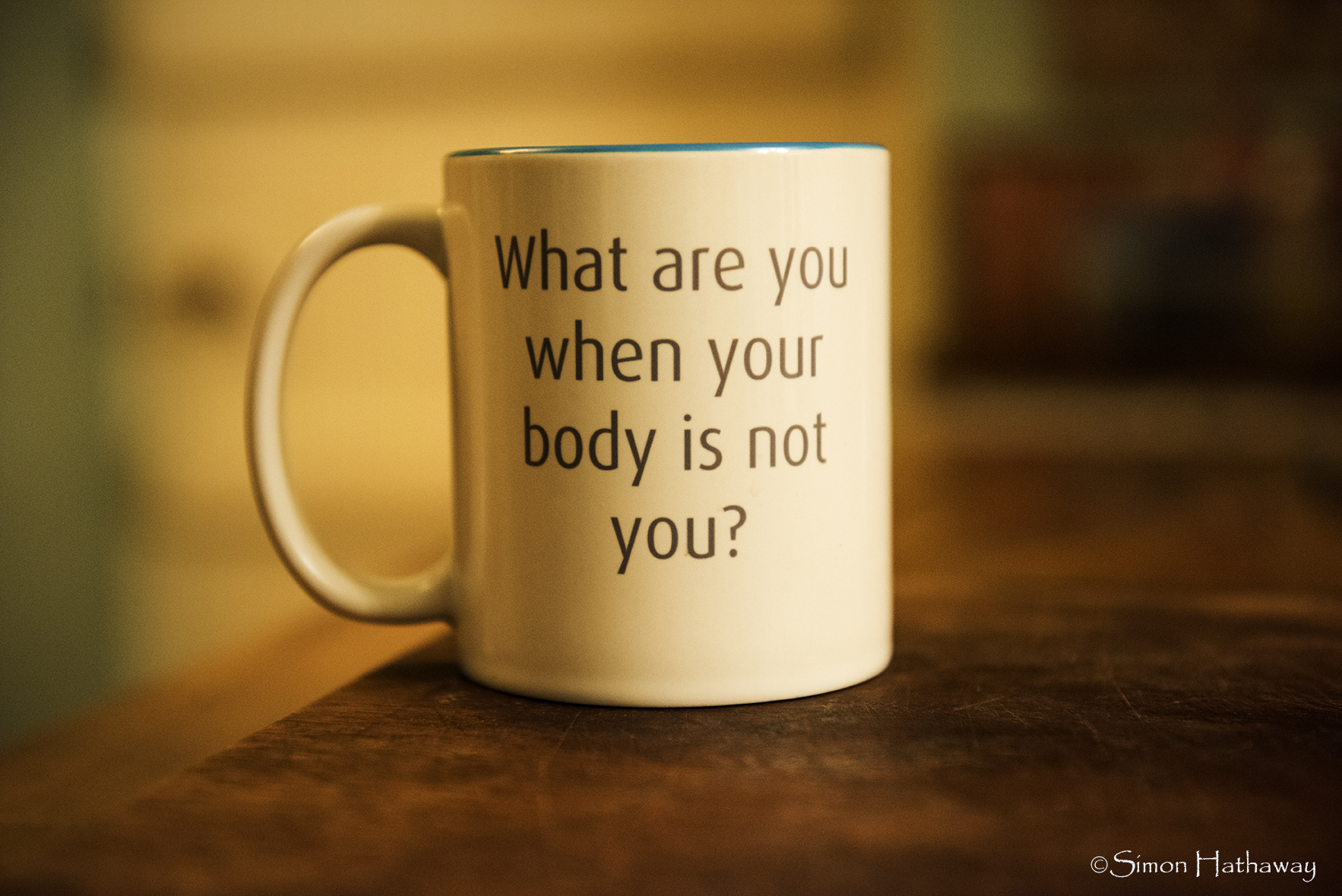
Q123. What shall I do in order to see what I am when my body is not me?
Q116. How can I remove illusions that cover my true-self?
A. Even though most people think illusions cover the true-self and try to see it by removing them, they in fact don’t know what illusions are and what the true-self is. In brief, they can’t distinguish illusions from the true-self because they’ve never seen the true-self. So they are not aware of the truth that the illusions are no other than the true-self.
Whatever you think of as illusions, don’t try to remove them by force. You can’t eliminate them since they are the true-self. Don’t strive to attain your true-self. You can’t not get it because it is already with you.
Don’t think we are looking for something that is hidden in a secret place we don’t know just like hunting for treasure on a treasure island. We are trying to ascertain in person the fact that we are the truth, i.e. eternity itself. Never try to remove illusions, but try to find the root from which they come.
The moment you find it, all the illusions will turn into the truth, your true-self.
©Boo Ahm
All writing ©Boo Ahm. All images ©Simon Hathaway
Q113. What is the middle path?
A. This is one of the most common misconceptions in Zen meditation or Buddhism. Most people interpret it as standing in the middle of both sides. They think, for instance, they should stand just in the middle of the right and the left without inclining toward either of them in order to keep the middle path. However, they are not in the middle path but are deceived by the illusions, the left and the right.
The truth is that the middle path means standing where there is neither side. In brief, you can be said to be in the middle path when all illusions have disappeared because the right side and the left side, as well as the centre and the edge are all illusions. Therefore, once all illusions have disappeared, you don’t have to try to keep the middle path because you can’t leave the middle path even for a moment.
©Boo Ahm
All writing ©Boo Ahm. All images ©Simon Hathaway
Q112. Why do you explain the true-self to us while saying it can’t be expressed with words?
A. It’s true that it can’t be explained with words, but paradoxically we can’t avoid using words to express it.
When masters, saying that it can’t be expressed with words, use words, we should know that they have another intention in using their words besides using them as a language. This alternative intention is primary and the language is secondary. So masters used to advise their students not to follow the secondary forsaking the primary. You should know their teachings are not the true-self itself, but signposts to the true-self.
©Boo Ahm
All writing ©Boo Ahm. All images ©Simon Hathaway
Q111. What are you when your body is not you?
A. Come again tomorrow.
I can’t tell you the answer today because I am not well today.
Commentary:
Come again tomorrow?
Don’t be fooled any more by the master.
His answer would be the same even if you were to come to him hundreds of times again.
If I were given the answer, I would say to him, “I am not asking him who is not well.”
©Boo Ahm
All writing ©Boo Ahm. All images ©Simon Hathaway
Q110. What shall I do when I have hatred for my friend for no particular reason?
A. Loving someone and hating someone, or loving someone today and hating him tomorrow, and the other way around is the way we live our lives. You don’t have to be worried about the fact that you hate your friend. The key point here is that you don’t know the root of the hatred you have for your friend. Saying you hate your friend, you actually don’t know who it is that hates your friend and who your friend is because you don’t know what you are. In brief, you don’t know who hates whom.
Either trace back your hatred of your friend to its root, or ask yourself what makes your body hate him, instead of repressing emotion. When reaching the root, that is finding the answer to the question, you will realise all emotions you feel are only illusions and then you can accept everything you experience like seeing a movie.
©Boo Ahm
All writing ©Boo Ahm. All images ©Simon Hathaway
Q109. If everything is the true-self, can I say that I am looking at my true-self while looking at this cup?
A. No, you can’t, because you are looking at a cup. As long as you see a cup as a cup, you can’t say that you see your true-self. Seeing a cup as a cup means seeing a car as a car and a person as a person, which means that all the labels or lines dividing one into many still remain. Your eyes, it is said, are covered with illusions or you are an open-eyed blind man.
The Buddha said, “If you realise that form is not form, you will see your true-self.”
Being able to see the cup as non-cup means that a car is not a car, a person is not a person any more to you and you are not you because all illusions have disappeared. The disappearance of all illusions means the disappearance of the lines that divide one into many. When all the lines disappear, many become one. There is no seer and no seen and no speaker and no listener in the situation where a cup is not a cup. It can be said that the seer is one with the seen, and speaker is one with the listener. There is nothing to mention, and speech is not speech any more here. Then everything, it is said, is the true-self. To experience this through your body in person is to realise the true-self.
©Boo Ahm
All writing ©Boo Ahm. All images ©Simon Hathaway
Q107. Can we realise the true-self through logic? If not, why not?
A. Your logic, however perfect it may be, might enable you to explain that everything is empty, but it prevents you from reaching the final goal.
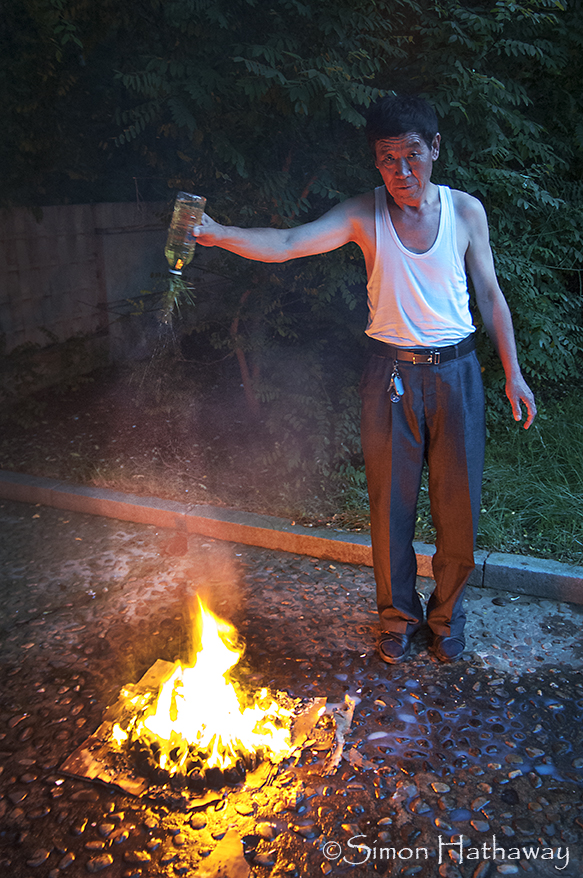
To see your true-self means to remove all illusions, but trying to build a perfect logic means strengthening your established illusions and adding to your illusions by creating new ones, or adopting the ones created by others. That is to go against your original intention of eliminating illusions, which is like fuelling a fire by pouring oil onto it, thereby making it more ferocious while intending to extinguish it. That is going in the opposite direction of your goal, against your intention.
All writing ©Boo Ahm. All images ©Simon Hathaway