Buddha, Buddhism, emptiness, empty, Enlightenment, illusion, master, Meditation, Photography, Practice, root, student, true self, Truth, Uncategorized, Zen

Q313. What is the true-self and what is an illusion?

A. The true-self is an illusion and an illusion is the true-self. When you can see, for example, the cup put before you as empty, it is the true-self, but it is an illusion when you can’t see it as empty and see it only as a cup. This is true of everything that you can see and hear; your wife, your friends, your puppy, et cetera. In other words, when you can see things as empty, everything is the true-self. When you can’t see things as empty, everything is an illusion.

srh_0455a_thumb


A thing doesn’t determine on its own whether it is seen as the true-self or an illusion, but it depends on whether or not you can see it as empty. When you can see everything as empty, you are said to have attained the eye of wisdom or enlightenment. So, an ancient master would say that if you get the eye of wisdom, all the rubbish heaps turn into treasure heaps. When you are enlightened, everything including yourself is perfection itself to you. That is referred to as the Pure Land or the Buddha Land.


Student: “What is the true-self?”

Master: “There is nothing that is not the true-self.”

Student: “Why can’t I see it?”

Master: “Because you seek it while seeing it.”


©Boo Ahm


All writing ©Boo Ahm. All images ©Simon Hathaway

Buddha, Buddhism, master, Meditation, One, Photography, Practice, root, student, true self, Truth, Uncategorized, Zen

Q311. What shall we do when we have no master around us?

A. Don’t think that you have no master around but think that you are not ready to meet him. Ready yourself to meet a master by asking yourself the questions that you will ask a master when you meet him. When a student is ready, a master will appear. When not ready, a student can’t recognise a master even though he appears before him. In fact, he is already beside you and always ready to help you. He is waiting to be recognised by you.

_srh8326a_thumb


All the people and everything around you are your master. Even you yourself are your master, too. They are giving Dharma talks to you every moment. Even you yourself are giving Dharma talks all the time. The point is that you are still not ready enough to hear the Dharma talk. Make yourself ready to meet him by practising hard and, sooner or later, he will suddenly appear before you.

©Boo Ahm


All writing ©Boo Ahm. All images ©Simon Hathaway

Buddha, Buddhism, Enlightenment, Truth, Uncategorized, Zen

​Q299. Is faith a stepping stone for or an obstacle to enlightenment?

A. Right faith and wrong faith are to your enlightenment as good food and bad food are to your health. Right faith is said to be a cornerstone rather than a stepping stone for enlightenment, which is very essential on the way to enlightenment. Wrong faith leads you in the opposite direction from your goal.

Right faith means a combination of the belief in the truth that you are a perfect and eternal being, determination to realise the truth by all means and the confidence that you can realise the truth. In fact, right faith is the foundation of Zen and it is impossible to attain enlightenment without right faith.

Wrong faith in Zen is to believe that there is an absolute being such as Buddha, or God somewhere else and that we have to depend on him for our eternal life or happiness since we are imperfect. That is no other than idol worship, or primitive religion. This means that we are deluded by imaginary figures created by our imagination. Producing imaginary figures is an obstacle to enlightenment because removing imaginary figures is the essence of Zen.

©Boo Ahm
All writing ©Boo Ahm. All images ©Simon Hathaway

Bible, Buddha, Buddhism, emptiness, empty, Enlightenment, illusion, Meditation, Photography, true self, Truth, Uncategorized, Zen

Q295. Shouldn’t I remove not only illusions but also the true-self since illusions are the true-self?

A. Of course, you should remove the true-self, too if you can. You should remove not only the true-self but also your mother and father. Only when have you removed all of them can you see the true-self and the true form of your parents.


Jesus said, “Whoever does not hate his father and his mother cannot become a disciple to me. And whoever does not hate his brothers and sisters and take up his cross in my way, will not be worthy of me.” Ancient Masters also said, “If you are to see the Buddha, kill Buddha.”


Why did Jesus tell people to hate their parents while saying that we should love our neighbours as ourselves? Why did Masters talk people into killing Buddha while teaching how to see Buddha? Both advised us to remove names, which are just imaginary lines.


_srh4801a_thumb


When we say ‘the true-self’, the name ‘true-self’ is not the true-self but only a label used to express the true-self. The more important a thing is to you, the more difficult its name is to remove. So, Masters would say that the more reasonable a comment sounds, the more firmly it will stick to you.


You should remove all names, or labels, whatever they are and no matter how important they look to you.

©Boo Ahm


All writing ©Boo Ahm. All images ©Simon Hathaway
Buddha, Buddhism, Enlightenment, final goal, master, Meditation, Photography, Practice, root, student, true self, Truth, Uncategorized, Zen

Q293. Is it possible to transmit enlightenment to other people?

A. ‘Transmit enlightenment’ and ‘Transmit dharma’ are very common sayings in Zen. These, however, are very incorrect expressions that can bring about misunderstanding. Enlightenment is neither a physical matter nor a type of knowledge that we can give and take in the way that we can do with gold, or the four rules of arithmetic.


Suppose that there is a person who, not knowing that he is already part of the Earth, wishes to go to the Earth. As a result of your efforts to help him, one day he realises the truth that he is part of the Earth that he has been so anxious to reach. You can say to him, “At last you have now realised the truth that you are part of the Earth.” Likewise, saying ‘You’ve now realised dharma,’ usually while giving a symbolic thing like a piece of writing or a robe, is said to be the transmission of dharma. The bowl and robe given to his student by Bodhidharma is a good example of this. Therefore, ‘Transmit dharma’ doesn’t mean to transfer dharma but rather to approve a student’s realisation of dharma.

srh_8220a_thumb


Student: “How can I receive enlightenment?”

Master: “You should have no hands.”


©Boo Ahm


All writing ©Boo Ahm. All images ©Simon Hathaway

Buddha, Buddhism, emptiness, empty, Enlightenment, final goal, master, Meditation, Mind, Photography, Religion, root, self, student, sutras, true self, Truth, Uncategorized, Zen

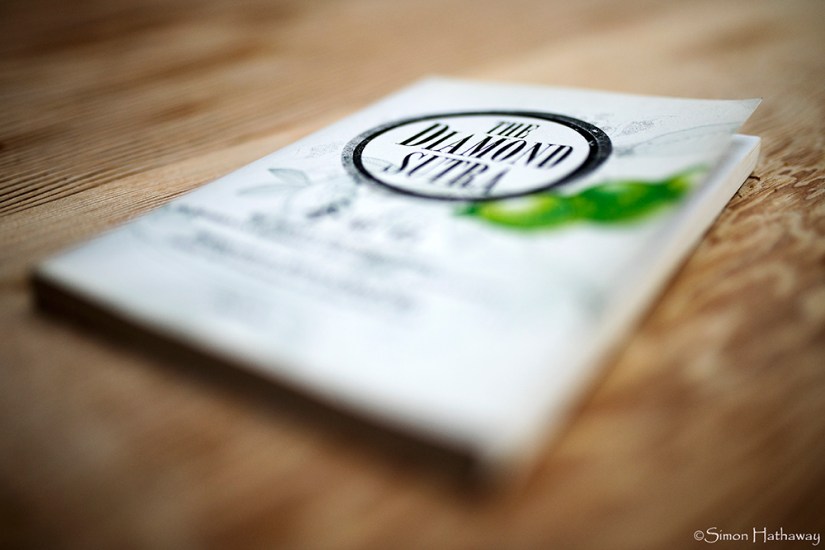
Q290. I have made it a rule to read the Diamond Sutra and Zen books every day for over ten years. Is this a good way?

A. It is said that going one kilometre by studying books is not as good as going one metre by practising. It’s because the former adds to illusions whereas the latter decreases them. The former regresses rather than advances us in Zen meditation. So, ancient masters would say, “Trying to attain enlightenment through books is like trying to pick the moon with a pole.”


Instead of spending so much time reading the Sutra and Zen books, I would like to advise you to allocate 90% of this time to practising meditation. The remaining 10% of this time can still be used for reading.

srh_3904a_thumb


Whatever you do, wherever you are, you are practising well only if you keep questioning what is making you do what you are doing. Reading the Sutras for ten hours is not as good as drinking tea, or washing the dishes for an hour with the question in your mind.


Master: “What did you do last night?”

Student: “I read the Diamond Sutra.”

Master: “How much did you read?”

Student: “I read three pages.”

Master: “You didn’t see the Sutra, let alone read it. The true Sutra has no pages.”


©Boo Ahm

All writing ©Boo Ahm. All images ©Simon Hathaway


Buddha, Buddhism, emptiness, empty, Enlightenment, final goal, illusion, master, Meditation, Mind, One, Photography, root, student, true self, Truth, Uncategorized, Zen

Q287. Why did ancient masters say that there is no Buddha in the Buddha Land?

A. The Buddha Land, interpreted literally, is a land without any sentient beings where only Buddhas are. When there is only Buddha without any sentient beings, Buddha is not Buddha any more than the right is the right when there is no left.

In fact, the Buddha Land is not a land somewhere else other than the Earth where we live but simply a non-discriminating mind without any illusions. Buddha and sentient beings are, in fact, illusions, all fruits of discrimination. In other words, when we don’t make any discrimination, there is neither Buddha nor sentient beings, which is called Buddha Land. So, one of the famous ancient masters used to say, “Pass by quickly where there is no Buddha, and don’t stay where there is Buddha.”

srh_3243a_thumb


Student: “Where is the Buddha Land?”

Master: “In your house.”

Student: “There is no Buddha, and there are only my wife and children in my house.

Master: “There is no sun to a blind man even at midday.”


©Boo Ahm


All writing ©Boo Ahm. All images ©Simon Hathaway

Buddha, Buddhism, Enlightenment, final goal, Koan, master, Meditation, Mind, Photography, Practice, root, self, student, true self, Truth, Uncategorized, Zen

Q285. Student: “You always say that everything within sight is the true-self. How can you show it to me?”

A. Master: “Am I not within your sight?”

_srh4603a_thumb


Commentary:

Why can’t the student see what is within his sight even though there is no barrier between them?

Instead, put up a barrier and he will see it.


©Boo Ahm


All writing ©Boo Ahm. All images ©Simon Hathaway

Buddha, Buddhism, Enlightenment, final goal, illusion, master, Meditation, Photography, Practice, root, self, student, true self, Truth, Uncategorized, Zen

Q276. Student: “Why is the true-self so invisible?”

A. Master: “Don’t speak ill of it. It has never hidden itself.”

srh_5140a_thumb


Commentary:

It’s like a lost child who has not seen his mother for so long that he can’t recognise her while being in her bosom.


©Boo Ahm


All writing ©Boo Ahm. All images ©Simon Hathaway
Buddha, Buddhism, emptiness, empty, Enlightenment, final goal, Happiness, illusion, Meditation, Mind, Photography, Practice, root, true self, Truth, Uncategorized, Zen

Q275. I am a little frightened that I may fall into emptiness.

A. It may be due to the impression that comes from the stereotype of the word ’emptiness’ that you have such a feeling. Some people are worried that if they fall into emptiness, everybody they love comes to look like a shadow or a ghost, and that they may lose the feeling of love and connection they have shared with them so far. They may also think that everything will seem to be so valueless and useless because it looks empty to them. In the end, they are afraid that they are likely to become pessimistic.

srh_0589a_thumb


Don’t misunderstand emptiness. The word ’emptiness’ used in Zen doesn’t mean what you have imagined so far. Its meaning is much closer to freedom than to void in that we free ourselves from all the yokes of life. Having fear of falling into emptiness is like having fear of falling into great eternal happiness because you have never experienced such happiness. Emptiness is where you are from and are to return to, so that you may obtain eternal happiness. Don’t be afraid to face this unknown happiness.


©Boo Ahm


All writing ©Boo Ahm. All images ©Simon Hathaway