A. Master: “Why don’t you ask yourself?”

Commentary:
They are laughing at you.
©Boo Ahm
All writing ©Boo Ahm. All images ©Simon Hathaway


A. Master: “Why don’t you ask yourself?”
Commentary:
They are laughing at you.
©Boo Ahm
All writing ©Boo Ahm. All images ©Simon Hathaway

A. You don’t have to stop reading books, but should not entirely depend on books for grasping the core meaning of the books. Think of reading books on Zen as listening to masters’ dharma talks. When you come across what seems to make no sense in reading books, try to find out the meaning through practice, not by reading other books.

To consult other books to understand problems from a book is like eating more food to digest some undigested food. When some undigested food remains in your stomach, you should try to digest it by taking digestive medicine, rather than eat other food. The digestive medicine means to practice.
Undigested knowledge is to your enlightenment as undigested food is to your body. Just as what we need is not more food but digestive medicine when we suffer from indigestion, so it is not more books but practice that we need for our undigested knowledge.
©Boo Ahm
All writing ©Boo Ahm. All images ©Simon Hathaway

A. Practising hard is very important. However, what is more important is practising in the right way. Practising hard in the wrong way can lead you nowhere, or far away from your goal. For instance, after strong determination to reach London on foot from Manchester, you decide to walk 8 hours a day without fail. If you take the right path, you will be sure to get nearer and nearer your destination with time and reach there some day. If you, however, walk hard only in your garden, or in the opposite direction, no matter how hard and long you may walk, you will still be in the same place, your garden or farther away from your destination in spite of your vigorous effort.
So, checking whether you are taking the right way is as important as practising hard. You seem to have tried in vain to calm your mind by holding it firmly while not knowing what it is. The purpose of Zen meditation is not to keep your mind still but to realise what your mind is. Try to see what your mind is from now on instead of trying to calm it. If you see it clearly, you don’t have to try to calm it because it is always calm.

Student: “Why can’t I calm down my mind?”
Master: “Because you try to calm it down.”
©Boo Ahm
All writing ©Boo Ahm. All images ©Simon Hathaway

A. Master: “It’s already open”

Commentary:
If you stick to ‘open’, it’s already locked.
©Boo Ahm
All writing ©Boo Ahm. All images ©Simon Hathaway

A. ‘Cause and effect’ is a rule for explaining the world of form. No one can escape it. Buddha, while alive, said that he himself couldn’t avoid it as well as long as living in the world of form. To become free from karma is not to remove, or do away with it, but to realise that karma is empty.
Let’s suppose there is a golden cup. It can be dented, or crushed when dropped from a height, or hit on a hard thing. It is dented in just the same way regardless of whether a foolish man drops it or Buddha does. This is called karma, or cause and effect.
To be free from karma is not to remove it, but to change our view of it.
People who see the cup only as a cup, without realising that its essence is gold, will get upset and disappointed when the cup loses its form of a cup, or is disfigured by any number of causes such as dropping or hitting it. Thinking that all of its value is gone, they are sometimes so frustrated that they may even give it up.

However, those who are aware that the cup is made of gold know that the essence and its intrinsic value never change regardless of what form it takes on. They are not swayed by the change of the form of it because they know that the essence of the cup is not the form of a cup but gold itself, and that there is no change at all in the essence. To realise the emptiness of things and not to be swayed by the change of them is said to be freedom from karma.
©Boo Ahm
All writing ©Boo Ahm. All images ©Simon Hathaway

A. Remove all the labels attached to you by others. Remove all words that can describe your identity. Let’s suppose you are a sixty-year-old British man named John who is living in London. When you say that you were born in London sixty years ago, what is left when all the labels are removed? ‘You’ or ‘I’, ‘were born’, ‘in London’, ‘sixty’, ‘years’ and ‘ago’ all are labels. You still have a lot of labels to represent your identity such as your parents, your job, your school records and so on. You think that you are human being, which is also an artificially coined label. Remove all artificial labels and see what is left, whatever it is. That’s it. What is it?

Master: “What is left now?”
Student: “Nothing is left.”
Master: “If nothing were left, what would be saying, ‘Nothing is left’?”
©Boo Ahm
All writing ©Boo Ahm. All images ©Simon Hathaway

A. Master: “Because you try to see it.”

Commentary:
Cut the tendon in the air and you can see it clearly.
©Boo Ahm
All writing ©Boo Ahm. All images ©Simon Hathaway

A. Emptiness is not void but being both existent and non-existent at the same time, as it were, before division into ‘being existent’ and ‘being non-existent’. That is a state or an appearance without any imaginary lines. When asked what emptiness is like, some masters would say that it is full and others that it is active. All you can feel is emptiness. Even your body is emptiness. There is nothing that is not empty. If you follow emptiness, you will forsake it.

Student: “What is emptiness?”
Master: “Don’t forsake it.”
©Boo Ahm
All writing ©Boo Ahm. All images ©Simon Hathaway
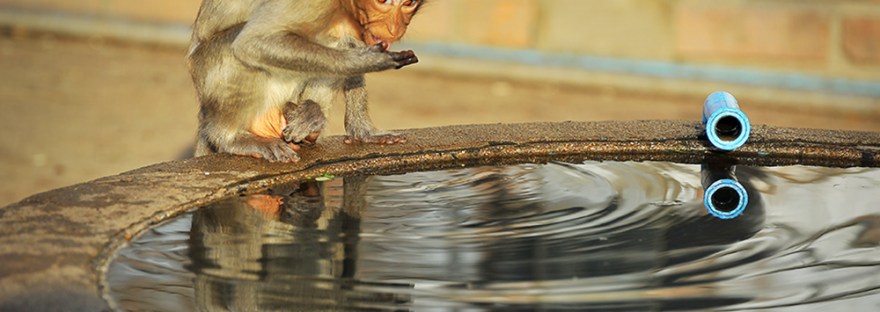
A. An ancient master said, “Everybody has a mirror. An unenlightened person’s life is like a monkey looking in a mirror, but an enlightened person’s is like a mirror looking at a monkey.” A monkey, when looking in a mirror, mistakes its reflection as another monkey and tries in vain to do something with it. However, a mirror, when something or someone is before it, just reflects the thing or the person as it is or as they are. It neither names, evaluates nor loves or hates it or them. In other words, it never discriminates. So, ‘being like a mirror’ represents the undiscriminating mind of the enlightened.

Student: “How do you feel when you are like a mirror?”
Master: “I become a big liar if I answer your question.”
©Boo Ahm
All writing ©Boo Ahm. All images ©Simon Hathaway

A. Master: “What you think is the true-self is an illusion and what you think is an illusion is the true-self.”

Commentary:
Both the true-self and an illusion are illusions.
It is the true-self that tries to distinguish the true-self from an illusion.
©Boo Ahm
All writing ©Boo Ahm. All images ©Simon Hathaway
 Zen Fools