Buddhism, Enlightenment, final goal, Meditation, Practice, zen

Q127. Can I reach the final goal in a year if I focus all my attention to practising Zen?

A. Who could say, “No”? However, the fact is that no one knows how long it will take. Be determined but don’t be impatient. Impatience can cause attachment, which can raise side effects. The harder you try to reach it, when you are impatient, the farther you can get away from it. Watering a flowering plant twice as much as usual doesn’t make it grow and bloom twice as fast as usual; rather it can damage its root. Likewise, a hen, however hard it incubates its eggs, can’t shorten the period of incubation and move the hatching time a few days forward. You should be patient enough to wait for the time to grow ripe. If you get lost in your practice, you will reach the stage where you become indifferent even to the final goal. That is a sign of your being close to the final goal.

_SRH7154a_thumb

If you tune the string of a violin too loosely, it doesn’t make a sound.
If you tune it too tightly, it breaks.
Only when you tune it properly does it make a beautiful sound.

©Boo Ahm

All writing ©Boo Ahm. All images ©Simon Hathaway

Buddhism, Enlightenment, final goal, illusion, Meditation, Mind, root, self, true self, Truth, zen

Q124. I always struggle with continuous thoughts during meditation. Will they disappear with time?

A. No, they won’t disappear in that way. You can’t win the fight.
When a thought arises, you can’t lock it in even with thousands of locks, can’t tie it up even with thousands of ropes, or destroy it even with a heavy hammer.

_DSC0556a_thumb
Don’t distinguish it as either good or bad, and also don’t try to stop it. Distinguishing between good and bad is adding one more thought to the existing thoughts, and trying to stop them is strengthening them. Fighting with thoughts is like fighting with shadows as long as you don’t realise the root. Leave them alone and just trace them back to their root. All the various thoughts are from the same root. The moment you realise the root of the thoughts, they will lose their power and change from your enemy to your servant.

©Boo Ahm

All writing ©Boo Ahm. All images ©Simon Hathaway

Buddhism, desire, Enlightenment, Happiness, illusion, Meditation, Mind, poisons, Practice, true self, Truth, zen

Q122. What are the antidotes for the three poisons against happiness?

A. The antidote for the poison of ignorance is wisdom, which means the ability to see everything as it is. That enables us to see a piece of broken rope as a piece of broken rope and rotten food as rotten food.

The antidote for the poison of greed is the precepts, which aim to control greed. We should suppress greed artificially before getting enlightened. To obey the precepts in the strictest sense, however, is not to suppress greed artificially but to have no greed to control through realising that everything is an illusion. Only then can we be said to obey the precepts. For example, when we have the wisdom to see everything as it is, we don’t have any desire to run away from the piece of broken rope, or to chase after rotten food because we can see rope as rope and rotten food as rotten food.

File0070a_thumb

The antidote for the poison of anger is stillness, which naturally comes about when we obey the precepts. That is, when we obey the precepts, we have no greed. Then we need not struggle to fulfill our greed. When we don’t have to strive to satisfy our greed, there is no anger or disappointment that comes from the failure to meet our greed. Then our life becomes still.

In fact, the core of the three poisons is ignorance, and that of the three antidotes is the wisdom to see things as they are.
©Boo Ahm

All writing ©Boo Ahm. All images ©Simon Hathaway

Buddha, Buddhism, desire, Happiness, illusion, Meditation, poisons, Truth, zen

Q121. What are the three poisons that prevent us from being happy?

A. The first poison, ignorance, is the lack of ability to see things as they are. For instance, we look upon a piece of broken rope as a snake, or mistake rotten food for healthy food. When we can’t see things as they are like this, we are said to see illusions as real.

P1180565a_thumb

The second poison, greed, is the desire to get or avoid such illusions. When we are confused into seeing illusions as being real, we want to run away from illusions like a piece of broken rope that look awful or ugly, or strive to obtain illusions like rotten food that look attractive. Such desire is called greed.

Finally, when we struggle to obtain or avoid illusions that we mistake for being real, things usually don’t go as we desire. Repeated failures to achieve our goals, whether to avoid or obtain such illusions, cause us to lose our temper. Even if we sometimes succeed in achieving such illusions, we are disappointed or upset to see that they are not what we desired and don’t give us as much happiness as we expected. Such emotion, the third poison, is called anger.
©Boo Ahm

All writing ©Boo Ahm. All images ©Simon Hathaway

Buddhism, Koan, Meditation, Truth, zen

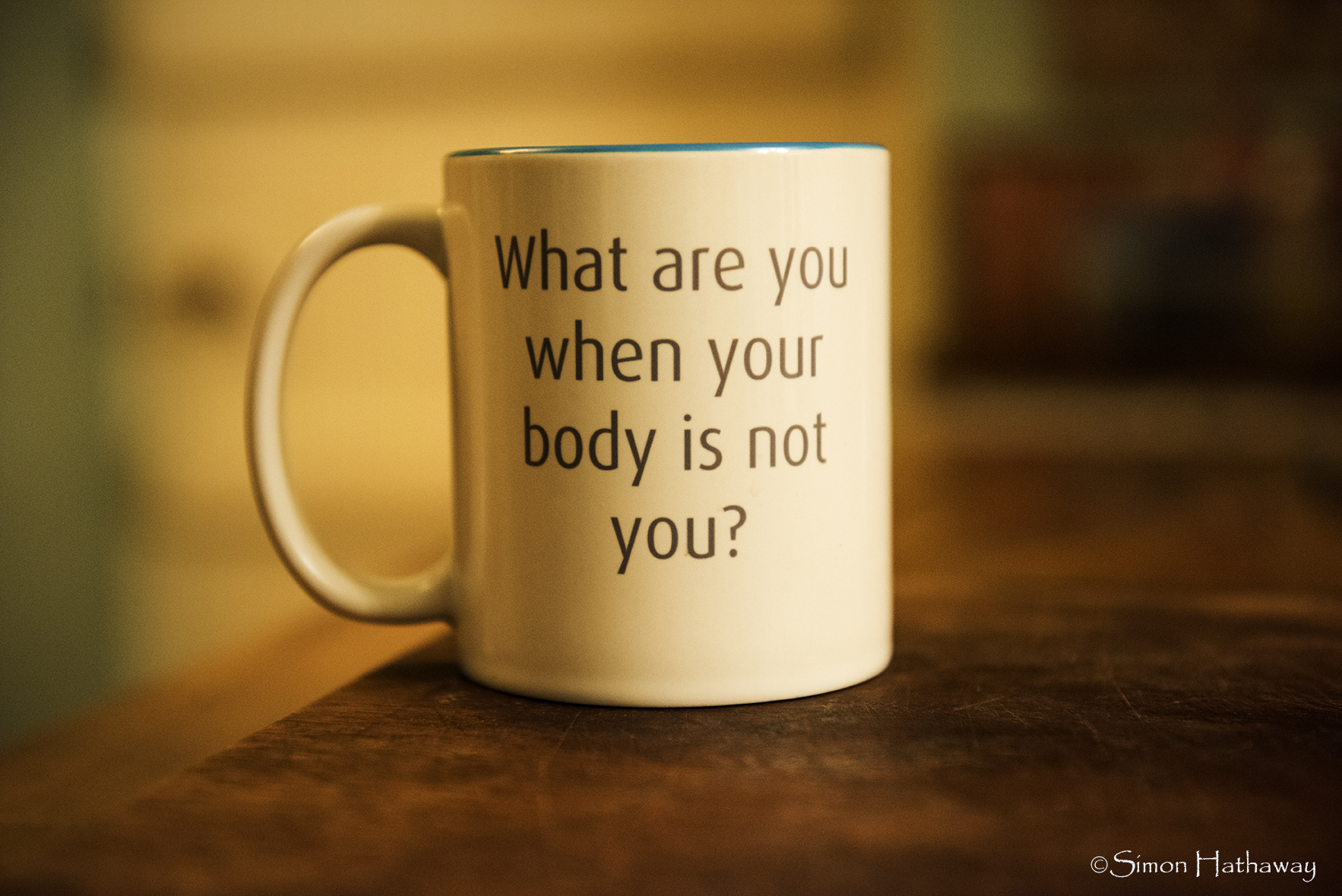
Q117. What am I like when my body is not me?

A. It has neither a head nor a tail.

SRH_2670a_thumb

Commentary:
Do you wonder how it can see and speak when it has no head?
It has nothing to see and speak of when it has no head.

A wind finds its way even though it has no eyes,
Makes sounds even though it has no mouth,
And shakes things even though it has no hands.

©Boo Ahm

All writing ©Boo Ahm. All images ©Simon Hathaway

Buddha, Buddhism, Enlightenment, final goal, illusion, meditaion, Meditation, self, true self, Truth, zen

Q109. If everything is the true-self, can I say that I am looking at my true-self while looking at this cup?

A. No, you can’t, because you are looking at a cup. As long as you see a cup as a cup, you can’t say that you see your true-self. Seeing a cup as a cup means seeing a car as a car and a person as a person, which means that all the labels or lines dividing one into many still remain. Your eyes, it is said, are covered with illusions or you are an open-eyed blind man.

SRH_2266a_thumb

The Buddha said, “If you realise that form is not form, you will see your true-self.”
Being able to see the cup as non-cup means that a car is not a car, a person is not a person any more to you and you are not you because all illusions have disappeared. The disappearance of all illusions means the disappearance of the lines that divide one into many. When all the lines disappear, many become one. There is no seer and no seen and no speaker and no listener in the situation where a cup is not a cup. It can be said that the seer is one with the seen, and speaker is one with the listener. There is nothing to mention, and speech is not speech any more here. Then everything, it is said, is the true-self. To experience this through your body in person is to realise the true-self.
©Boo Ahm

All writing ©Boo Ahm. All images ©Simon Hathaway

Buddha, Buddhism, illusion, Koan, Meditation, Practice, Truth, zen

Q104. Sometimes angels appear during my practice. Am I practising in the wrong way? What shall I do?

A. There are times like that. I am sure that you are not wide awake to your question during the experience. Some people say that they see beautiful angels or even the Buddha and Jesus Christ, some say they see their late parents or grandparents, some say that they see their previous lives, and others say they see ghosts or monsters as if having a nightmare. Do remember that everything you experience during your practice is nothing but an illusion whether fantastic or terrible. When you experience something beautiful you have never experienced in your life before, you are apt to feel attracted by it. They are only the actions of your emotions hidden in your sub-consciousness. If you feel attached to great figures like the Buddha or Jesus and scared of the terrible figures, you are fooled by illusions. Leave them alone and focus on your question, and they will disappear by themselves.

SRH_3522a_thumb
©Boo Ahm

All writing ©Boo Ahm. All images ©Simon Hathaway