Buddha, Buddhism, emptiness, empty, final goal, illusion, master, Meditation, Mind, Photography, poisons, Practice, root, self, student, true self, Truth, Uncategorized, Zen

Q272. How can I escape from the three worlds: the world of greed, the world of form and the world of formlessness?

A. Above all, you ought to know not that you are in the three worlds, but that the three worlds are in you. As long as you try to escape from them while thinking that you are locked in them, you can’t succeed in escaping by any means.


To realise they are also nothing but illusions is to escape from them. However good or bad they look, they are no more than illusions produced by your imagination. The harder you try to escape from them, the firmer you will make them as long as you regard these illusions as real.

srh_2413a_thumb


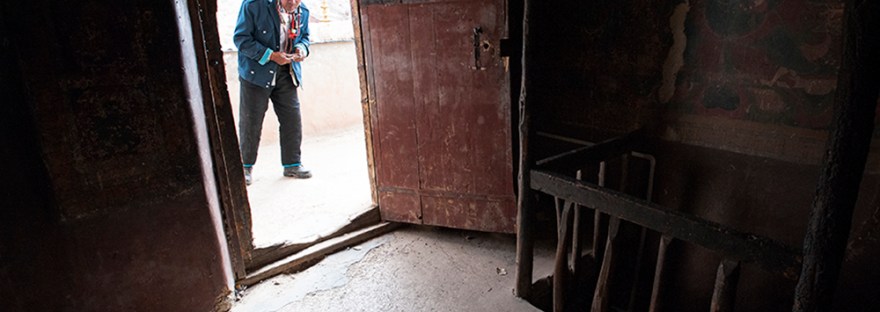
Student: “How can I escape from the three worlds?”

Master: “Have you ever seen them?”

Student: “No.”

Master: “Then, you are not in them.”


©Boo Ahm


All writing ©Boo Ahm. All images ©Simon Hathaway

Buddha, Buddhism, emptiness, empty, Enlightenment, final goal, illusion, Koan, master, Meditation, Mind, Photography, Practice, root, student, suffering, sutras, true self, Truth, Uncategorized, Zen

Q271. What does the phrase ‘You should neither hold on to the meaning of the Sutras nor let go of it’ mean?

A. Holding on to the meaning of the Sutras means keeping the words without perfect understanding, in other words keeping food undigested in the stomach. Letting go of it means to ignore and forget it. For better understanding, let’s take the following as an example.


Buddha had a student who was notorious for having killed many people and even tried to kill Buddha before becoming a monk. One day this monk happened to visit one of Buddha’s lay students, when his wife was having a hard time being in labour. The layman said to the monk, “Please relieve my wife of this terrible suffering with your power.” The monk responded, “I still don’t have such divine power. I will go and ask my master, Buddha for this favour for your wife.” Upon returning to Buddha, the monk explained the situation and asked him what he should do. Buddha answered, “You go back to the house, and tell her that you have never killed anyone.” The monk did as he was told to, and then, on hearing his words, she was relieved of her suffering.


_srh6149a_thumb


This metaphor implies that everything is empty.


When Buddha said to his disciple, “Tell her that you have never killed anyone”, he meant that whatever bad and cruel things, or whatever good and beautiful things we may do, they are all empty, so the young monk’s murder was also empty. He likened her childbirth to the young monk’s murder. The woman in labour, on hearing what the monk said, realised the truth that the suffering she was going through was also empty, just as the murders the monk committed were empty.


We should understand what the Sutras say, in the same way that the woman in labour understood Buddha’s remark passed on by his student. The moment she heard Buddha’s message, she made it part of herself. If she had ignored, let go of the message or remembered it only as a meaningful saying, or held on to the meaning of it, she couldn’t have been relieved of her suffering.


Master: “What did Buddha tell his student to say to the woman in labour?”

Student: “He told him to say, ‘I’ve never killed anyone’.”

Master: “Why did Buddha tell him to say so?”

Student: “Because He wanted to teach her that everything is empty.”

Master: “You are still holding on to the meaning of Buddha’s teaching.”

Student: “Then, what did He say?”

Master: “He didn’t say anything, and his student didn’t go to her house.”


©Boo Ahm


All writing ©Boo Ahm. All images ©Simon Hathaway


Buddha, Buddhism, emptiness, empty, Enlightenment, final goal, illusion, Koan, master, meditaion, Mind, Photography, Practice, root, self, student, true self, Truth, Uncategorized, Zen

Q267. Student: “What is the matter when the gate won’t open, however hard I try to open it?”

A. Master: “It’s already open”

file13816_thumb


Commentary:

If you stick to ‘open’, it’s already locked.


©Boo Ahm


All writing ©Boo Ahm. All images ©Simon Hathaway
Buddha, Buddhism, desire, emptiness, empty, Enlightenment, final goal, master, Meditation, Photography, root, self, true self, Truth, Uncategorized, Zen

Q266. How can I be free from all past karma if causation is inevitable?

A. ‘Cause and effect’ is a rule for explaining the world of form. No one can escape it. Buddha, while alive, said that he himself couldn’t avoid it as well as long as living in the world of form. To become free from karma is not to remove, or do away with it, but to realise that karma is empty.

Let’s suppose there is a golden cup. It can be dented, or crushed when dropped from a height, or hit on a hard thing. It is dented in just the same way regardless of whether a foolish man drops it or Buddha does. This is called karma, or cause and effect.

To be free from karma is not to remove it, but to change our view of it.

People who see the cup only as a cup, without realising that its essence is gold, will get upset and disappointed when the cup loses its form of a cup, or is disfigured by any number of causes such as dropping or hitting it. Thinking that all of its value is gone, they are sometimes so frustrated that they may even give it up.

srh_5939a_thumb

However, those who are aware that the cup is made of gold know that the essence and its intrinsic value never change regardless of what form it takes on. They are not swayed by the change of the form of it because they know that the essence of the cup is not the form of a cup but gold itself, and that there is no change at all in the essence. To realise the emptiness of things and not to be swayed by the change of them is said to be freedom from karma.


©Boo Ahm


All writing ©Boo Ahm. All images ©Simon Hathaway

Buddha, Buddhism, emptiness, empty, Enlightenment, final goal, illusion, Koan, master, Meditation, Mind, Photography, Practice, root, self, student, true self, Truth, Uncategorized, Zen

Q265. What am I when my body is not me?

A. Remove all the labels attached to you by others. Remove all words that can describe your identity. Let’s suppose you are a sixty-year-old British man named John who is living in London. When you say that you were born in London sixty years ago, what is left when all the labels are removed? ‘You’ or ‘I’, ‘were born’, ‘in London’, ‘sixty’, ‘years’ and ‘ago’ all are labels. You still have a lot of labels to represent your identity such as your parents, your job, your school records and so on. You think that you are human being, which is also an artificially coined label. Remove all artificial labels and see what is left, whatever it is. That’s it. What is it?

dsc_1570a_thumb


Master: “What is left now?”

Student: “Nothing is left.”

Master: “If nothing were left, what would be saying, ‘Nothing is left’?”


©Boo Ahm


All writing ©Boo Ahm. All images ©Simon Hathaway

Buddha, Buddhism, emptiness, empty, Enlightenment, final goal, illusion, Koan, master, Meditation, Mind, One, Photography, root, self, student, true self, Truth, Uncategorized, Zen

Q264. Student: “The deepest lake, when dried up, reveals its bottom after all. Why can’t we see a person’s mind even when he dies?”

A. Master: “Because you try to see it.”

p1050989b_thumb


Commentary:

Cut the tendon in the air and you can see it clearly.


©Boo Ahm


All writing ©Boo Ahm. All images ©Simon Hathaway

Buddha, Buddhism, emptiness, empty, Enlightenment, final goal, illusion, master, Meditation, Photography, Practice, root, self, true self, Truth, Uncategorized, Zen

Q263. What is emptiness?

A. Emptiness is not void but being both existent and non-existent at the same time, as it were, before division into ‘being existent’ and ‘being non-existent’. That is a state or an appearance without any imaginary lines. When asked what emptiness is like, some masters would say that it is full and others that it is active. All you can feel is emptiness. Even your body is emptiness. There is nothing that is not empty. If you follow emptiness, you will forsake it.

srh_3576a_thumb


Student: “What is emptiness?”

Master: “Don’t forsake it.”


©Boo Ahm


All writing ©Boo Ahm. All images ©Simon Hathaway

Buddha, Buddhism, emptiness, empty, Enlightenment, final goal, illusion, master, Meditation, Mind, One, Practice, Religion, root, true self, Truth, Uncategorized, Zen

Q262. The phrase ‘Striving to reach London while staying in London’ doesn’t make any sense to me. What does it mean?

A. The purpose of Zen meditation is to experience emptiness in person. London is a symbol of emptiness and reaching London means to experience emptiness. It means, in other words, that we are trying to experience emptiness while being emptiness itself. Reaching emptiness is realising the truth that we ourselves are emptiness, not reaching it by moving towards it.

p1170114b_thumb


In order to see whether you grasp these words clearly, ask yourself the following question.


Student: “How do you feel when you realise emptiness?”

Master: “I’ll be wrong if I answer your question.”


©Boo Ahm


All writing ©Boo Ahm. All images ©Simon Hathaway

Buddha, Buddhism, emptiness, empty, illusion, master, Meditation, Mind, Religion, root, self, student, true self, Truth, Uncategorized, Zen

Q261. Master: “When a guest comes, you should take care of him, but when a thief comes, you should turn him away.”

A. Student: “How shall I take care of a guest?”

Master: “Don’t welcome him.”

Student: “How should I turn away a thief?”

Master: “Don’t reject him.”

srh_8322a_thumb


Commentary:

If there is anyone you should serve or fight against, you are still being deluded by illusions.


©Boo Ahm


All writing ©Boo Ahm. All images ©Simon Hathaway

Buddha, Buddhism, emptiness, empty, Enlightenment, master, Meditation, Practice, Religion, root, self, student, true self, Truth, Uncategorized, Zen

Q259. How can I grasp the core meaning of the Sutras?

A. What do you think the core teaching of the Sutras is? It is enlightenment. What all the Sutras say is nothing but how to attain enlightenment and what enlightenment is like, nothing else. If you are to grasp the core teaching of Buddha, don’t look for it in the Sutras. The Sutras are only like a map or an arrow pointing to your destination. They are not the place itself that you want to reach.


Don’t think of Zen meditation as being apart from the Sutras. Zen meditation is an expedient means to grasp the core teaching of the Sutras. The Sutras are maps and Zen is to move towards the destination indicated by the maps. So, the best way to grasp the core meaning of the Sutras is to experience what the Sutras say through practice.

srh_2758b_thumb


Student: “How can I grasp the core meaning of the Sutras?”

Master: “Discard all the Sutras.”


©Boo Ahm


All writing ©Boo Ahm. All images ©Simon Hathaway